

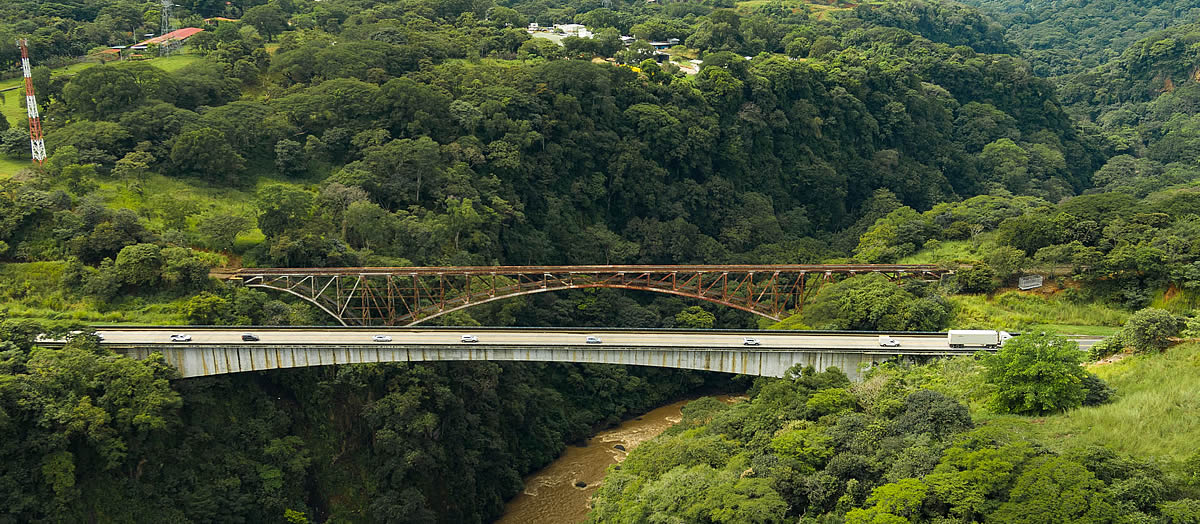
Bridges over a river in the green, mountainous valley of Concepción, Costa Rica | photo by Luis Alberto Arias
Costa Rica - Global Development
CR
Costa Rica reaches high-income status even as homicides surge and a new government embraces Bukele-style security policies
Costa Rica has long been Central America’s exception: no standing army since 1948, one of the world’s cleanest electricity grids, and a stable democracy in a region defined by instability. In 2025, the World Bank reclassified it as a high-income country. At almost the same moment, a security crisis has pushed homicides to record levels and delivered the country’s most decisive political realignment in decades. This article covers aid, tax, climate, and trade, the same four threads RYB tracks across every country page, alongside the security crisis now reshaping Costa Rican politics.
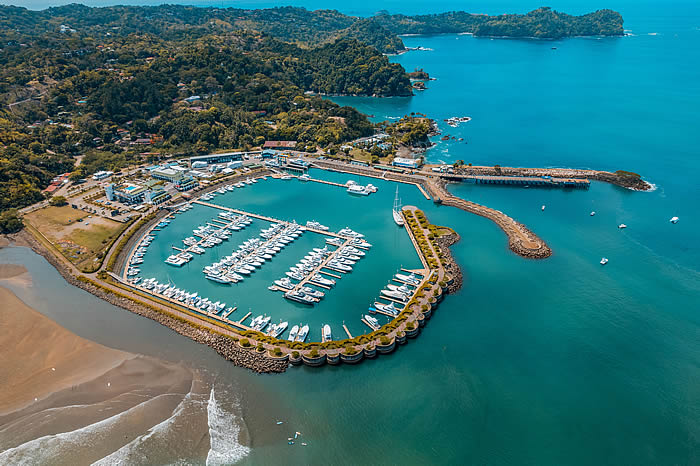
Marina in Quepos, Costa Rica, showcasing moored boats and vibrant blue waters | photo by Luis Kuthe
From Development Recipient to High-Income Security Partner
Costa Rica’s relationship with international financing has shifted fundamentally. Having graduated from upper-middle to high-income status according to World Bank classification in 2025, Costa Rica no longer fits the traditional aid-recipient profile RYB documents on many other country pages. Its financing relationship with the US now runs primarily through security cooperation, not development grants.
Congress designated at least $46 million in US bilateral and regional security assistance for Costa Rica in FY2025, rising to a proposed $50 million for FY2026, aimed at counternarcotics, cybersecurity, and migration cooperation. Secretary of State Marco Rubio called Costa Rica a regional “model” during a February 2025 visit. Yet the status of this funding turned genuinely uncertain after the Trump administration’s broader 2025 review and termination of thousands of foreign assistance programmes, leaving Costa Rica’s security partnership in a state of real ambiguity.
Costa Rica separately holds a two-year, $1.5 billion IMF flexible credit line, approved in June 2025, intended as a financial buffer against external shocks rather than a development programme, another marker of its transition toward high-income financial relationships.
Tax: Free Trade Zones and Cautious Fiscal Progress
Costa Rica’s tax system centres on a decades-old free trade zone regime, offering generous tax incentives that have successfully attracted semiconductor manufacturers, medical device companies, and technology firms, the export sectors now driving national income. This strategy explains Costa Rica’s unusual export profile for a Central American nation: high-value electronics and precision manufacturing rather than commodities alone.
Costa Rica has made genuine, if incremental, progress toward fiscal stability in recent years, improving on the persistent deficits that long constrained public investment. Costa Rica does not appear among the world’s significant secrecy jurisdictions RYB documents on its Tax Havens page; its tax policy concerns centre more on the revenue trade-offs of its free trade zone incentives than on enabling capital flight elsewhere.
Climate: A Renewable Leader Facing a Real Vulnerability
Costa Rica has long been a global reference point for renewable electricity, generating close to 100% of its power from hydro, geothermal, wind, and solar sources for years running. That record slipped in 2023: renewable generation’s share of total energy use fell from 98% in 2022 to between 92% and 95%, driven by drought affecting the hydroelectric plants that anchor the system, even as overall electricity demand kept rising.
This is a genuinely instructive vulnerability for RYB’s climate coverage: a country with among the world’s cleanest electricity mixes remains structurally exposed to the same climate variability its clean energy system is meant to help address. Costa Rica’s 2023 “Aligning the Financial Flows of Costa Rica’s Financial Sector with the Climate Change Objectives of the Paris Agreement” initiative targets net-zero emissions by 2050, alongside the country’s longstanding Payment for Environmental Services programme, which helped reverse decades of deforestation and remains a widely studied model for conservation financing elsewhere.
Costa Rica’s own 2024 national report noted a further concern: even as the country uses less energy per unit of economic output, overall consumption keeps climbing, meaning efficiency gains alone will not be enough to sustain the country’s climate credentials without addressing demand growth directly.
Trade: Tariff Headwinds on a High-Tech Export Base
Costa Rica’s Central Bank estimates GDP growth slowed to 4.2% in 2025 and projects a further slowdown to 3.5% in 2026, attributing part of the deceleration directly to US tariffs and softening global demand. This is a genuinely different tariff story from the bespoke bilateral deals RYB has covered in Indonesia, Pakistan, and Japan: Costa Rica has not secured a distinctive carve-out, and its high-value electronics and medical device exports, precisely the sectors its free trade zone strategy was built around, now face the same broader tariff headwinds affecting global manufacturing trade.
Costa Rica’s external debt, at roughly 42% of GDP, is mostly private and closely linked to foreign direct investment inflows, meaning sustained FDI remains essential to financing the current account deficit, a structural dependency that a slower growth environment could meaningfully strain.
The Security Crisis: A Peaceful Exception Under Strain
Costa Rica’s defining 2025-26 story is the erosion of its longstanding reputation as Central America’s peaceful exception. The homicide rate rose from 11.2 per 100,000 people in 2020 to 17.2 in 2023, the deadliest year on record, driven substantially by drug trafficking gangs operating as surrogates for international cartels using Costa Rica as a transshipment point. Homicides climbed roughly 50% between 2021 and 2023 alone, even as the economy grew at a healthy 4% annually over the same period.
Virtual kidnapping scams targeting foreign business owners surged roughly 625% between early 2025 and the same period in 2026, according to Costa Rica’s own judicial investigation agency. Press freedom has declined sharply too: Reporters Without Borders ranked Costa Rica 8th globally in 2022, falling to 36th by 2025, a genuinely steep drop for a country long considered a regional democratic anchor.
This crisis reshaped Costa Rican politics directly. February 1, 2026 elections delivered a decisive win to Laura Fernández, a close ally of outgoing President Rodrigo Chaves, who won the presidency outright in the first round with 48.53% of the vote and became only the second woman to hold the office. Her Sovereign People’s Party also won a legislative majority, the first single-party majority in Costa Rica’s Legislative Assembly since 1990, on a campaign built around “tough-on-crime” rhetoric that analysts have explicitly compared to El Salvador’s Bukele model, including public discussion of a mega-prison.
Costa Rica’s 2024 constitutional amendment allowing extradition of drug traffickers and domestic terrorists to foreign authorities reflects the same shift. Election monitors from International IDEA nonetheless praised the vote itself, noting turnout rose ten points to 69.1%, and calling Costa Rica’s Supreme Electoral Tribunal one of the region’s most credible institutions, even amid a polarised and violent backdrop.
Migration and a Court That Pushed Back
Costa Rica hosts nearly 251,000 forcibly displaced people, including roughly 193,000 Nicaraguans fleeing political repression, one of the highest displaced-population shares relative to size in the Americas. The US provided close to $90 million to humanitarian organisations supporting migrants and refugees in Costa Rica between 2018 and 2024.
A more contentious arrangement emerged in February 2025, when the US transferred 200 unauthorised migrants of other nationalities to Costa Rica to await repatriation, funded by Washington with implementation support from the International Organization for Migration, part of a broader “third country” deportation strategy the Trump administration pursued across the region. Costa Rica’s Supreme Court pushed back directly: in June 2025, it ruled the migrants’ rights had been violated and ordered the release of roughly 28 who remained in the country, a genuine, functioning check on executive migration policy that RYB has not seen as clearly documented on other country pages this year.
What Costa Rica Still Contributes
Costa Rica’s abolition of its military in 1948 remains a genuinely distinctive global development model, redirecting resources toward education and health that most nations of comparable size spend on defence. Its Payment for Environmental Services programme continues to be studied internationally as a model for compensating conservation, and its electoral institutions, even under real strain, retain a credibility few regional peers can match.
How This Connects to the SDGs
Costa Rica’s homicide surge and declining press freedom directly threaten SDG 16, peace, justice, and strong institutions, at the exact moment its democratic reputation faces its sharpest test in decades. Its renewable energy vulnerability to drought connects SDG 7, affordable clean energy, directly to SDG 13, climate action, showing how climate variability can undermine even a genuinely clean electricity system.
The Supreme Court’s ruling against the migrant deportation arrangement offers a rare, concrete example of SDG 16’s institutional accountability functioning as intended, even under significant political and diplomatic pressure. Its high-income graduation reflects real progress against SDG 1 and SDG 8, decent work, even as the security crisis threatens to erode the same stability that enabled that progress.
Looking Forward
President Fernández’s tough-on-crime approach will be tested quickly against Costa Rica’s own democratic and human rights standards, standards that have historically distinguished it from neighbours pursuing similar security-first strategies. Whether “Bukele-style” rhetoric translates into policies compatible with Costa Rica’s institutional traditions, or strains them, will be one of the clearest stories to watch regionally in 2026.
The uncertain status of US security assistance funding, alongside slowing growth from broader tariff pressure, leaves Costa Rica navigating real financial constraints just as its security needs are most acute. RYB will track how Costa Rica’s new government balances its security crisis against its democratic institutions, whether renewable energy vulnerability to drought recurs, and how the country’s high-income transition affects its access to development financing going forward. This page will be updated as new data and political developments emerge.
Sources and References
- Congress.gov, “Costa Rica: An Overview,” CRS In Focus IF10908 — congress.gov
- BTI 2026 Costa Rica Country Report — bti-project.org
- Coface, “Costa Rica: Country File, Economic Risk Analysis” — coface.us
- Wikipedia, “2026 Costa Rican general election” — en.wikipedia.org
- Foreign Policy, “Costa Rica Election: Right-Wing Candidate Wins Amid Crime Wave” — foreignpolicy.com
- AULA Blog, “Costa Rica 2026: Political Continuity and Signs of Democratic Erosion” — aulablog.net
- Latinoamérica21, “Costa Rica’s new political landscape” — latinoamerica21.com
- International IDEA, “Costa Rica 2026: Elections with integrity in times of polarization” — idea.int
- OSAC, Costa Rica Country Security Report — osac.gov
- RYB, Official Development Assistance (ODA) — redyellowblue.org/finance/oda/

Costa Rica
Republic of Costa Rica
República de Costa Rica
Population
5,256,612 (2023 est.)
5,151,140 (2021)
4,987,142 (2018)
4,930,258 (2017)
Capital: San José
Internet country code: .cr
Government
Official website Presidencia de la República de Costa Rica: presidencia.go.cr
Ministerio de Economía Industria y Comercio: meic.go.cr/meic
Costa Rica Tourism Board: ict.go.cr
Instituto Nacional de Estadistica y Censos (INEC): ecuadorencifras.gob.ec/estadisticas
Republic of Costa Rica
Although explored by the Spanish early in the 16th century, initial attempts at colonizing Costa Rica proved unsuccessful due to a combination of factors, including disease from mosquito-infested swamps, brutal heat, resistance from Indigenous populations, and pirate raids. It was not until 1563 that a permanent settlement of Cartago was established in the cooler, fertile central highlands. The area remained a colony for some two-and-a-half centuries. In 1821, Costa Rica was one of several Central American provinces that jointly declared independence from Spain. Two years later it joined the United Provinces of Central America, but this federation disintegrated in 1838, at which time Costa Rica proclaimed its sovereignty and independence.
Since the late 19th century, only two brief periods of violence have marred the country’s democratic development. General Federico Tinoco Granados led a coup in 1917, but the threat of US intervention pushed him to resign in 1919. In 1948, landowner José Figueres Ferrer raised his own army and rebelled against the government. The brief civil war ended with an agreement to allow Figueres to remain in power for 18 months, then step down in favor of the previously elected Otilio Ulate. Figueres was later elected twice in his own right, in 1953 and 1970.
Costa Rica experienced destabilizing waves of refugees from Central American civil wars in the 1970s and 1980s, but peace in the region has since helped the economy rebound. Although it still maintains a large agricultural sector, Costa Rica has expanded its economy to include strong technology and tourism industries.
That same 1948 decision to abolish the military, which Figueres made permanent after his own brief civil war, remains the foundation of Costa Rica’s development identity today, one now being tested as directly as at any point since, by a security crisis its unarmed democratic model was never built to face alone.