

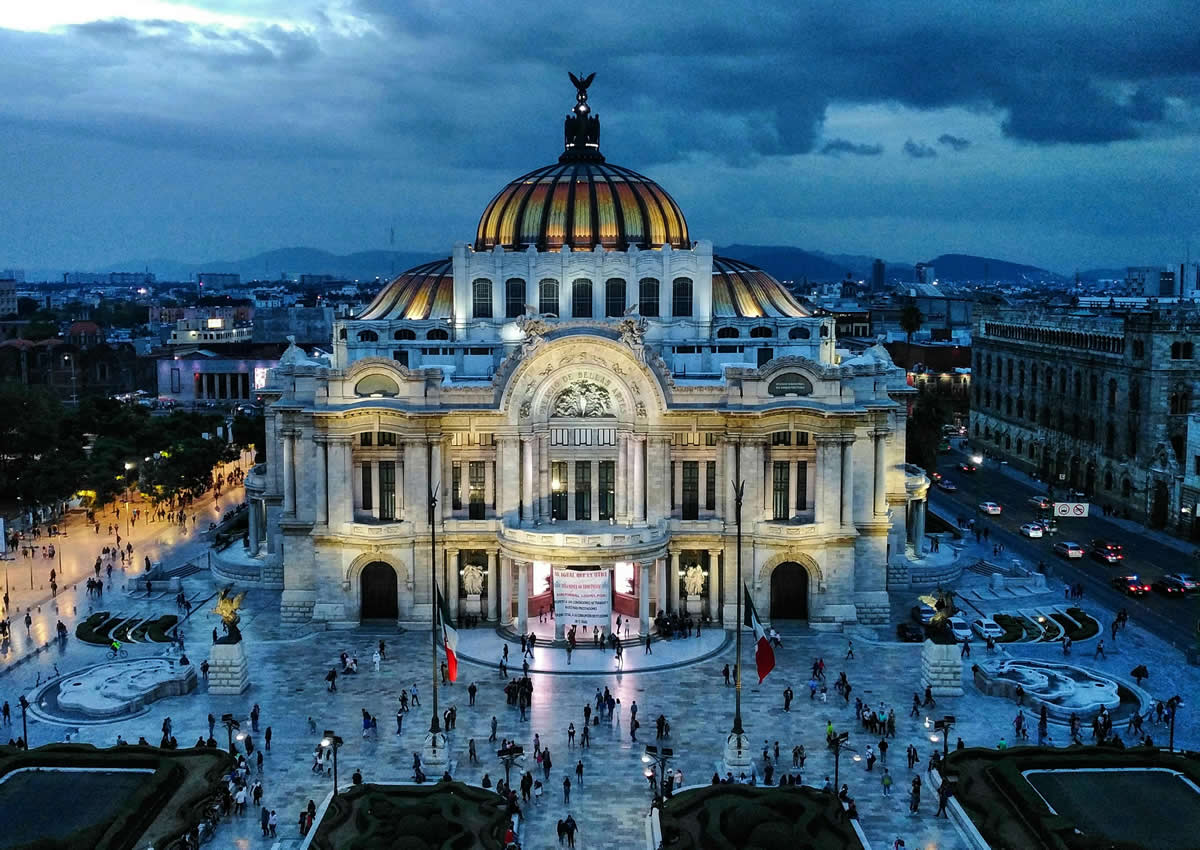
Mexico City, Mexico - Photo: Ivon Gorgonio
Mexico - Global Development
MX
Mexico faces the USMCA’s pivotal July 2026 review as Trump calls the deal irrelevant and cartel-linked prosecutions escalate
Mexico enters mid-2026 at the center of the most consequential trade negotiation in North America in a generation. The USMCA, governing roughly $1.8 trillion in annual trade, faces its first formal joint review this year, just as President Trump has called the deal “irrelevant” and Washington has begun directly prosecuting Mexican officials over alleged cartel ties. This article covers aid, tax, climate, and trade, the same four threads RYB tracks across every country page.
Security Cooperation Has Replaced Traditional Aid
Mexico is not a major recipient of traditional development aid; its relationship with Washington runs instead through security cooperation, now more tightly bound to trade than at any point in the relationship’s history. In 2025, the Trump administration designated six Mexican drug cartels as Foreign Terrorist Organizations, and the 2026 National Drug Control Strategy formally classifies fentanyl as a weapon of mass destruction, expanding US legal authority for extraterritorial operations against trafficking networks.
President Claudia Sheinbaum, Mexico’s first female president and a climate scientist by training, has pursued what analysts call “deep cooperation without intervention.” Her government recorded fentanyl seizures at record levels, including a 1.1 metric-tonne bust in December 2025, extradited more than 90 suspects, and deployed 10,000 security forces to the border. In February 2026, the Mexican military killed Jalisco New Generation Cartel leader Nemesio “El Mencho” Oseguera, the first time Mexican forces have eliminated a cartel leader of that stature, a result achieved with US intelligence support but no US personnel on Mexican soil.
Sheinbaum has drawn one firm line throughout: rejecting any proposal for US troops to operate inside Mexico, stating plainly, “Sovereignty is not for sale.” She has, however, allowed US surveillance drone flights over Mexican territory and agreed to coordinated border patrols. That cooperation faced a genuine test in 2026 when US prosecutors indicted a sitting Mexican state governor, Rubén Rocha Moya of Sinaloa, over alleged cartel-political collusion, prompting Sheinbaum to publicly question the charges’ legitimacy and, for the first time in her presidency, criticise the US ambassador’s “interventionist posture.”
Tax: Structural Weaknesses Investors Keep Flagging
Mexico’s tax collection remains among the lowest in the OECD, at roughly 16% of GDP, a chronic shortfall that limits public investment in infrastructure, healthcare, and education. Heavy reliance on VAT places a disproportionate burden on lower-income households, while property taxation remains structurally underdeveloped relative to Mexico’s real estate wealth concentration, and special economic zones and maquiladora tax incentives continue eroding the revenue base multinational operations might otherwise contribute.
Judicial reform now compounds these concerns directly. Mexico’s move to directly elect judges aligned with political parties has drawn explicit criticism in the US Trade Representative’s own report to Congress, alongside energy reforms favouring state agencies over private investors and unpredictable tax enforcement, all cited as factors undermining the nearshoring appeal Mexico had hoped to build on. As one CSIS analysis notes, resolving most of these concerns requires no new legislation, only consistent, transparent enforcement of rules that already exist.
Climate: Plan Mexico’s Renewable Ambitions
Sheinbaum’s flagship economic strategy, Plan Mexico, launched January 2025, targets $277 billion in domestic and foreign investment, including private investment in renewable energy, a genuine point of continuity with her background as a climate scientist. Whether this ambition survives contact with an energy policy that continues favouring state agencies over private renewable developers remains an open question raised directly by US and Mexican investors alike.
Mexico’s underlying environmental challenges persist regardless of trade politics: water scarcity from aquifer overexploitation, urban air quality among the world’s worst in several cities, and continued extractive industry activity with limited environmental accountability. A resolved 2025 dispute over Mexico’s water deliveries to Texas under the 1944 bilateral treaty, settled through negotiation after the US threatened tariffs that were ultimately never implemented, illustrates how closely climate and water issues are now bound to the broader trade relationship.
Trade: The USMCA’s Pivotal Moment
The US, Mexico, and Canada launched the USMCA’s first formal joint review bilaterally, without Canada, on March 18, 2026. July 1, 2026, the pact’s six-year anniversary, is the pivotal decision node at which parties must signal whether to extend the agreement for another sixteen years, renegotiate it, or begin withdrawal procedures. In June 2026, Trump told reporters he was “not looking to renew” the deal and called it “irrelevant,” a striking reversal from his 2019 description of USMCA as “the best and most important trade deal ever made by the USA.”
Non-renewal would not immediately end the pact; it would trigger rolling annual reviews, with the agreement remaining in force until at least 2036 regardless. The practical stakes are nonetheless real: USMCA-compliant imports from Mexico rose from 45% of total US imports in January 2025 to 88% by October 2025, as Mexican exporters raced to qualify for tariff-free treatment.
Tariffs remain genuinely unsettled. The US imposed IEEPA tariffs on Mexican imports in March 2025, tied to a declared fentanyl and migration emergency, reaching a 25% rate that a threatened increase to 30% never took effect, paused pending negotiation. In February 2026, the US Supreme Court ruled the administration could not use IEEPA to impose tariffs at all, throwing the legal basis for the entire Mexico tariff regime into question just as the USMCA review began in earnest. Mexico has not imposed retaliatory tariffs at any point, choosing consistent diplomatic engagement over confrontation, a marked contrast to Canada’s more confrontational posture.
Mexico has pursued its own tariff strategy in parallel: a 50% tariff on more than 1,000 products from countries without a Mexican free trade agreement, including China and India, took effect January 1, 2026, explicitly aimed at curbing Chinese import competition and circumvention of US tariffs through Mexican supply chains, a step Washington has broadly welcomed even as Mexican opposition lawmakers warn it could raise domestic prices.
Economic growth has slowed under this uncertainty: roughly 1% in 2025, with 2026 forecasts ranging from under 1% by the World Bank’s more cautious estimate to 1.4-1.6% from Mexico’s own central bank, reflecting genuine disagreement over how much the USMCA uncertainty itself, rather than underlying economic weakness, is responsible for the slowdown.
What Mexico Still Contributes
Sheinbaum’s security results, including El Mencho’s killing and record fentanyl seizures, demonstrate a genuine model of deep bilateral cooperation achieved without foreign troops on Mexican soil, a distinction her government has defended consistently even under sustained pressure. Mexico’s cultural sector showed real resilience through the turbulence: Mexico City’s National Museum of Anthropology drew over 5 million visitors in 2025, up from 3.78 million the year before, becoming one of Latin America’s most-visited cultural venues.
How This Connects to the SDGs
The USMCA review’s outcome will shape SDG 8, decent work and economic growth, and SDG 17, global partnerships, for one of the world’s most integrated manufacturing regions, with Mexico’s own growth forecasts already reflecting the uncertainty. Mexico’s narrow tax base and judicial reform concerns connect to SDG 16, strong institutions, precisely the area US trade officials have flagged as undermining investor confidence independent of the security relationship.
Cartel violence and the criminal-political collusion cases now under US prosecution strike directly at SDG 16 from another angle, testing whether Mexico’s institutions can hold public officials accountable under intense external pressure. Water scarcity and the resolved Texas treaty dispute connect to SDG 6, clean water and sanitation, showing how climate and trade issues increasingly overlap in the bilateral relationship.
Looking Forward
The USMCA review’s July 2026 decision node is, in CSIS’s own assessment, “the most consequential moment in North American commercial relations in a generation.” Whether the three governments extend the pact, renegotiate its terms, or let it drift into rolling annual reviews will shape Mexican trade policy for years regardless of the formal outcome, since even non-renewal keeps the underlying agreement in force through 2036.
The security relationship carries its own unresolved tension: Washington has signalled it may consider unilateral action against cartels absent sustained, measurable results, a red line Sheinbaum has firmly rejected. Whether the Rocha Moya indictment marks an isolated case or the start of a broader pattern of US prosecutions targeting Mexican officials will be a genuine test of how far security cooperation can be decoupled from questions of sovereignty. RYB will track the USMCA review’s outcome, Mexico’s cartel prosecutions, and whether Plan Mexico’s renewable energy ambitions survive the current investment climate. This page will be updated as new developments emerge.
Sources and References
- Congress.gov, “Mexico: Background and Key Issues in U.S. Relations,” CRS Report R48859 — congress.gov
- CSIS, “USMCA Review 2026: Six Scenarios for North America’s Future” — csis.org
- CSIS, “Sinaloa Governor Indicted: USMCA, Cartels, and the Future of U.S.-Mexico Trade” — csis.org
- Rio Times, “USMCA 2026: The Complete Guide to the Trade-Pact Review” — riotimesonline.com
- Mexico Business News, “US Drug Strategy 2026 Targets Mexico” — mexicobusiness.news
- Mexico News Daily, “Mexico’s week in review: Sovereignty debate reaches boiling point as Trump ramps up pressure on cartels” — mexiconewsdaily.com
- RYB, Official Development Assistance (ODA) — redyellowblue.org/finance/oda/

Mexico
United Mexican States
Estados Unidos Mexicanos (Spanish)
Population
129,875,529 (2023 est.)
130,207,371 (2021)
125,959,205 (2018)
Capital: Mexico City
Internet country code: .mx
Government
Official website: gob.mx
Secretaría de Turismo del Gobierno de México: gob.mx/sectur
Etymology: named after the capital city, whose name stems from the Mexica, the largest and most powerful branch of the Aztecs; the meaning of the name is uncertain
Background
Mexico was the site of several advanced Amerindian civilizations, including the Olmec, Toltec, Teotihuacan, Zapotec, Maya, and Aztec, until Spain conquered and colonized the area in the early 16th century. Administered as the Viceroyalty of New Spain for three centuries, it achieved independence early in the 19th century. Elections held in 2000 marked the first time since the Mexican Revolution in 1910 that an opposition candidate, Vicente Fox of the National Action Party, defeated the party in government, the Institutional Revolutionary Party. He was succeeded in 2006 by another PAN candidate, Felipe Calderón, but Enrique Peña Nieto regained the presidency for the PRI in 2012. Left-leaning anti-establishment politician Andrés Manuel López Obrador, from the National Regeneration Movement (MORENA), became president in 2018.
The US-Mexico-Canada Agreement entered into force in 2020, replacing NAFTA. Mexico is currently the US’s second-largest goods trading partner, after Canada. Ongoing concerns include low real wages, high underemployment, and inequitable income distribution, particularly for the largely indigenous population in the impoverished southern states. Since 2007, Mexico’s powerful transnational criminal organizations have engaged in a struggle to control criminal markets, resulting in tens of thousands of drug-related homicides and forced disappearances. Claudia Sheinbaum, a close ally of López Obrador and Mexico’s first female president, was inaugurated in October 2024.
That same USMCA, negotiated during Trump’s first term as an improvement on NAFTA, now sits at the center of the most consequential test of Mexico’s relationship with Washington since it took effect, arriving at almost the exact moment Sheinbaum’s government is being asked to prove its security cooperation can satisfy an administration openly questioning the trade pact’s value.