

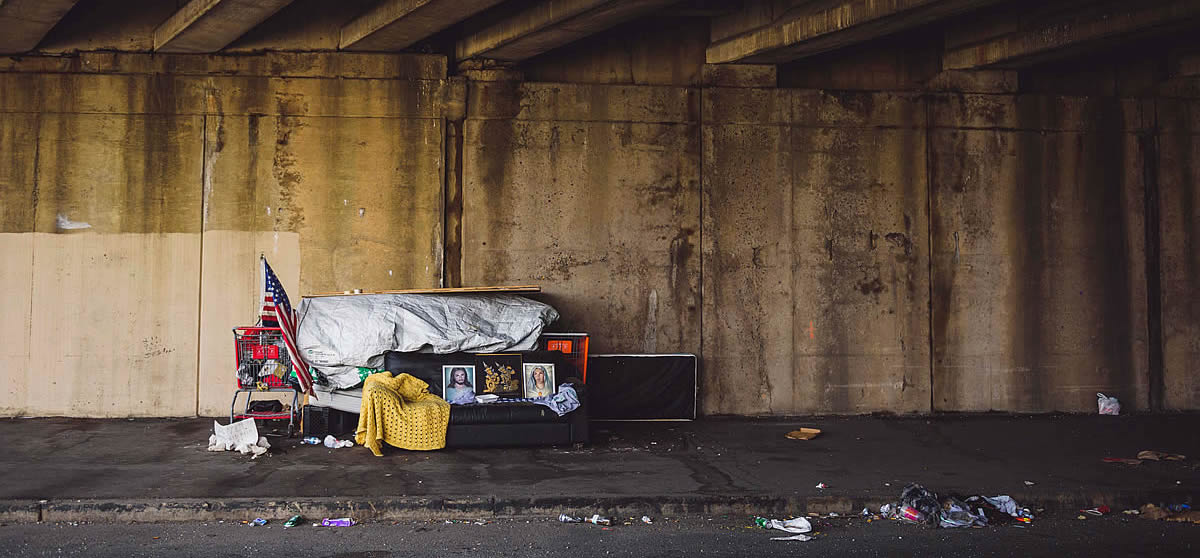
A gritty urban underpass in Philadelphia with signs of homelessness and American flag | photo: Dan Parlante
Poverty
847 million people live in extreme poverty as billionaire wealth hits $18.3 trillion, a record high in 2025
Poverty means living without enough money to meet basic needs: food, clean water, shelter, education. In 2026, two numbers define the global picture. Hundreds of millions of people still live below the poorest survival threshold economists can define, while the world’s richest individuals have never held more wealth than they do right now.
Follow the Money
What Counts as Extreme Poverty
The World Bank measures extreme poverty using an International Poverty Line, updated in June 2025 to $3.00 per person per day, based on 2021 purchasing power parity. This replaced the previous $2.15 line, itself based on older 2017 price data.
That single change added 125 million people to global extreme poverty counts overnight, not because the world became poorer, but because the poverty threshold rose to reflect updated prices. Incomes among the world’s poorest are, if anything, slightly higher than earlier estimates suggested.
The 2024-2026 Numbers
As of the World Bank’s most recent update, 847 million people lived in extreme poverty in 2024, roughly 10.4% of the global population, or about one in every ten people alive. The World Bank’s nowcast projects this falling slightly to 10.0% by 2026, though that projection predates 2025’s global aid cuts and trade disruptions, and does not yet account for their effects.
Progress has clearly slowed. Since 1990, over a billion people have escaped extreme poverty, one of the great achievements in modern economic history. But that steady decline has stalled in recent years, weighed down by the pandemic, conflict, and now aid retrenchment.
Where Poverty Concentrates
Extreme poverty is not evenly distributed. Sub-Saharan Africa accounts for roughly 80% of the world’s extreme poor, with a regional poverty rate of 46%, and the region is only expected to return to pre-pandemic poverty levels in 2025, five years behind the rest of the world.
The Democratic Republic of Congo has more people living in extreme poverty than any other country, an estimated 76.2 million. South Sudan has the highest rate of any country, with close to 8 in 10 people living below the poverty line, the result of prolonged civil conflict and displacement.
One region is moving in the wrong direction entirely. The Middle East, North Africa, Afghanistan, and Pakistan region is now the only one where extreme poverty is rising, driven by crises in Yemen, Afghanistan, and revised, worse-than-expected data from Pakistan, pushing the regional rate up to 14.4%.
A Long-Term Warning
The World Bank’s own long-range modelling carries a genuinely uncomfortable finding. If current national trends continue unchanged, the global poverty rate could rise from around 10% today to roughly 15% by 2050, an increase of more than 600 million people, even as individual countries make progress.
The reason is demographic, not just economic. Populations in countries with extreme poverty rates above 10% are growing at nearly 2.5% a year, five times faster than in wealthier countries. Poverty reduction within countries can be real and still lose the race against population growth at the global level.
Aid Cuts and Poverty: A Direct Line
RYB’s ODA page documents 2025’s historic 23.1% collapse in global development aid, the steepest single-year decline on record. That collapse arrives at precisely the moment poverty reduction has already slowed, not a coincidence but a compounding shock.
The clearest single estimate of the human cost comes from USAID’s dismantling alone. Health researchers and Oxfam both cite projections that the closure of USAID and the wider 2025 aid cuts could cause an additional 14 million deaths by 2030, a toll that would fall overwhelmingly on people already living in or near extreme poverty.
This is why RYB treats ODA, tax policy, and poverty as one connected story rather than three separate topics. A dollar lost to a tax haven and a dollar cut from an aid budget both ultimately reduce the same thing: resources available to lift someone out of poverty.
The Wealth at the Other End
While extreme poverty stayed roughly flat, wealth at the very top surged. Oxfam’s January 2026 report, timed to the World Economic Forum in Davos, found global billionaire wealth reached a record $18.3 trillion in 2025, up more than 16% in a single year, and up 81% since 2020.
The concentration at the very top is extraordinary. The world’s twelve richest individuals now hold a combined $2.635 trillion, more than the entire poorest half of humanity, over four billion people, combined. The number of billionaires passed 3,000 for the first time in 2025. Elon Musk became the first person in history worth more than half a trillion dollars.
Oxfam frames this as more than an economic statistic. It calls the resulting concentration of political influence a form of “political poverty”: billionaires are roughly 4,000 times more likely to hold political office than an average citizen, giving enormous influence over the same tax and spending decisions that determine aid budgets and poverty programmes.
This connects directly to RYB’s Tax Havens coverage. Oxfam explicitly ties 2025’s billionaire wealth surge to tax cuts for the wealthy and weakened enforcement against corporate tax avoidance, the same structural dynamics documented elsewhere on this site.
Flipping the Poverty Narrative
RYB has long featured anthropologist Jason Hickel’s critique of how mainstream poverty narratives get told, and it remains worth reading alongside the numbers above. Hickel has argued that celebratory framing around declining poverty rates obscures a harder truth: only a small fraction of new income from global economic growth reaches the world’s poorest, even as they produce much of what the world consumes.
Read together with Oxfam’s 2026 findings, that critique looks less like a contrarian argument and more like a description of the current data. Billionaire wealth grew three times faster than its five-year average in 2025, in the very year extreme poverty reduction stalled and aid budgets collapsed simultaneously.
How This Connects to the SDGs
Poverty sits at the center of SDG 1, the very first Sustainable Development Goal, which set a target of ending extreme poverty in all its forms by 2030. On current trends, that target will not be met. The World Bank’s own nowcasts show poverty falling only marginally through 2026, before accounting for the effects of 2025’s aid collapse at all.
SDG 10, reducing inequality, is directly undermined by the wealth concentration Oxfam documents, both within countries and between them. SDG 17, global partnerships, connects the two halves of this page most directly: it is the goal that explicitly measures whether wealthy nations meet their aid commitments and curb harmful financial flows, the same commitments now falling furthest behind.
Looking Forward
The next full picture of 2025’s impact on poverty will not be clear until the World Bank’s future updates fully incorporate the year’s aid cuts and trade disruptions, something the current 10.0% 2026 nowcast does not yet reflect. That update, expected later in 2026, deserves close attention.
Oxfam’s own recommendations, taxing extreme wealth, strengthening firewalls between money and politics, and reversing aid cuts, mirror exactly the reforms RYB tracks across its ODA, Tax Havens, and Financial Secrecy pages. The connections between these topics are not incidental; they are the same story told from different angles.
RYB will continue tracking how poverty, aid, and inequality move together, rather than treating them as separate statistics. This page will be updated as new World Bank and Oxfam data emerge.
Further Perspectives
Jason Hickel, “Bill Gates says poverty is decreasing. He couldn’t be more wrong” — theguardian.com
Sources and References
- World Bank, “June 2025 Update to Global Poverty Lines” — worldbank.org
- World Bank, “March 2026 global poverty update from the World Bank” — blogs.worldbank.org
- World Bank, “September 2025 global poverty update from the World Bank” — blogs.worldbank.org
- World Bank, Atlas of Global Development, “Past, Present, and Future: 100 Years of Challenges in Tackling Extreme Poverty” — data360.worldbank.org
- Our World in Data, “$3 a day: A new poverty line has shifted the World Bank’s data on extreme poverty” — ourworldindata.org
- Mappr, “Mapped: Global Poverty Rates by Country (2026 World Bank Update)” — mappr.co
- Oxfam International, “Billionaire wealth jumps three times faster in 2025 to highest peak ever” — oxfam.org
- Oxfam GB, “Oxfam’s Global Inequality Report” — oxfam.org.uk
- CNBC, “Billionaires are richer than ever, says Oxfam” — cnbc.com
- World Economic Forum, “Oxfam: Fighting Inequality to Build a Fairer Future” — weforum.org
- RYB, Official Development Assistance (ODA) — redyellowblue.org/finance/oda/
- RYB, Tax Havens and the Offshore World — redyellowblue.org/finance/tax-havens-offshore-world/