

Brazil Sustainable Development Goals (SDGs)
53
SDG Index rank, out of 169 countries
74.2
SDG Index score, out of 100
6
Spillover rank, out of 169 countries
96.6
Spillover score, out of 100
Source: Sustainable Development Report 2026, SDSN / Dublin University Press
Most people have never heard of the Sustainable Development Goals in any real detail. Surveys across the US, UK, France, and Germany find only 8–12% of people can actually say what the SDGs are. RYB exists to close that gap, looking at the same reports and reviews the UN and researchers use, and explaining them as we go.
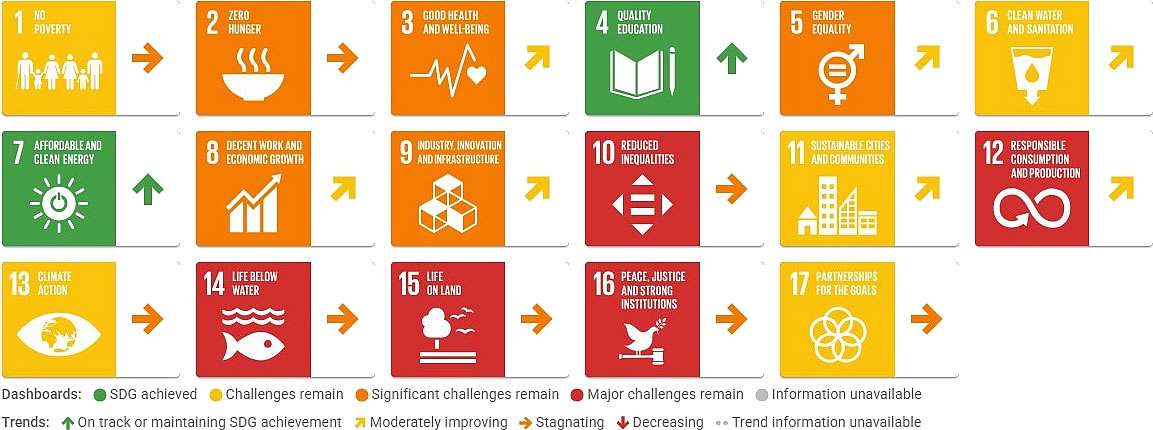
Here’s a finding that runs against almost everything else on this site so far: Brazil ranks 53rd in the world on overall SDG progress, well behind Finland, the UK, and the Netherlands. But on the Spillover Index, the score that measures harm done to other countries, Brazil ranks 6th. Nearly every wealthy country RYB has covered so far gets this backwards.
Brazil — Sustainable Development Report 2026
BR
Voluntary National Reviews: A Gap, Then a Comeback
Brazil’s relationship with formal UN reporting hasn’t been steady. The country’s last VNR before its recent run dated back to 2017, and its National Commission for the SDGs was dissolved entirely in 2019.
The reversal came in 2023, when the commission was recreated as a parity body, with all ministries, state and municipal governments, and civil society represented. Brazil returned to the HLPF stage in 2024, and presented again in 2026, describing that VNR as the close of “a development cycle marked by tangible impact.”

SDG 18, Twice Over
One detail stands out internationally: Brazil’s recent reviews include a proposal for a voluntary 18th SDG on ethnic-racial equality. President Lula announced it at the UN General Assembly in 2023, and it now has ten drafted targets covering workplace racism, access to justice, housing, health care, education, and reparative justice for Indigenous peoples and Afro-descendants. It is Brazil’s highest-level commitment to addressing racism as a development issue, not just a social one.
This is a different SDG 18 proposal from the culture-focused one UNESCO is pushing through MONDIACULT, tracked elsewhere on this site. “An 18th goal” is currently being proposed from more than one direction at once.
Worth noting: these two proposals don’t carry equal political weight, at least not yet. Brazil’s SDG 18 launched through one government’s own initiative. UNESCO’s culture goal launched through more than 100 culture ministers signing one joint declaration in Barcelona at MONDIACULT 2025. A hundred governments moving together will likely carry more weight at the 2027 SDG Summit than one government acting alone, however developed Brazil’s own proposal already is. Brazil isn’t the only country pushing for a new goal either: Costa Rica, Laos, Cambodia, and India have all floated their own additions in recent years.
Worth keeping in view: this kind of expansion has happened before. The Millennium Development Goals started at eight, for the period 2000–2015. The SDGs that followed grew to seventeen, for 2015–2030. If history holds, the next agenda, likely 2030–2045, probably won’t stay at seventeen either. Whether it ends up with one new goal, several, or none at all, is genuinely still open.
Voluntary Local Reviews: An Unusually Deep Bench
Brazil’s local SDG reporting runs deeper than almost any country RYB has covered. By 2021, São Paulo, Rio de Janeiro, Taquari, and Afogados de Ingazeira had all published their own VLRs. The State of Pará went further still, coordinating a joint review across 144 municipalities at once.
The most striking entry is the State of São Paulo itself, which published a VLR covering more than 45 million people, a review operating at the scale of a mid-sized country, not a city. Smaller municipalities took part too: Francisco Morato, a city of roughly 170,000, published its own Informe Voluntário Local, proving the format scales down as well as up.
What the Sustainable Development Report Shows: Two Scores That Don’t Match
The Sustainable Development Report scores every country two ways. The overall score measures how well a country is doing for its own people. The spillover score measures how much harm a country’s economy causes everyone else. For Brazil, these two numbers point in opposite directions, more sharply than for any other country covered on this site so far.
Brazil’s overall score sits at 74.2 out of 100, ranking 53rd out of 169 countries, solidly mid-table. Its spillover score sits at 96.6 out of 100, ranking 6th in the world, just behind a handful of small island and least-developed nations that barely register on global trade and finance at all.
Why Brazil’s Spillover Score Is So Strong
- Trade-embodied harm stays remarkably low. Exports of plastic waste sit at just 0.025 kg per capita, a near-perfect green score. Compare that to Finland’s 4.525 kg per capita (orange) or the Netherlands’ 30.162 (red).
- Weapons exports stay minimal. Conventional weapons exports sit at 0.038 TIV per 100,000 people, green. The US, by comparison, scores 0 out of 100 on this same normalized indicator, the worst possible rating.
- Tax policy causes less damage than in comparable economies. Brazil’s Corporate Tax Haven Score sits at 38 out of 100, better than Finland’s 60, the US’s 45, and far better than the UK’s 86.25 or the Netherlands’ 72.3.
- Multilateral cooperation runs strong. Brazil’s UN-based multilateralism score sits at 81.6 out of 100. For comparison, the US scores 1.7 on this same measure.
The Pattern This Breaks
The Sustainable Development Report’s own researchers note a common pattern: wealthy countries tend to lead the SDG Index while scoring poorly on spillovers, since the trade and financial position that supports strong domestic performance often pushes costs onto countries with less capacity to absorb them.
Brazil doesn’t fit that pattern. It ranks lower overall, partly reflecting real, unresolved domestic challenges, but it isn’t buying that lower ranking through harm exported elsewhere. Wealth and spillover damage aren’t actually the same thing. Brazil is the clearest evidence of that on this site so far.
Why These Numbers Matter
These pages matter more than their topic suggests on the surface. The SDGs are, in effect, the world’s working roadmap for its biggest shared problems, yet most citizens have never engaged with them directly. A Voluntary Local Review can change that at the scale where it’s most achievable: one city, one community, people who might otherwise never cross paths brought into the same conversation about what their home needs most.
Culture and the arts barely feature in that conversation today. Brazil’s own VLRs, São Paulo’s among them, show how much room still exists for that to change. RYB expects it will, eventually, in Brazil and everywhere else this site looks.
RYB’s Place in This Picture
RYB tracks Brazil because it complicates a pattern that looked consistent across Finland, the UK, the Netherlands, and the US. A country doesn’t have to choose between being a domestic SDG leader and a low-harm global actor, but very few countries are managing both at once. Brazil’s spillover story deserves to be read alongside those other four, not after them.
Looking Forward
Watch the 2027 SDG Summit, where Brazil’s ethnic-racial equality proposal and UNESCO’s culture goal will both compete for space in whatever comes next. And watch whether Brazil’s strong spillover position holds as its economy grows, since results like this can shift quickly as trade patterns change.
Sources
- Sustainable Development Report 2026 — dashboards.sdgindex.org/profiles/brazil
- Voluntary National Reviews 2026, Brazil — hlpf.un.org
- Voluntary National Reviews 2024, Brazil — hlpf.un.org
- Brazil proposes new SDG focused on ethnic-racial equality, Agência Brasil — agenciabrasil.ebc.com.br
- SDG 18 – Ethnic-Racial Equality, Brazilian Ministry of Racial Equality — gov.br
- Voluntary Local Review Declaration, NYC Mayor’s Office for International Affairs — nyc.gov
- Guidelines for Voluntary Local Reviews, Volume 2, UN-Habitat / UCLG — unhabitat.org
- Municipal localization of the SDGs, ABCS Health Sciences — portalnepas.org.br