

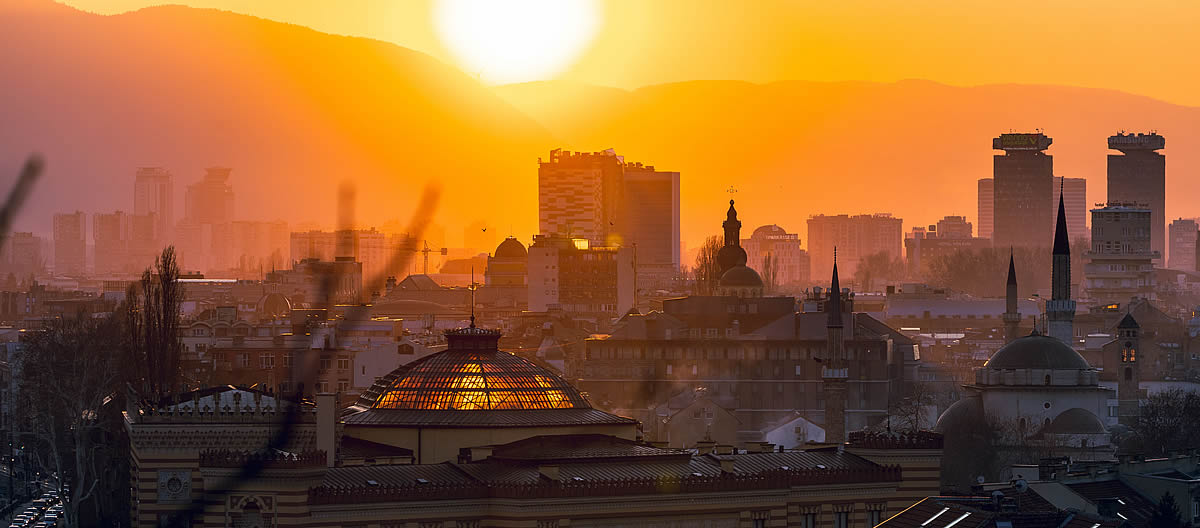
An enchanting sunset over Sarajevo | photo Amel Uzunovic
Women, Culture and Peace › Women’s Days for Culture of Peace › Calendar › Culture Women’s Day Bosnia and Herzegovina › Bosnia and Herzegovina
Culture Women's Day Bosnia and Herzegovina
Women's Right to Vote / August 11 (1945)
One of 193 national Women’s Days for Culture of Peace — a day for every UN member state. See the full calendar.
BA
When did women get the right to vote in Bosnia and Herzegovina?
On August 11, 1945, women in Bosnia and Herzegovina gained universal suffrage as part of the new Socialist Federal Republic of Yugoslavia. The right was granted equally across all of Yugoslavia’s constituent republics, making August 11 a shared milestone for what are today Bosnia and Herzegovina, Croatia, Slovenia, Serbia, Montenegro, North Macedonia, and Kosovo.
The date carries particular weight for Bosnia and Herzegovina. Women in this region had little political history to draw on before 1945. The Ottoman and Austro-Hungarian empires had governed the territory in turn, and the interwar Kingdom of Yugoslavia had not extended suffrage to women. August 11 was, therefore, a genuine and dramatic first.
Women voted for the first time in the November 1945 parliamentary elections. Their participation was immediate and high — partly a reflection of the socialist state’s active mobilization, and partly of women’s own wartime contributions to the Partisan resistance.
Half a century later, the 1992–1995 war would test everything those rights had built. But Bosnian women’s response to that war became one of the most significant chapters in modern feminist peacebuilding history.
How did women in Bosnia and Herzegovina win the vote?
The path to August 11, 1945 in Bosnia and Herzegovina ran almost entirely through wartime resistance rather than a formal suffrage campaign.
- 1918–1941. The interwar Kingdom of Yugoslavia did not grant women the vote. Political organizing by women remained limited and largely urban.
- 1941–1945. Women joined the Yugoslav Partisans in large numbers across all republics, including Bosnia and Herzegovina. Around 110,000 women fought in the anti-fascist resistance. Their contribution made the argument for political equality impossible to ignore after liberation.
- August 11, 1945. The new Yugoslav state granted universal suffrage to all citizens. In Bosnia and Herzegovina, a republic with deep ethnic and religious diversity — Bosniaks, Serbs, and Croats — the right was extended equally regardless of faith or ethnicity.
- November 1945. Women voted for the first time in federal elections. The socialist framework also opened education and employment to women, expanding formal equality across multiple domains simultaneously.
As scholar Djurdja Knezevic observed about women’s rights in this region more broadly, formal rights granted “from above” through socialist revolution left less space for an independent women’s movement to develop. Bosnia and Herzegovina’s women’s movement built its real organizational strength not in 1945, but in the ashes of the 1990s war.
Key Women in Bosnia and Herzegovina’s Women’s Movement
Nusreta Sivac (1951– )
A judge in Prijedor before the war, Sivac survived the Omarska concentration camp in 1992 and immediately began gathering testimonies from hundreds of rape survivors. Together with Jadranka Cigelj, she helped prepare the first ICTY indictment in 1995. Her work was a turning point: the United Nations recognized wartime rape as a war crime under international law for the first time, in part because of the evidence Sivac collected. She has continued testifying for decades since.
Hatidža Mehmedović (1952–2018)
A homemaker from Srebrenica who lost her husband and two sons in the July 1995 genocide, Mehmedović returned to Srebrenica in 2002 as one of the first Bosniaks to do so. She founded the Mothers of Srebrenica that same year, building a movement demanding justice, truth, and accountability. She resisted attempts by Republika Srpska authorities to deny access to mass grave sites. Her words — “No story can bring back our dearest ones, but by telling a story we can prevent new genocides, new crimes and future wars” — remain among the most quoted in post-war Bosnia.
Medica Zenica (founded 1993, active today)
Established in 1993 during the war to provide counseling to women who had survived sexual violence, Medica Zenica became one of BiH’s most important feminist organizations. It now operates as a center for psychosocial support, legal aid, and feminist organizing. It also became a hub for the development of Islamic feminist thought in Bosnia, bridging secular and faith-based approaches to women’s rights.
Nela Porobić and Gorana Mlinarević (active today)
Two feminist scholars and activists associated with WILPF Bosnia and Herzegovina, Porobić and Mlinarević co-authored The Peace That is Not: 25 years of Experimenting with Peace in Bosnia and Herzegovina. Their work challenges mainstream interpretations of the Dayton peace process and advocates for feminist alternatives to the country’s current political and economic framework.
Bakira Hasečić (1953– )
A survivor of wartime rape, Hasečić founded the Women Victims of War association in Sarajevo and has spent decades pursuing prosecutions of war criminals in Bosnian courts. She has testified in more than 100 trials and was awarded the Council of Europe’s Human Rights Prize for her tireless advocacy for survivors.
Why this day matters today
Bosnia and Herzegovina occupies a unique place in the history of women, peace, and security. In 2010, it became one of the first post-conflict states in the world to adopt a National Action Plan implementing UN Security Council Resolution 1325 — the landmark resolution that recognized women as essential actors in peacebuilding, not only victims of war.
That connection to UNSCR 1325 runs directly through what Bosnian women built after 1995. Their testimony, their organizations, and their insistence on justice helped shape the international framework for Women, Peace and Security that now guides policy in more than 80 countries.
Today’s picture is mixed. Women hold around 21% of parliamentary seats at the state level — below the European average and far short of parity. The ethnic and political complexity of the Dayton framework creates structural obstacles to women’s political participation across entity lines. Domestic violence remains inadequately addressed. Economic empowerment programs for women have advanced but unevenly.
At the same time, civil society in Bosnia and Herzegovina remains active and organizationally strong, shaped by decades of women-led rebuilding. That civic strength is one of the most distinctive legacies of what happened here after 1995.
Culture Women’s Day within Women, Culture and Peace
Culture Women’s Day Bosnia and Herzegovina is part of a larger framework: Women, Culture and Peace (WCP). WCP builds on UNESCO’s Culture of Peace programme and the UN’s Women, Peace and Security agenda.
The connection is direct. The Women, Peace and Security agenda that Bosnian women helped build through their post-war testimony is the same agenda that WCP draws on as one of its foundations. Bosnia and Herzegovina did not only receive the WPS framework — it helped create it.
WCP works through culture, art, and community rather than formal institutions alone. It follows a women-centered organizing model, developed by scholars Stall and Stoecker. This model builds relationships and shared leadership, instead of competing for power.
Women’s Days for Culture of Peace is one expression of WCP. The initiative marks a day for every UN member state — 193 in total. Each day recognizes a nation’s path toward women’s political voice. Each day also opens space to reflect on peacebuilding, gender equality, and sustainable development still ahead, central to SDG 5.
What could Culture Women’s Day Bosnia and Herzegovina become?
This day is still young within the Women’s Days for Culture of Peace calendar. Its meaning is not fixed. It can grow as more people discover it and decide what it should hold.
A national Women’s Day could become a moment to honor the women who built peace in Bosnia and Herzegovina after 1995, often without recognition or institutional support. It could become an occasion to connect August 11, 1945 — the date of the formal right — to the deeper story of what Bosnian women did with that right across the decades that followed.
It could also become a day of international solidarity. Bosnia and Herzegovina’s story is not only local. The women who testified at the ICTY, who founded Mothers of Srebrenica, who built Medica Zenica changed how the world understands the relationship between women and peace. That contribution deserves acknowledgment beyond BiH’s own borders.
None of this is prescribed from above. Like WCP itself, the day grows through shared leadership, not instruction.
Ideas for celebration and reflection
These are starting points, not a program. Pick what resonates. Leave the rest. Add your own.
- Online. Share a post or story using #CultureWomensDay or #WCP, and name a woman from Bosnia and Herzegovina who inspired you.
- In schools. Start a classroom dialogue about women’s suffrage in Bosnia and Herzegovina, paired with a question: what does political voice mean today?
- In culture. Organize a library display, a small exhibition, or a reading group built around women’s history in Bosnia and Herzegovina.
- In organizations. Pause during a team meeting to mark Culture Women’s Day Bosnia and Herzegovina and connect it to ongoing equality work.
- At home or with friends. Share one story about a woman who shaped your own family or community history.
- In communities. Host a local PeaceTable-style gathering, open to anyone with a story, a question, or an idea to bring.
Some of these need an afternoon. Others need only a sentence shared with a colleague. Both matter.
A growing network, one country at a time
Bosnia and Herzegovina shares August 11 with the other successor states of Yugoslavia — Croatia, Slovenia, Serbia, Montenegro, North Macedonia, and Kosovo. Each marks the same date from a different national experience. Together they form a small, natural network within the larger calendar of 193 days.
What makes Bosnia and Herzegovina’s August 11 distinct is the second chapter — the one that unfolded after 1992. Women here did not only receive a right in 1945. They rebuilt it, defended it, and in doing so helped rewrite international law.
RYB does not direct this growth. It offers the framework, the calendar, and the connection back to WCP. What happens next depends on the people who discover it.
Looking Forward
Culture Women’s Day Bosnia and Herzegovina marks August 11, 1945, when women in this region first gained the right to vote as citizens of a new Yugoslavia. That date is a beginning.
The fuller story of Bosnian women’s political voice unfolded over the following eight decades — through socialist equality, war, survival, testimony, justice, and rebuilding. It continues today in the work of Medica Zenica, the Women Victims of War association, the Women’s Network BiH, and hundreds of local organizations whose names are less well known but whose work is equally real.
August 11 is worth marking. Not only as a historical date, but as an annual occasion to remember what Bosnian women built — and to ask what comes next.
The invitation stands open. Explore the Women, Culture and Peace framework, browse the calendar of 193 national days, and consider what this day could mean to you on August 11.
Sources and Links
- Ending Violence in Bosnia and Herzegovina — Powerful Women — Remembering Srebrenica | srebrenica.org.uk/news/ending-violence-in-bosnia-and-herzegovina-powerful-women
- The Courage to Testify: Nusreta Sivac — Remembering Srebrenica | srebrenica.org.uk/survivor-stories/the-courage-to-testify-nusreta-sivac/
- Nusreta Sivac — Wikipedia | en.wikipedia.org/wiki/Nusreta_Sivac
- Hatidža Mehmedović and the Mothers of Srebrenica — Holocaust Memorial Day Trust | hmd.org.uk/resource/hatidza-mehmedovic-and-the-mothers-of-srebrenica-hmd-2020/
- Mothers of Srebrenica — Wikipedia | en.wikipedia.org/wiki/Mothers_of_Srebrenica
- Medica Zenica — official site | medicazenica.org/en/
- Netizens across former Yugoslavia celebrate 75 years of women’s suffrage — Global Voices, September 3, 2020 | globalvoices.org/2020/09/03/netizens-across-former-yugoslavia-celebrate-75-years-of-womens-suffrage/
- Women, Citizens and Believers as Agents of Peace in Bosnia and Herzegovina — Academia.edu | academia.edu/34098306/Women_Citizens_and_Believers_as_Agents_of_Peace_in_Bosnia_and_Herzegovina
- Conflicts and feminist peacebuilding: From Bosnia to Gaza — EURAC Research, November 2025 | eurac.edu/en/blogs/gender-matters/conflicts-and-feminist-peacebuilding-from-bosnia-to-gaza
- Bosnia and Herzegovina — WILPF | wilpf.org/focus-countries/bosnia-herzegovina/
- The Quiet Revolution: Islamic Feminism Gains Ground in Post-War Bosnia and Herzegovina — Chronicle AI, May 2026 | chronicleai.org/article/the-quiet-revolution-islamic-feminism-gains-ground-in-post-war-bosnia-and-herzegovina
- Bosnia and Herzegovina — UN Women | unwomen.org/en/get-involved/step-it-up/commitments/bosnia-and-herzegovina
- Women’s Leadership and Political Participation: Facts and Figures — UN Women | unwomen.org/en/articles/facts-and-figures/facts-and-figures-womens-leadership-and-political-participation
- Women in Politics: 2025 Map — IPU and UN Women | ipu.org/resources/publications/infographics/2025-03/women-in-politics-2025
- Women, Culture and Peace (WCP) — RYB Global Development | redyellowblue.org/women-culture-and-peace/
- Calendar of Women’s Days for a Culture of Peace — RYB Global Development | redyellowblue.org/womens-days-for-culture-of-peace/calendar/
- Bosnia and Herzegovina — Global Development — RYB Global Development | redyellowblue.org/data/ba/