

Bosnia and Herzegovina Sustainable Development Goals (SDGs)
54
SDG Index rank, out of 169 countries
73.92
SDG Index score, out of 100
80
Spillover rank, out of 169 countries
90.93
Spillover score, out of 100
Source: Sustainable Development Report 2026, SDSN / Dublin University Press
Most people have never heard of the Sustainable Development Goals in any real detail. Surveys across the US, UK, France, and Germany find only 8–12% of people can actually say what the SDGs are. RYB exists to close that gap, looking at the same reports and reviews the UN and researchers use, and explaining them as we go.
Bosnia and Herzegovina crossed a threshold in the most recent Human Development data that very few post-conflict states ever reach: it now sits in the UN’s “very high human development” category for the first time, thirty years after Dayton. Most coverage of Bosnia and Herzegovina still centers on its frozen political architecture. The Sustainable Development Report finds something worth noting underneath its own numbers, too: despite ranking only 54th overall, Bosnia and Herzegovina posts weapons-export and plastic-waste figures a fraction of what several wealthier countries on this site record, and out-scores both the Netherlands and the UK on support for UN-based multilateralism.
Bosnia and Herzegovina — Sustainable Development Report 2026
BA
Voluntary National Reviews: From First Attempt to Institutional Follow-Through
Bosnia and Herzegovina presented its first Voluntary National Review (VNR) at the High-Level Political Forum in New York in July 2019, its first-ever formal report on the SDGs to the UN. What followed mattered more than the review itself: in 2021, the Council of Ministers adopted the country’s first cross-government “SDG Framework” in over a decade, and established an inter-ministerial SDG Council to coordinate it, an unusually concrete institutional step for a country whose governance is split across two entities and the Brčko District.
The second VNR followed in 2023, jointly prepared by institutions at every level of government. In the run-up to it, more than 45 civil society organisations, many working with vulnerable groups, were consulted directly, in Sarajevo, Brčko District, Banja Luka, Tuzla, and Mostar. That geographic spread is itself a small signal: a genuinely nationwide consultation, in a country where “nationwide” coordination is rarely simple.
Voluntary Local Reviews: One City, A Different Method
Bosnia and Herzegovina’s entry into local SDG reporting looks nothing like the standard Voluntary Local Review. In 2023, the City of Bijeljina became one of just three municipalities worldwide, alongside Emboreet and Kibaha in Tanzania, chosen by Sweden’s International Centre for Local Democracy (ICLD) to pilot a review built on Community-Based Participatory Research (CBPR) rather than on indicators and dashboards.
Instead of a data-heavy report, researchers embedded directly in the community to gather stories and lived experience around three goals: SDG 5 (gender equality), SDG 10 (reduced inequalities), and SDG 17 (partnerships). The resulting review found real citizen involvement at the planning stage, but concluded that ongoing monitoring still rests mostly with the city administration rather than the community itself, a candid finding a conventional data-only VLR would be unlikely to surface.
It’s a small pilot, one city, three goals, but it points at a genuine gap in how VLRs are usually built: most measure a city’s SDG position, not whether residents feel any ownership of getting there.
What the Sustainable Development Report Shows: A Small Footprint, Not a Clean Story
The Sustainable Development Report scores every country two ways. The overall score measures how well a country is doing for its own people. The spillover score measures how much harm a country’s economy causes everyone else.
Bosnia and Herzegovina’s overall score sits at 73.92 out of 100, ranking 54th out of 169 countries. Its spillover score sits at 90.93 out of 100, a high absolute number, but one that only ranks 80th in the world. That gap between a strong score and a middling rank is worth naming on its own: dozens of small, low-trade economies cluster tightly near the top of the spillover measure, because a country that trades and invests less abroad has fewer channels through which to export harm in the first place. Some of Bosnia and Herzegovina’s individual spillover indicators are genuinely striking on their own terms, though, not just by default of size:
- Corporate Tax Haven Score: 0 out of 100, the best possible rating, and the strongest score RYB has recorded for any country covered so far: better than Brazil (38), the US (45), Finland (60), the Netherlands (72.3), and the UK (86.25).
- Shifted profits of multinationals: $0 billion, tied with Brazil, Finland, and the US, and a striking contrast with the Netherlands’ $166.8 billion and the UK’s $89.2 billion.
- Conventional weapons exports: 0.14 TIV per 100,000 people, far below the UK’s 1.553, the Netherlands’ 2.15, and the US’s 3.773, though still above Brazil’s near-zero 0.038.
- Exports of plastic waste: 0.905 kg per capita, well below the Netherlands’ 30.162 kg and the UK’s 11.966 kg, though again higher than Brazil’s 0.025 kg.
- Support for UN-based multilateralism: 69.0 out of 100, ahead of the Netherlands (67.6) and the UK (54.9), far ahead of the US (1.7), though behind Brazil (81.6).
The picture that doesn’t hold up as well is statistical capacity itself. Bosnia and Herzegovina’s Statistical Performance Index sits at just 68.6 out of 100, the lowest of any country RYB has covered so far, well behind Brazil (82.3), the Netherlands (85.1), the UK (88.4), the US (90.1), and Finland (90.4). That gap is consistent with something reported elsewhere: the 2025 Europe Sustainable Development Report excluded Bosnia and Herzegovina, along with Albania, Georgia, and Moldova, from its regional rankings entirely, citing missing data. The same pattern shows up in the country’s Corruption Perceptions Index score of 34 out of 100 (109th globally), close to Brazil’s 35, but far behind Finland (88), the Netherlands (78), the UK (70), and the US (64), a consistent theme across Bosnia and Herzegovina’s own VNRs, not something the SDR is surfacing on its own.
Bosnia and Herzegovina’s spillover rank sits alongside every other country RYB tracks on the Global Responsibility page, where rankings like these are shown together across all the countries covered on this site.
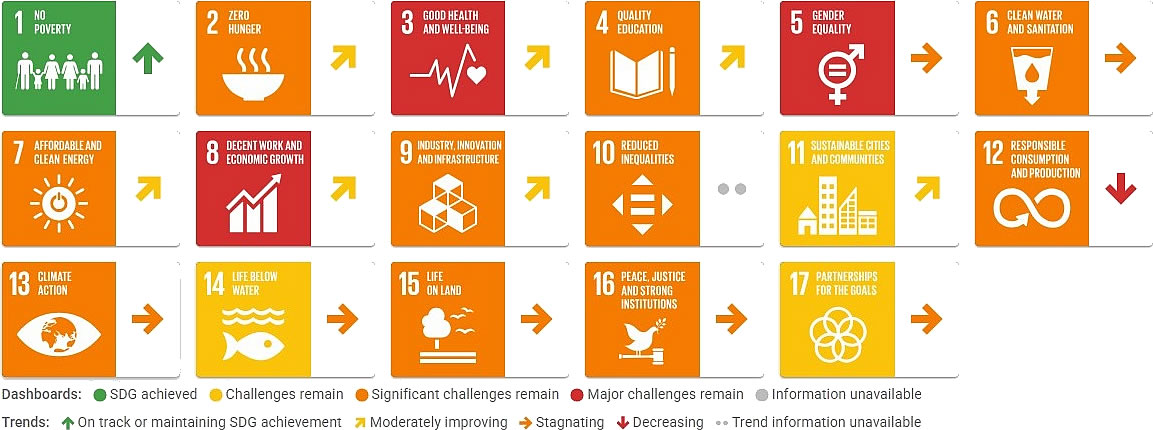
Bosnia and Herzegovina’s full SDG dashboard, Sustainable Development Report 2026 →
Why Bosnia and Herzegovina’s Spillover Score Holds Up
- Conventional weapons exports: 0.14 TIV per 100,000 people, far below the UK’s 1.553, the Netherlands’ 2.15, and the US’s 3.773, though still above Brazil’s near-zero 0.038.
- Exports of plastic waste: 0.905 kg per capita, well below the Netherlands’ 30.162 kg and the UK’s 11.966 kg, though again higher than Brazil’s 0.025 kg.
- Support for UN-based multilateralism: 69.0 out of 100, ahead of the Netherlands (67.6) and the UK (54.9), far ahead of the US (1.7), though behind Brazil (81.6).
A useful contrast: RYB’s Finland SDGs page tells almost the opposite story, a global leader overall, 1st out of 169, ranking only 144th on spillovers. Bosnia and Herzegovina’s numbers run the other way on nearly every one of the indicators above, without ranking anywhere near Finland’s overall position. Wealth, or the lack of it, isn’t what spillover harm actually tracks.
Where the Work Remains
The picture that doesn’t hold up as well is statistical capacity itself. Bosnia and Herzegovina’s Statistical Performance Index sits at just 68.6 out of 100, the lowest of any country RYB has covered so far, well behind Brazil (82.3), the Netherlands (85.1), the UK (88.4), the US (90.1), and Finland (90.4). The same pattern shows up in the country’s Corruption Perceptions Index score of 34 out of 100 (109th globally), close to Brazil’s 35, but far behind Finland (88), the Netherlands (78), the UK (70), and the US (64), a consistent theme across Bosnia and Herzegovina’s own VNRs, not something the SDR is surfacing on its own. On the dashboard itself, SDG 12 (Responsible Consumption and Production) is the one goal currently moving in the wrong direction rather than stagnating or improving.
Bosnia and Herzegovina’s spillover rank sits alongside every other country RYB tracks on the Global Responsibility page, where rankings like these are shown together across all the countries covered on this site.
Why These Numbers Matter
These pages matter more than their topic suggests on the surface. For Bosnia and Herzegovina specifically, the SDGs and the HDI are measuring recovery as much as development, three decades on from a war that these same indicators, life expectancy, education, income, institutional trust, were built to track the aftermath of. A country moving from “high” to “very high” human development, one government’s worth of years after the fact, is not a small thing, even when the headline ranking still lands in the middle of the pack.
Culture and the arts barely feature in that recovery story today, in the SDG Framework, in the VNRs, or in Bijeljina’s own pilot review. RYB tracks Bosnia and Herzegovina precisely because that space is still open, and because a Culture of Peace lens has more to offer a country still rebuilding shared institutions than it does almost anywhere else RYB covers.
RYB’s Place in This Picture
RYB tracks Bosnia and Herzegovina because its numbers cut against a simpler story than the headlines usually allow. A country can be gaining ground quickly on human development, post a perfect Corporate Tax Haven Score, and still rank mid-table on the SDGs overall, still carry one of Europe’s lower Corruption Perceptions scores, and still get excluded from its own regional Index for lacking the data to be ranked in the first place. None of these figures cancel each other out. Read together, they’re a more honest picture of where the country actually stands than any single number on its own.
Looking Forward
Watch whether Bosnia and Herzegovina’s HDI gains hold through the next review cycle, given how closely they track a governance structure that remains genuinely fragile. Watch Bijeljina’s participatory VLR model too, ICLD has signaled more research on whether it can be replicated elsewhere, in Bosnia and Herzegovina and beyond. And watch the country’s next VNR, expected to test whether the 45-organisation consultation model from 2023 was a one-off or the new baseline.
One Report, Not Two
Unlike Finland, Norway, or the Netherlands, Bosnia and Herzegovina doesn’t get a second scorecard. The Europe Sustainable Development Report 2025 excluded Bosnia and Herzegovina, along with Albania, Georgia, and Moldova, from its regional rankings entirely, citing missing data, though it still published a country profile and dashboard. For now, the global Sustainable Development Report is the only ranked, comparative measure Bosnia and Herzegovina has.
UNDP
Human Development Report — Bosnia and Herzegovina
The Human Development Index measures something narrower and older than the SDGs: life expectancy, education, and income, combined into a single score, with no 2030 deadline attached. It is a different lens on the same country, worth reading alongside the SDG data above rather than instead of it.
For Bosnia and Herzegovina, that lens shows real movement: an HDI of 0.804 in 2023, its first year in the “very high human development” category, up six places to 74th out of 193 countries. The gain sits alongside two caveats worth reading in full on UNDP’s own page: a gender gap between men’s and women’s HDI, and an environmental adjustment that pulls the score down once resource use is priced in.
Bosnia and Herzegovina’s Human Development Index data →
What is the difference between the HDI and the SDGs? →
Sources
- SDG Index database, Sustainable Development Report 2026 — Fuller, G., Iablonovski, G., Lafortune, G. and Sachs, J.D. (2026), SDSN / Dublin University Press, DOI:10.82163/225
- Sustainable Development Report 2026, Bosnia and Herzegovina profile — dashboards.sdgindex.org/profiles/bosnia-and-herzegovina
- Europe Sustainable Development Report 2025 — eu-dashboards.sdgindex.org
- Voluntary National Reviews 2023, Bosnia and Herzegovina — hlpf.un.org
- Voluntary National Review 2019, Bosnia and Herzegovina — hlpf.un.org
- SDGs in review: Bosnia and Herzegovina, UN Resident Coordinator — bosniaherzegovina.un.org
- Voluntary Local Review, City of Bijeljina — icld.se
- Empowering Local Voices: Participatory Research in SDG VLRs, ICLD — icld.se
- Global Human Development Stalls as Inequalities Deepen: Bosnia and Herzegovina, UNDP — undp.org
- Human Development Report 2025, Statistical Annex — hdr.undp.org