

Israel Sustainable Development Goals (SDGs)
55
SDG Index Rank, out of 169 countries
73.9
SDG Index Score, out of 100158
Spillover Rank, out of 169 countries
58.6
Spillover Score, out of 100
Source: Sustainable Development Report 2026, SDSN / Dublin University Press
Most people have never heard of the Sustainable Development Goals in any real detail. Surveys across the US, UK, France, and Germany find only 8–12% of people can actually say what the SDGs are. RYB exists to close that gap, looking at the same reports and reviews the UN and researchers use, and explaining them as we go.
Israel presented its Sustainable Development Goals Report 2026, an assessment of progress covering all 193 UN member states, alongside the newer SDGs Report 2026 published by UN DESA on 7 July 2026. Together, they set the backdrop for where Israel currently stands.
Israel — Sustainable Development Report 2026
IL
Voluntary National Reviews: One Report, Filed in 2019
A Voluntary National Review (VNR) is how a country tells the world how it’s doing on the SDGs. Countries present these reviews at the UN’s High-Level Political Forum every July. It isn’t mandatory. It is, by now, nearly universal: since 2016, more than 440 VNRs have been submitted worldwide.
Israel submitted its first, and so far only, VNR in July 2019. An inter-ministerial task force, created in 2018 under the Prime Minister’s National Economic Council, led the process. The review covered water technology exports, disaster relief programmes, and off-grid solar initiatives Israel runs in developing countries.
Seven years on, Israel has not filed a second VNR. It is not alone in this; most countries file only once or twice per decade. Still, Israel was absent from the list of 36 countries presenting VNRs at the 2026 High-Level Political Forum.
→ See the Israel fact sheet on the Sustainable Development Report.
Voluntary Local Reviews: A Gap Filled by a Health Network Instead
While national reporting stalled after 2019, no Israeli city has yet published a formal Voluntary Local Review (VLR), the city-level counterpart to the VNR that more than 300 local and regional governments worldwide have now produced.
Something adjacent filled part of that gap. The Israeli Healthy Cities Network (IHCN), part of the WHO European Healthy Cities Network, began mapping SDG adoption among its member cities. A 2024 academic study reviewed how these Israeli municipalities track and act on the 17 goals, even without a formal UN-recognised review process behind it.
That leaves Israel in an unusual position: a single national review from 2019, and city-level SDG tracking that exists, but outside the formal VLR system most global cities now use.
What the Sustainable Development Report Shows: Two Very Different Scores
The Sustainable Development Report scores every country two ways. The overall score measures how well a country is doing for its own people. The spillover score measures how much harm a country’s economy causes everyone else.
Israel’s overall score sits at 73.9 out of 100, ranking 55th out of 169 countries, a mid-table result. Its spillover score sits at 58.6 out of 100, ranking 158th, close to the bottom of the table. The gap between these two rankings, 55th overall but 158th on spillovers, is the real story, and it closely mirrors the pattern seen in other high-income countries such as the United States.
Why the Spillover Score Lags So Far Behind
- Conventional weapons exports rate red, the worst possible score. Israel’s normalized score on this indicator is 0 out of 100. Its raw export volume, 14.45 TIV per 100,000 people, is nearly four times the United States’ figure on the same measure.
- Multilateral cooperation scores lowest of all. Israel’s Index of countries’ support to UN-based multilateralism sits at just 26.5 out of 100, also a normalized score of 0. A separate 2024 edition of the same index ranked Israel 190th out of 193 countries, among the five lowest-ranked states in the world.
- Foreign aid remains far below international norms. Israel’s ODA stood at 0.05–0.06% of GNI in the latest reporting, against a UN target of 0.7%. This indicator also scores 0 out of 100.
- Tax policy is a bright spot by comparison. Israel’s Corporate Tax Haven Score is 0, the best possible result, earning a full normalized score of 100. Its Financial Secrecy Score, 63 out of 100, is more middling.
- Plastic waste exports rate reasonably well. At 2.81 kg per capita, Israel scores 76.6 out of 100 on this measure, ahead of several other OECD economies.
The pattern is uneven rather than uniformly poor. Israel scores near the top on tax transparency and reasonably on plastic waste, while scoring at the very bottom on weapons exports, aid, and multilateral engagement.
Inside the Index: Where Israel’s Own Goals Stand
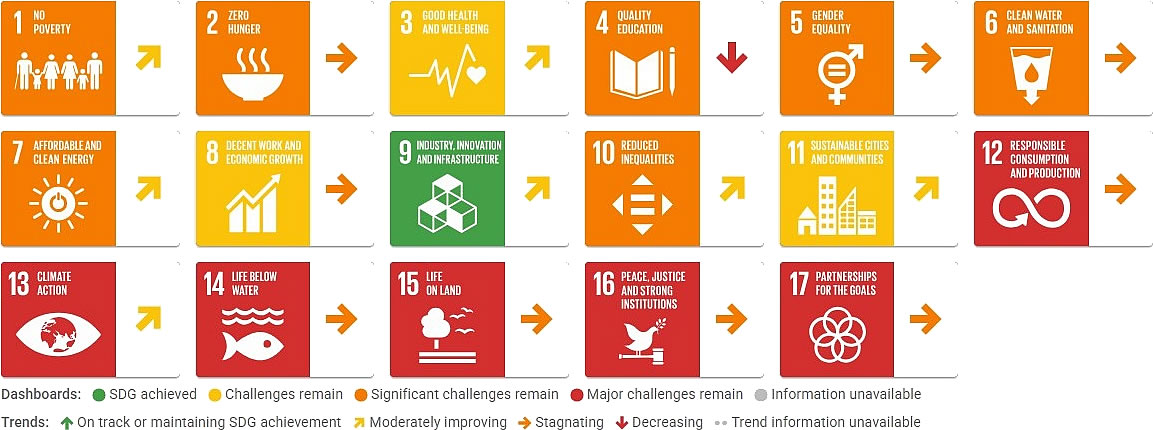
Beyond the headline score, the 17 individual goal scores show a country doing well domestically on some fronts and struggling on others.
Israel’s strongest scores sit in Goal 9, Industry, Innovation and Infrastructure (96.3, the only goal rated green), Goal 1, No Poverty (97.9), and Goal 4, Quality Education (96.9, though this indicator is trending downward).
Its weakest score by a wide margin is Goal 15, Life on Land, at just 23.9 out of 100, the lowest of any goal and rated red. Goal 14, Life Below Water, follows at 38.3, also red. Goals 12 (Responsible Consumption), 16 (Peace, Justice and Strong Institutions), and 17 (Partnerships for the Goals) all rate red as well, each scoring below 68.
Four goals show a declining trend, most notably Goal 4 on education. Six show clear improvement, including Goal 1 on poverty and Goal 13 on climate action, even though Goal 13 itself still carries a red rating overall.
UNDP
Human Development Index: A Third Lens
A third measure adds more texture to this picture: the Human Development Index (HDI), published annually by the UN Development Programme. Unlike the SDG Index, the HDI ignores GDP entirely. It measures only three things: how long people live, how educated they are, and how much income they earn.
By that measure, Israel looks strong. It ranks 27th out of 193 countries, with an HDI score of 0.919, comfortably inside the “very high human development” tier.
Adjust for inequality, and the picture shifts. The Inequality-adjusted HDI (IHDI) discounts a country’s score based on how unevenly its gains are shared. Israel’s score drops to 0.813, a fall to 37th place, an 11.5% loss due to inequality in health, education, and income distribution.
That is a smaller drop than the United States sees on the same adjustment (11.3% loss, though the US falls further in rank terms due to a stronger group of near-neighbours). It is still a larger loss than most Western European peers, such as Slovenia (4.9%) or Denmark (5.5%), post.
The SDG Index and the HDI measure different things, and it helps to know how. Read our full explainer: Human Development Report vs SDGs — What’s the Difference?
Why These Numbers Matter
These pages matter more than their topic suggests on the surface. The SDGs are, in effect, the world’s working roadmap for its biggest shared problems, yet most citizens have never engaged with them directly. A Voluntary Local Review can change that at the scale where it’s most achievable: one city, one community, people who might otherwise never cross paths brought into the same conversation about what their home needs most.
RYB’s Place in This Picture
RYB tracks VNRs, VLRs, spillover scores, and the HDI together because they reveal different layers of accountability: national, local, and global impact, plus how evenly a country’s own success is shared. Israel’s case shows a country strong on some individual goals and international tax transparency, but weak on the spillover effects its economy has on the rest of the world, and largely quiet on formal SDG reporting since 2019.
Looking Forward
Watch whether Israel files a second VNR before 2030, given that seven years have now passed since its first and only submission. Watch, too, whether any Israeli city moves from informal SDG mapping, like the Healthy Cities Network’s work, toward a formal Voluntary Local Review recognised by the UN system.
On the numbers themselves, the widest gap to close sits in Goal 15, Life on Land, currently the lowest-scoring goal in Israel’s entire profile. Multilateral engagement and ODA levels also have the most room to improve among the spillover indicators, both currently scoring at the floor of the index.
Sources
- Israel Sustainable Development Report 2026 — dashboards.sdgindex.org
- Sustainable Development Report 2026 (full report, SDSN / Dublin University Press) — s3.amazonaws.com
- The Sustainable Development Goals Report 2026, UN DESA — unstats.un.org
- Israel Voluntary National Review 2019, UN HLPF — hlpf.un.org
- Voluntary National Reviews, HLPF 2026 (list of 36 presenting countries) — hlpf.un.org
- “Implementation of the UN’s SDGs among the Member Cities of the Healthy Cities Network in Israel,” Sustainability, 2024 — doi.org/10.3390/su16010310
- Sustainable Development Report 2024, Israel Policy Efforts (UN-Mi 2024 ranking) — dashboards.sdgindex.org
- Human Development Report 2025, Statistical Annex — hdr.undp.org
List of countries by inequality-adjusted Human Development Index (IHDI 2023 data) — en.wikipedia.org - Human Development Index, UNDP — hdr.undp.org
- RYB: Human Development Report vs SDGs — What’s the Difference? — redyellowblue.org