

Switzerland Sustainable Development Goals (SDGs)
22
SDG Index rank, out of 169 countries
80.32
SDG Index score, out of 100
166
Spillover rank, out of 169 countries
42.08
Spillover score, out of 100
Source: Sustainable Development Report 2026, SDSN / Dublin University Press
Most people have never heard of the Sustainable Development Goals in any real detail. Surveys across the US, UK, France, and Germany find only 8–12% of people can actually say what the SDGs are. RYB exists to close that gap, looking at the same reports and reviews the UN and researchers use, and explaining them as we go.
Switzerland’s Corporate Tax Haven Score is 89 out of 100, the highest, meaning the worst, RYB has recorded for any country on this site so far. Its multinationals shifted an estimated $94.6 billion in profits in the latest year measured, the second-largest figure RYB has seen after only the Netherlands. Both are real, directly measured figures, not the imputed defaults that show up for countries the underlying index doesn’t track closely. Switzerland ranks 22nd out of 169 overall, a strong domestic position, but 166th out of 169 on spillovers, second only to the Netherlands for the weakest spillover rank RYB has recorded.
Switzerland — Sustainable Development Report 2026
CH
Voluntary National Reviews: A Government That Names Its Own Contradiction
Switzerland submitted its first Voluntary National Review at the 2018 HLPF, one of the countries that helped design the VNR process itself. That first review included an unusually direct admission for a government report: it stated plainly that while Switzerland’s domestic resource consumption was decreasing, “use of resources from abroad is increasing in an unsustainable way,” naming the exact pattern that shows up in its spillover score years later.
Switzerland’s third VNR followed in 2022, built on a 2018-2022 baseline assessment prepared by the Federal Department of Foreign Affairs. Its fourth VNR was presented at the High-Level Political Forum on July 13, 2026, the same day as Italy’s third review, continuing one of the more consistent reporting records RYB has covered.
Voluntary Local Reviews: Four Firsts in a Single Season
Switzerland’s local reporting arrived all at once. At the UNECE Regional Forum in Geneva in April 2026, Switzerland presented the first Voluntary Local Reviews from four jurisdictions simultaneously: the cities of Geneva, Bern, and Basel, and the canton of Aargau. Markus Reubi, the Federal Council’s Delegate for the 2030 Agenda, framed the moment plainly: “Implementing the goals requires the cooperation of all state and non-state actors.” Four VLRs from one country in one season is more than most countries RYB has covered have produced in total.

What the Sustainable Development Report Shows: Domestic Strength, the Weakest Spillover Score RYB Has Recorded
The Sustainable Development Report scores every country two ways. The overall score measures how well a country is doing for its own people. The spillover score measures how much harm a country’s economy causes everyone else.
Switzerland’s overall score sits at 80.32 out of 100, ranking 22nd out of 169 countries. Its spillover score sits at just 42.08 out of 100, translating to a rank of 166th, the lowest spillover score of any country RYB has covered, and the second-weakest spillover rank after the Netherlands’ 167th.
Why Switzerland’s Spillover Score Is So Weak
- Corporate Tax Haven Score: 89 out of 100. Worse than the UK’s 86.25, the Netherlands’ 72.3, Poland’s 54, and Italy’s 48, the highest, meaning worst, figure RYB has recorded for any country covered so far.
- Shifted profits of multinationals: $94.6 billion. Second only to the Netherlands’ $166.8 billion, and higher than the UK’s $89.2 billion.
- Financial Secrecy Score: 75 out of 100, a separate but related measure of how easily the country’s financial system can obscure the ultimate ownership of assets.
- Plastic waste exports: 9.82 kg per capita, higher than Poland (3.885 kg) or Italy (3.654 kg), though still well below the Netherlands’ 30.162 kg.
What makes Switzerland’s case distinctive is what isn’t driving the weak score. Its weapons exports, 1.106 TIV per 100,000 people, sit in the middle of the range RYB has recorded, and its support for UN-based multilateralism, 77.68 out of 100, is genuinely strong, ahead of the Netherlands (67.6) and well ahead of the UK (54.9). Switzerland’s spillover problem is close to entirely a financial one.
Where the Work Remains
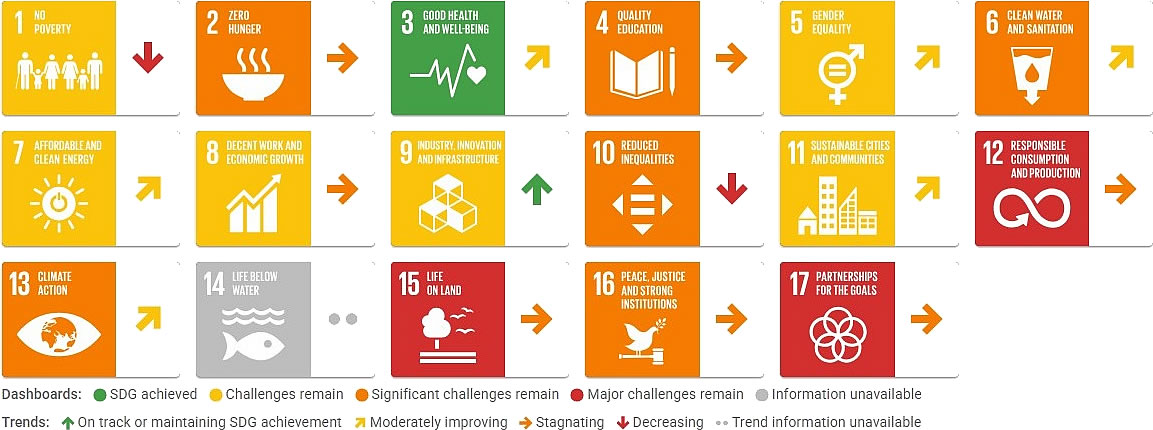
By almost every domestic measure, Switzerland performs near the top of every country RYB has covered. Its Corruption Perceptions Index score, 80 out of 100, and Statistical Performance Index, 88.7 out of 100, are both among the strongest recorded. Its poverty headcount ratio at $3.00 a day, 0.14%, is the lowest RYB has seen. On the dashboard, Good Health and Well-Being (SDG 3) is the sole green rating, while Responsible Consumption and Production (SDG 12), Life on Land (SDG 15), and Partnerships for the Goals (SDG 17), the goal that captures most of the financial-spillover indicators above, all rate the dashboard’s worst color, red. No Poverty (SDG 1) and Reduced Inequalities (SDG 10) are both currently trending backward, an unusual pairing for a country this wealthy.
Switzerland’s spillover rank sits alongside every other country RYB tracks on the Global Responsibility page, where rankings like these are shown together across all the countries covered on this site.
Why These Numbers Matter
These pages matter more than their topic suggests on the surface. The SDGs are, in effect, the world’s working roadmap for its biggest shared problems, yet most citizens have never engaged with them directly. A Voluntary Local Review can change that at the scale where it’s most achievable: one city, one community, people who might otherwise never cross paths brought into the same conversation about what their home needs most.
Culture and the arts barely feature in Switzerland’s VNRs, or in its four new VLRs, understandably focused on establishing local monitoring for the first time. RYB tracks Switzerland because a Culture of Peace lens has genuine room to connect a country long associated with international diplomacy and humanitarian law to a development framework its own financial sector complicates.
RYB’s Place in This Picture
RYB tracks Switzerland because it’s the cleanest test yet of a question this site keeps returning to: whether being a well-governed country domestically says anything about the harm a country’s economy causes elsewhere. Switzerland’s own 2018 VNR answered that question honestly, years before the data caught up to confirm it.
Looking Forward
Watch the details of Switzerland’s July 2026 VNR as the full report becomes available, and whether it addresses the country’s weak spillover position as directly as its 2018 predecessor did. Watch the SDG 1 and SDG 10 trends specifically, both currently moving backward. And watch whether Geneva, Bern, Basel, and Aargau’s first VLRs are followed by more Swiss cities and cantons.
UNDP
Human Development Report — Switzerland
The Human Development Index measures something narrower and older than the SDGs: life expectancy, education, and income, combined into a single score, with no 2030 deadline attached. It is a different lens on the same country, worth reading alongside the SDG data above rather than instead of it.
Switzerland’s HDI reached 0.970 in 2023, tied with Norway for the second-highest in the world, behind only Iceland’s 0.972, and by far the highest HDI of any country RYB has covered on this site so far, ahead of Italy’s 0.915. “Very high human development” barely describes the gap: Switzerland sits closer to the very top of the global ranking than to the “very high” tier’s own cutoff.
Switzerland’s Human Development Index data →
What is the difference between the HDI and the SDGs? →
Sources
- SDG Index database, Sustainable Development Report 2026 — Fuller, G., Iablonovski, G., Lafortune, G. and Sachs, J.D. (2026), SDSN / Dublin University Press, DOI:10.82163/225
- Sustainable Development Report 2026, Switzerland profile — dashboards.sdgindex.org
- Voluntary National Review 2018, Switzerland — hlpf.un.org
- Voluntary National Review 2022, Switzerland — hlpf.un.org
- UN Compiles Main Messages from 2026 VNRs Ahead of HLPF, SDG Knowledge Hub — sdg.iisd.org
- Switzerland and the 2030 Agenda: SDG implementation, strategy and ESG implications, Generation Impact Global — generationimpact.global
- Human Development Report 2025, Statistical Annex — hdr.undp.org