

Italy Sustainable Development Goals (SDGs)
26
SDG Index rank, out of 169 countries
79.91
SDG Index score, out of 100
135
Spillover rank, out of 169 countries
69.08
Spillover score, out of 100
Source: Sustainable Development Report 2026, SDSN / Dublin University Press
Most people have never heard of the Sustainable Development Goals in any real detail. Surveys across the US, UK, France, and Germany find only 8–12% of people can actually say what the SDGs are. RYB exists to close that gap, looking at the same reports and reviews the UN and researchers use, and explaining them as we go.
Italy presented its third Voluntary National Review at the High-Level Political Forum on July 13, 2026, alongside Cabo Verde and Senegal, just weeks before this page was written. Its SDG Index numbers, a solid 26th out of 169 overall, sit at odds with its spillover position: 135th, the weakest spillover rank RYB has recorded for any country on this site so far, behind even Poland’s 127th.
Italy — Sustainable Development Report 2026
IT
Voluntary National Reviews: Three Reviews, Local Governments Built In From the Start
Italy presented its first Voluntary National Review in 2017 and its second in 2022, a year-long process explicitly built around multilevel governance, coordinating regions, autonomous provinces, and metropolitan cities directly into the national reporting structure rather than treating SDG progress as a purely national-government exercise. The 2022 review also reaffirmed the 2030 Agenda in direct response to Russia’s invasion of Ukraine, stating plainly that “there can be no sustainable development without peace and no peace without sustainable development.”
Italy’s third VNR, presented on July 13, 2026 as one of 36 countries reviewing that year, reaffirmed a focus on “innovations in governance, policymaking, and impact assessment” alongside international partnerships, continuing a reporting rhythm few countries RYB has covered have matched this consistently.
Voluntary Local Reviews: Built Into the National Process, Not Separate From It
Unlike most countries RYB has covered, Italy doesn’t treat Voluntary Local Reviews as a separate track from its national reporting. Its VNRs explicitly incorporate VLRs prepared by regional and metropolitan authorities cooperating directly with central government. The Lombardy Region, home to Milan, published its own Voluntary Local Review in 2022, developed jointly with the Metropolitan City of Milan and folded directly into that year’s national submission, a genuinely collaborative model rather than the parallel or absent local reporting seen in most countries covered on this site so far.

What the Sustainable Development Report Shows: A Solid Score, the Weakest Spillover Rank RYB Has Recorded
The Sustainable Development Report scores every country two ways. The overall score measures how well a country is doing for its own people. The spillover score measures how much harm a country’s economy causes everyone else.
Italy’s overall score sits at 79.91 out of 100, ranking 26th out of 169 countries. Its spillover score sits at 69.08 out of 100, translating to a rank of 135th, the weakest spillover position of any country RYB has covered on this site, past even Poland’s 127th.
Why Italy’s Spillover Score Is So Weak
- Weapons exports are the second-highest RYB has recorded. At 2.675 TIV per 100,000 people, Italy’s figure trails only the US’s 3.773, and sits well above the Netherlands’ 2.15, the UK’s 1.553, and Poland’s 0.747.
- Plastic waste exports run above most of the countries RYB has covered. At 3.654 kg per capita, Italy’s figure is close to Poland’s 3.885 kg, well above Bulgaria’s 2.507 kg or Bosnia and Herzegovina’s 0.905 kg, though still far below the Netherlands’ 30.162 kg.
- Tax architecture is a moderate concern. Italy’s Corporate Tax Haven Score sits at 48 out of 100, close to Poland’s 54, worse than Brazil’s 38, though still better than the Netherlands’ 72.3 or the UK’s 86.25.
Where the Work Remains
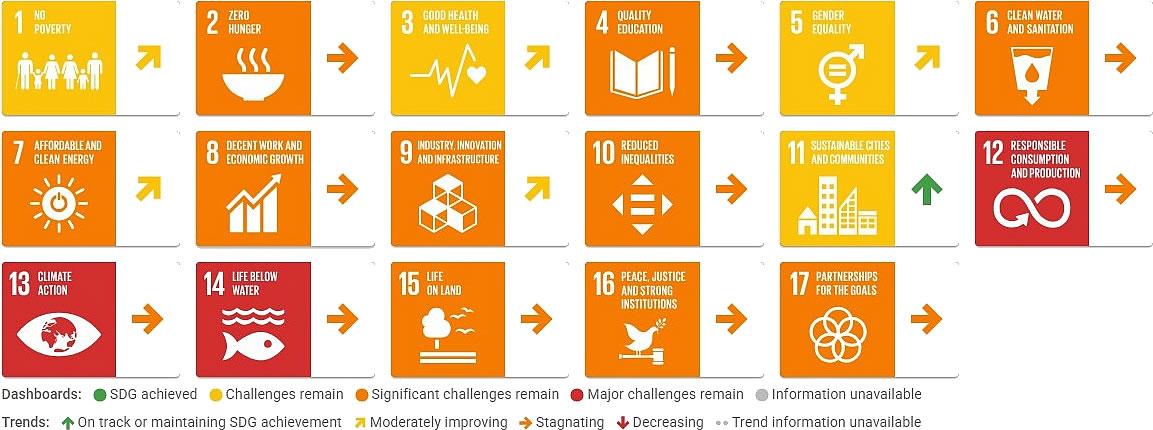
Italy’s Statistical Performance Index sits at 90.9 out of 100, essentially tied with Poland’s 91.1 for the strongest RYB has recorded, and its Corruption Perceptions Index score, 53 out of 100, matches Poland’s too. The dashboard’s real weak points are environmental: Responsible Consumption and Production (SDG 12), Climate Action (SDG 13), and Life Below Water (SDG 14) all rate the dashboard’s worst color, red, and no goal on Italy’s dashboard rates green at all. Sustainable Cities and Communities (SDG 11) is the one bright spot trending in the right direction, rated “on track” rather than merely improving.
Italy’s spillover rank sits alongside every other country RYB tracks on the Global Responsibility page, where rankings like these are shown together across all the countries covered on this site.
Why These Numbers Matter
These pages matter more than their topic suggests on the surface. The SDGs are, in effect, the world’s working roadmap for its biggest shared problems, yet most citizens have never engaged with them directly. A Voluntary Local Review can change that at the scale where it’s most achievable: one city, one community, people who might otherwise never cross paths brought into the same conversation about what their home needs most.
Culture and the arts barely feature in Italy’s VNRs, despite a country whose cultural heritage is arguably its most globally recognized asset. RYB tracks Italy because a Culture of Peace lens has real room to connect that heritage to the SDG framework in a way Italy’s own reporting hasn’t yet done.
RYB’s Place in This Picture
RYB tracks Italy because it’s the clearest case yet of a country whose domestic strength and international footprint move in completely opposite directions. A top-30 overall rank, the strongest statistical capacity RYB has recorded, and still the single weakest spillover rank on this site. Italy’s numbers argue that being a well-governed, well-measured country domestically carries no guarantee about the harm that same economy causes elsewhere.
Looking Forward
Watch the details of Italy’s July 2026 VNR as the full report becomes available, particularly whether it engages directly with the country’s weak spillover position. Watch the SDG 12, 13, and 14 trends specifically, the three goals currently rated red on Italy’s dashboard. And watch whether more Italian regions follow Lombardy’s lead in producing VLRs folded directly into future national reviews.
UNDP
Human Development Report — Italy
The Human Development Index measures something narrower and older than the SDGs: life expectancy, education, and income, combined into a single score, with no 2030 deadline attached. It is a different lens on the same country, worth reading alongside the SDG data above rather than instead of it.
Italy’s HDI reached 0.915 in 2023, up from 0.906 the year before, its highest level on record, and ranks 29th out of 193 countries, “very high human development.” Adjusted for inequality, Italy’s IHDI falls to 0.817, ranking 35th, worth reading in full on UNDP’s own page. A separate EU measure worth noting alongside it: 23.1% of Italy’s population was at risk of poverty or social exclusion in 2024, a considerably larger share than the 9.4% figure captured by the income-only poverty line alone.
Italy’s Human Development Index data →
What is the difference between the HDI and the SDGs? →
Sources
- SDG Index database, Sustainable Development Report 2026 — Fuller, G., Iablonovski, G., Lafortune, G. and Sachs, J.D. (2026), SDSN / Dublin University Press, DOI:10.82163/225
- Sustainable Development Report 2026, Italy profile — dashboards.sdgindex.org
- Voluntary National Review 2022, Italy — hlpf.un.org
- 36 Countries to Present VNRs at HLPF 2026, SDG Knowledge Hub — sdg.iisd.org
- UN Compiles Main Messages from 2026 VNRs Ahead of HLPF, SDG Knowledge Hub — sdg.iisd.org
- Voluntary Local Review of Lombardy 2022 — sdgs.un.org
- Human Development Report 2025, Statistical Annex — hdr.undp.org
- Economy of Italy, background reference — en.wikipedia.org