

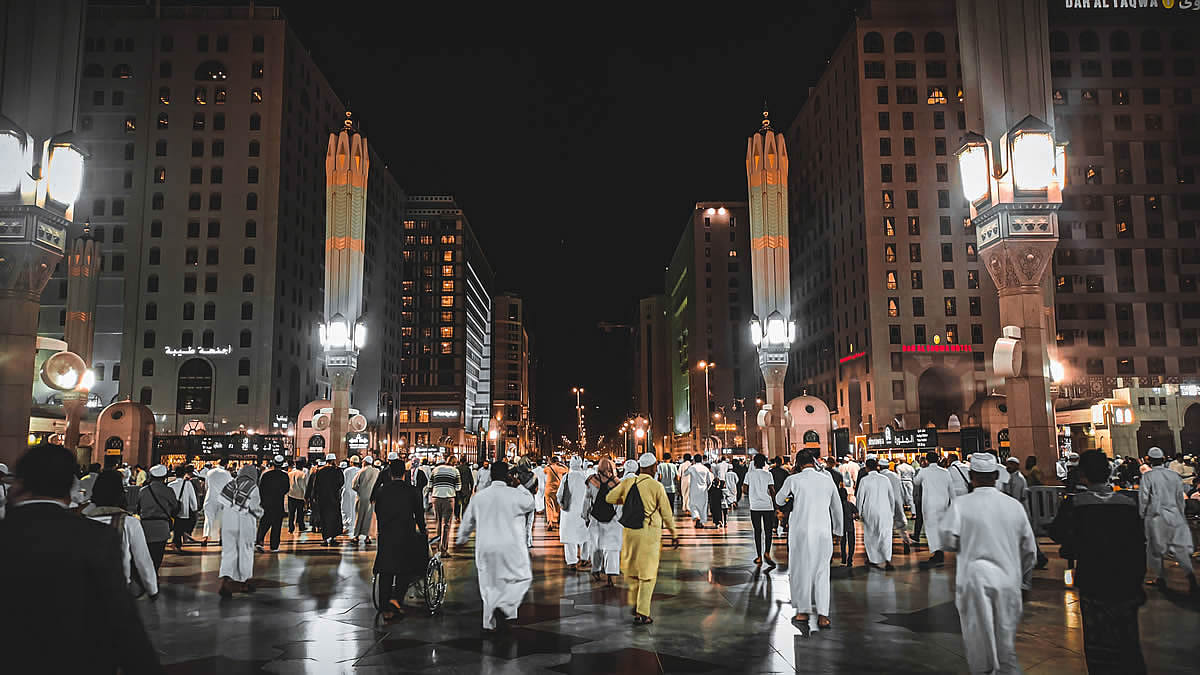
A busy street in Medina, Saudi Arabia, filled with people under illuminated city lights at night. Photo: Gun Tfk
Gender Gap Saudi Arabia — The World's Fastest-Improving Economy Also Has Zero Women in Cabinet
SA
The World Economic Forum's 2026 report names Saudi Arabia the strongest-improving high-income economy on gender parity since 2006. The same report lists it as one of only four countries anywhere with no women in ministerial positions at all.
Gender Gap Saudi Arabia — Two Numbers That Don’t Fit Together
Saudi Arabia is a genuinely strange case for this index. On the World Economic Forum’s 2026 Global Gender Gap Report, it ranks 137th of 145 countries, near the very bottom. It’s also, by the same report’s own analysis, the high-income economy that has closed its gender gap fastest of any since the index began in 2006, faster than any wealthy country in the world over that span. Both statements are true at once, and the gap between them is the story this page tracks.
The short version: economic and educational progress has been real and startlingly fast. Political power hasn’t moved at all. Saudi Arabia currently has zero women in ministerial positions, one of only four countries anywhere in the 2026 index, alongside Hungary, the United Arab Emirates, and Vanuatu, where that’s true.
This page follows the same structure as Gender Gap Netherlands and Gender Gap Indonesia: pay, power, safety, and education, each checked against the relevant UN target. As a non-European country, this page draws on Saudi Arabia’s General Authority for Statistics (GASTAT), the Human Rights Commission of Saudi Arabia, and independent research bodies, alongside the WEF’s Global Gender Gap Report.
Pay — SDG Target 5.4
By raw numbers, this is Saudi Arabia’s genuine good-news story. Female labor force participation has nearly doubled in under a decade, from roughly 17-22% in 2016 to 36.2% by early 2025, according to GASTAT, one of the sharpest such gains recorded anywhere in the world over that period. Vision 2030’s original target of 30% participation was met five years ahead of schedule, in 2021. Female unemployment has fallen to a historic low of 10.5%, and women now own an estimated 42-45% of the country’s small and medium businesses.
The drivers are specific and traceable: lifting the driving ban in 2018 removed a hard logistical barrier to holding a job at all; guardianship reforms in 2019 let women travel and register businesses independently for the first time; and new labor-law protections extended maternity leave and required employer-provided childcare above a certain company size. Despite all that, Economic Participation and Opportunity remains the widest gap in Saudi Arabia’s own WEF subindex scores, meaning the starting point was so low that even this pace of progress hasn’t closed the gap, only narrowed how wide it is.
Power — SDG Target 5.5 and SDG 16.7
This is where the “fastest-improving economy” framing breaks down entirely. Saudi Arabia has zero women in ministerial positions as of the 2026 WEF report, tied for last place globally with Hungary, the UAE, and Vanuatu. The Shura Council, the country’s only national consultative body, is appointed by the king rather than elected, and even there, women hold roughly 20% of seats, a ceiling set by royal decree in 2013 that hasn’t moved since. Saudi Arabia has never held a national election of any kind, for anyone. Municipal councils are the only elected bodies that exist at all, and Saudi women have voted in exactly one election, ever, held on December 12, 2015. No municipal elections, for men or women, have been held since.
The result is that Saudi Arabia’s Political Empowerment subindex score sits near the very bottom of the WEF’s 145-country ranking, worse than every other country in the Gulf except Oman and Qatar. It’s the specific dimension dragging the country’s overall rank down to 137th, even as its economic and educational scores climb.
Safety — SDG Target 5.2 and SDG 16.1
Domestic violence wasn’t formally criminalized in Saudi Arabia until 2013, following a viral national awareness campaign. Since then, estimates of how many women experience it vary widely by study, from about 19% to 57%, reflecting both real regional differences and how hard the topic is to survey reliably. One structural fact stands out across nearly every study: an estimated 90% of abusers are the woman’s own legal guardian, typically a father, husband, or brother, the same person she would often need permission from, or accompaniment by, to report the abuse in the first place.
A 2025 Guardian investigation added a darker dimension largely absent from official statistics: Dar al-Reaya, a network of state-run “care” facilities that function, according to former residents and staff interviewed, more like detention centers for women and girls sent there, often by their own guardians, for behavior labeled “disobedient,” including refusing an arranged marriage or attempting to leave home. Saudi Arabia’s Human Rights Commission has itself acknowledged that reported domestic violence rates have risen in recent years, even as the country’s official messaging emphasizes reform.
Education — Near Parity, With Nowhere Obvious to Go
Education is Saudi Arabia’s strongest dimension by a wide margin: the Educational Attainment subindex sits close to 97%, near-total parity, and Saudi women now outnumber men in university enrollment. Roughly 77% of Saudi women over 25 have completed secondary education.
What makes this dimension unusual on this page is that it isn’t feeding into the others the way it does almost everywhere else in the world. In most countries covered by this index, closing the education gap is the clearest predictor of closing the pay and power gaps that follow it a decade or two later. In Saudi Arabia, the education gap closed years ago, and the workforce gap is closing quickly behind it, but the power gap hasn’t moved even slightly. A highly educated population of women with growing economic independence still has no seat, formally, in how the country is governed.
RYB’s Place in This Picture
RYB doesn’t run GASTAT’s labor surveys, the WEF’s index, or the Human Rights Commission’s reporting. Those bodies, and the independent researchers and journalists cited throughout this page, do that work directly, some of it, like the Dar al-Reaya reporting, at real professional risk. What RYB does is connect it to the same global framework used everywhere else on this site. The SDGs Saudi Arabia page tracks the country against all seventeen UN goals; Culture Women’s Day Saudi Arabia covers the political history behind the Power section above in full.
World Economic Forum
Global Gender Gap Report Saudi Arabia
The Global Gender Gap Report benchmarks countries on their progress towards gender parity across four thematic dimensions: Economic Participation and Opportunity, Educational Attainment, Health and Survival, and Political Empowerment.
2026
Rank: 137 (out of 145 countries)
Score: 0.633
› report
General Authority for Statistics (GASTAT), Human Rights Commission of Saudi Arabia
National Data — Saudi Arabia
GASTAT’s quarterly Labor Market Bulletin and the Human Rights Commission’s public reporting are the primary national sources for the Pay and Safety sections above.
› stats.gov.sa
› hrc.gov.sa
Looking Forward
Saudi Arabia doesn’t fit the usual shape of a country closing its gender gap. Most countries on this calendar move on some combination of all four dimensions at once, unevenly, but together. Saudi Arabia is moving on three and standing still on the fourth, and the fourth happens to be the one that determines who actually decides what happens next.
That’s worth sitting with rather than resolving into a single number. A country can be the world’s fastest-improving high-income economy on gender parity and still have no woman in its cabinet, no national election for anyone, and a domestic violence system where the person a woman would report abuse to is, nine times in ten, the same person abusing her. Real progress and a frozen ceiling are both true here, at the same time, and neither cancels the other out.
Sources and Links
- Global Gender Gap Report 2026 — World Economic Forum | weforum.org
- Saudi Arabia Among Fastest-Improving Economies on Gender Parity: WEF — Arab News | arabnews.com
- Progress in the Saudi Labor Market — Ministry of Human Resources and Social Development | hrsd.gov.sa
- Vision 2030 Has Done Wonders for Women. But There’s Still Room to Enhance Their Economic Roles — Atlantic Council | atlanticcouncil.org
- Domestic Violence in Saudi Arabia — Wikipedia | en.wikipedia.org
- Domestic Violence Against Women in Saudi Arabia: A Persistent Dilemma Amidst Claims of Reform — Arab Reform Initiative | arab-reform.net
- Revealed: Saudi Arabia’s Secretive Rehabilitation “Prisons” for Disobedient Women — The Guardian | theguardian.com
- Systematic Review: Domestic Violence Against Women and Men and Childhood Maltreatment in Saudi Arabia — Journal of Social Service Research | tandfonline.com
- Experts Ask About Progress in Abolishing the Male Guardianship System — UN Office at Geneva, CEDAW Committee | ungeneva.org
- Women’s Rights in Saudi Arabia — Wikipedia | en.wikipedia.org
- Women Count Data Hub: Saudi Arabia — UN Women | data.unwomen.org
- SDGs Saudi Arabia — RYB Global Development | redyellowblue.org/data/sa/sdgs/
- Culture Women’s Day Saudi Arabia — RYB Global Development | redyellowblue.org/data/sa/wdsa/