

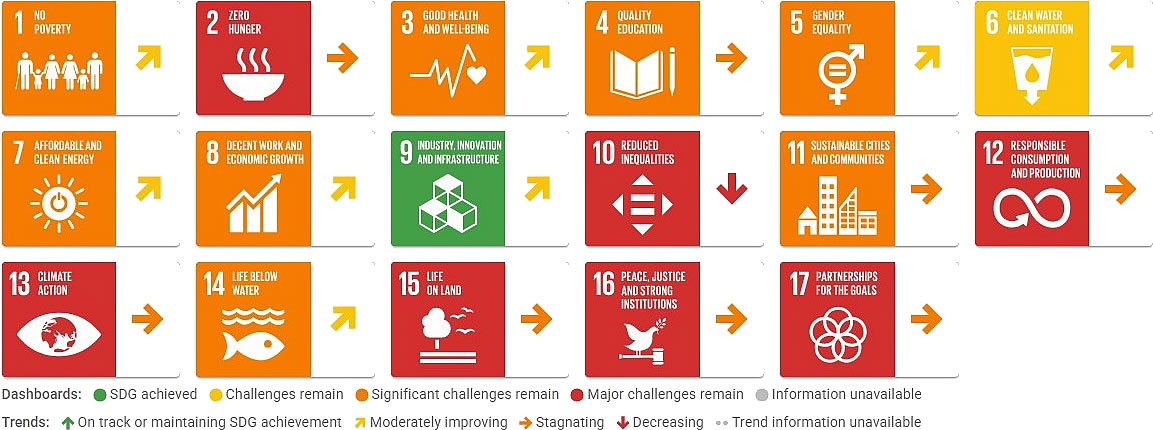
United States Sustainable Development Goals (SDGs)
45
SDG Index Rank, out of 169 countries
75.3
SDG Index Score, out of 100
154
Spillover Rank, out of 169 countries
61.3
Spillover score, out of 100
Source: Sustainable Development Report 2026, SDSN / Cambridge University Press
Most people have never heard of the Sustainable Development Goals in any real detail. Surveys across the US, UK, France, and Germany find only 8–12% of people can actually say what the SDGs are. RYB exists to close that gap, looking at the same reports and reviews the UN and researchers use, and explaining them as we go.
Three countries have never reported their progress on the SDGs to the UN. One is recovering from a devastating earthquake. One is under military rule. The third is the United States.
United States — Sustainable Development Goals Report 2026
US
Voluntary National Reviews: What They Are, and Why the US Has Skipped Every One
A Voluntary National Review (VNR) is how a country tells the world how it’s doing on the SDGs. Countries present these reviews at the UN’s High-Level Political Forum every July. It isn’t mandatory. It is, by now, nearly universal: since 2016, more than 440 VNRs have been submitted worldwide.
As of mid-2026, the United States remains one of only three UN member states that has never submitted one, alongside Haiti and Myanmar. The Sustainable Development Report confirms this directly: zero VNRs completed between 2016 and 2025.
The US does maintain its own federal SDG data effort, at sdg.data.gov. Even the US government labels it plainly: an “Alpha,” a development website still being built. It’s a fitting symbol for where US national-level SDG reporting stands.
→ See the US fact sheet on the Sustainable Development Report.

Voluntary Local Reviews: Where the Real Story Is
While the federal government has stayed silent, American cities have done something unexpected. They built one of the world’s most active local SDG reporting movements, almost entirely without Washington.
New York City started it. In 2018, NYC became the first city anywhere to report its own SDG progress directly to the UN, a format it invented and named the Voluntary Local Review (VLR). It has since published reviews in 2018, 2019, and 2025.
Other cities followed fast. Los Angeles released its first VLR in 2019, becoming the sixth city in the world to do so, and its second in 2021. Orlando and Pittsburgh built their own reviews soon after. San Diego launched its first in 2025. The State of Hawaii became the first US state to complete one. Sacramento took a different route entirely, partnering with UC Davis researchers to build its 2024 review around the city’s General Plan.
At least seven distinct US governments, cities and one state, have now reported directly to the UN on their own initiative. None waited for federal leadership to do it.
What the Sustainable Development Report Shows: Two Very Different Scores
The Sustainable Development Report scores every country two ways. The overall score measures how well a country is doing for its own people. The spillover score measures how much harm a country’s economy causes everyone else.
The US overall score sits at 75.3 out of 100, ranking 45th out of 169 countries, a solid, if unremarkable, mid-pack result for one of the world’s richest economies. The US spillover score sits at 61.3 out of 100, ranking 154th, close to the bottom of the table. The gap between these two rankings, 45th overall but 154th on spillovers, is the real story.
Why the Spillover Score Lags So Far Behind
- Conventional weapons exports rate red, the worst possible score. The US normalized score on this indicator is 0 out of 100, even though its raw export volume (3.773 TIV per 100,000 people) sits below the UK’s.
- Plastic waste exports rate only yellow. At 1.254 kg per capita, this is better than the UK or Netherlands, but still well behind Brazil’s near-perfect score.
- Tax and financial secrecy drag the score down. The Corporate Tax Haven Score sits at 45 out of 100; the Financial Secrecy Score sits at 70.8.
- Multilateral cooperation scores lowest of all. The US Index of countries’ support to UN-based multilateralism sits at just 1.7 out of 100. The US has ranked last on this measure since it was introduced in 2023.
None of these numbers describe pollution or instability happening on US soil. They describe environmental, security, and financial costs the US economy generates, that land somewhere else.
RYB’s Brazil SDGs page shows just how far this can be improved. Brazil’s multilateralism score, 81.6, is roughly 48 times higher than the US figure on the same indicator. Brazil ranks lower overall, 53rd against the US’s 45th, but its spillover rank, 6th in the world, isn’t close to comparable.
A System the US Is Actively Stepping Away From
This isn’t just a scoring problem. It’s matched by real, recent policy action. In 2025, the US federal government declared open opposition to the SDGs and the 2030 Agenda. In January 2026, it withdrew from more than 60 international organizations, alongside major treaties including the Paris Climate Agreement. It also walked away from negotiations at the UN’s Financing for Sustainable Development summit in Seville in June 2025.
The pattern shows up in how the US votes, too. In 2025, the US voted with the international majority on just 5% of recorded UN General Assembly resolutions.
UNDP
Human Development Index: A Third Lens
A third measure adds more texture to this picture: the Human Development Index (HDI), published annually by the UN Development Programme. Unlike the SDG Index, the HDI ignores GDP entirely. It measures only three things: how long people live, how educated they are, and how much income they earn.
By that measure, the US looks strong. It ranks 18th out of 193 countries, with an HDI score of 0.938, comfortably inside the “very high human development” tier.
Adjust for inequality, and the picture changes fast. The Inequality-adjusted HDI (IHDI) discounts a country’s score based on how unevenly its gains are shared. The US score drops to 0.832, a fall to 29th place, an 11.3% loss, the single largest inequality discount of any country in the HDI’s top 20.
The US falls behind South Korea, Japan, and France once this adjustment is applied, three countries that rank lower on the raw HDI but spread their development gains more evenly. The UNDP attributes the American loss to disparities running along racial, geographic, and income lines.
This is the same pattern the spillover score reveals, seen through a different lens. The headline number looks good. The moment you measure how evenly that success is shared, at home or abroad, the US ranking falls sharply.
Why These Numbers Matter
These pages matter more than their topic suggests on the surface. The SDGs are, in effect, the world’s working roadmap for its biggest shared problems, yet most citizens have never engaged with them directly. A Voluntary Local Review can change that at the scale where it’s most achievable: one city, one community, people who might otherwise never cross paths brought into the same conversation about what their home needs most.
RYB’s Place in This Picture
RYB tracks VNRs, VLRs, spillover scores, and the HDI together because they reveal different layers of accountability: national, local, and global impact, plus how evenly a country’s own success is shared. The US case is unusual on every layer at once. National accountability has stopped almost entirely, while city-level accountability keeps growing, almost as if filling a vacuum the federal government left behind.
Looking Forward
Watch whether more US cities join the VLR movement, now that San Diego and Sacramento have shown smaller, less internationally connected cities can do this too. And watch the 2027 SDR edition closely, to see whether the gap between the US’s mid-table overall rank and its bottom-tier spillover rank narrows or widens.
Sources
- United States Fact Sheet, Sustainable Development Report 2026 — dashboards.sdgindex.org
- US Government SDG Data Portal — sdg.data.gov
- Europe Sustainable Development Report 2026, Chapter 1 — eu-dashboards.sdgindex.org
- Voluntary Local Review, City of Los Angeles — sdg.lacity.gov
- Voluntary Local Review, New York City Mayor’s Office for International Affairs — nyc.gov
- City of Sacramento Voluntary Local Review on the SDGs, UC Davis Global Affairs — globalaffairs.ucdavis.edu
- San Diego to Launch its First Voluntary Local Review, ICLEI USA — icleiusa.org
- HDI By Country, Inequality-Adjusted Rankings — datapandas.org
- Human Development Index, UNDP — hdr.undp.org