
Finland Sustainable Development Goals (SDGs)
1
SDG Index Rank, out of 169 countries
87.4
SDG Index Score, out of 100
144
Spillover Rank, out of 169 countries
66.9
Spillover Score, out of 100
Source: Sustainable Development Report 2026, SDSN / Dublin University Press
Most people have never heard of the Sustainable Development Goals in any real detail. Surveys across the US, UK, France, and Germany find only 8–12% of people can actually say what the SDGs are. RYB exists to close that gap, looking at the same reports and reviews the UN and researchers use, and explaining them as we go.
Finland is no longer just a committed advocate for the United Nations Sustainable Development Goals. It is the country other nations are now measured against. The 2026 Sustainable Development Report places Finland at the very top of the global rankings, alongside Sweden and Denmark.
But the full picture has a real asterisk attached, one worth stating plainly rather than burying: Finland’s spillover rank, 144th out of 169, is genuinely weak for a country leading the overall table. The world’s top-ranked country on the SDGs is, on this second measure, closer to the bottom third of all nations. That contradiction is the most honest thing this page can say about Finland.
Finland — Sustainable Development Report 2026
FI
Finland and the Push for a Culture Goal
In September 2025, ministers of culture from across the globe gathered in Barcelona for MONDIACULT 2025, UNESCO’s World Conference on Cultural Policies and Sustainable Development. The conference closed with a Final Declaration in which 194 UNESCO member states agreed to advance culture as an independent goal within the UN’s post-2030 development agenda. Alongside the official conference, the long-running #Culture2030Goal campaign launched “Version 1” of an actual draft Culture Goal, complete with proposed targets and indicators.
Finland is not a bystander in this story. The Culture2030Goal campaign has repeatedly named Finland among a small group of countries that demonstrate what a culturally grounded approach to sustainable development looks like in practice. In Finland’s 2025 Voluntary National Review to the UN, the Ministry of Culture was directly involved in shaping the report, placing Finland among just eleven countries worldwide to give culture that level of institutional weight.
- Libraries, archives, and museums as development infrastructure. Finland’s review highlighted these institutions as active contributors to sustainable development, a framing international observers singled out as a model worth generalising.
- KEMUT, the toolkit for a more sustainable music industry. Founded in 2020 by Finland’s leading music and festival organisations, KEMUT was cited as a leading example of a cultural sector greening itself from within.
For RYB, this is a familiar story told in a new register. De Stijl’s red, yellow, and blue were never meant as decoration either — they were proposed as a universal language for peace. Watching culture argue its way toward a UN goal number of its own is a validation of the premise this network was built on.
SDG 18, More Than One Way
Finland is not the only country with a stake in an 18th goal, and not every proposal points the same direction. RYB’s Brazil SDGs page covers a second, entirely different SDG 18 proposal: one country’s own voluntary adoption of a goal on ethnic-racial equality, distinct from UNESCO’s culture goal but launched the same way new goals tend to launch, through ambition before consensus.
Worth keeping in view: this kind of expansion has happened before. The Millennium Development Goals started at eight, for the period 2000–2015. The SDGs that followed grew to seventeen, for 2015–2030. If history holds, the next agenda, likely 2030–2045, probably won’t stay at seventeen either. With over 100 culture ministers already behind one version of an 18th goal, culture looks like the leading candidate, though Brazil’s proposal and others from Costa Rica, Laos, Cambodia, and India show it won’t be the only idea on the table.

National Implementation and Monitoring
Finland’s domestic machinery for the SDGs remains one of the most established in the world:
- The Prime Minister’s Office: Coordinates national efforts and chairs the Finnish National Commission on Sustainable Development, which has operated continuously for more than 30 years.
- Statistics Finland: Monitors and reports on SDG indicators, supplying the data behind Finland’s submissions to the UN.
- Local Governments and Municipalities: Translate national commitments into community-level action, including several Finnish cities that have produced their own Voluntary Local Reviews.
Finland presented its third Voluntary National Review to the UN High-Level Political Forum in July 2025, following earlier reviews in 2016 and 2020.
The Local Layer: Five Cities, One Shared Guide
Five Finnish cities, Helsinki, Espoo, Tampere, Vantaa, and Turku, submitted Voluntary Local Reviews in 2025 alone, brought together by the Association of Finnish Local and Regional Authorities under the heading “Five Voices, One Vision.” Finland has now produced seventeen VLRs in total, more than almost any other country, and publishes a shared guide so each new city doesn’t have to start from zero.
What the Sustainable Development Report Shows: Two Scores That Don’t Match
The Sustainable Development Report scores every country two ways. The overall score measures how well a country is doing for its own people. The spillover score measures how much harm a country’s economy causes everyone else.
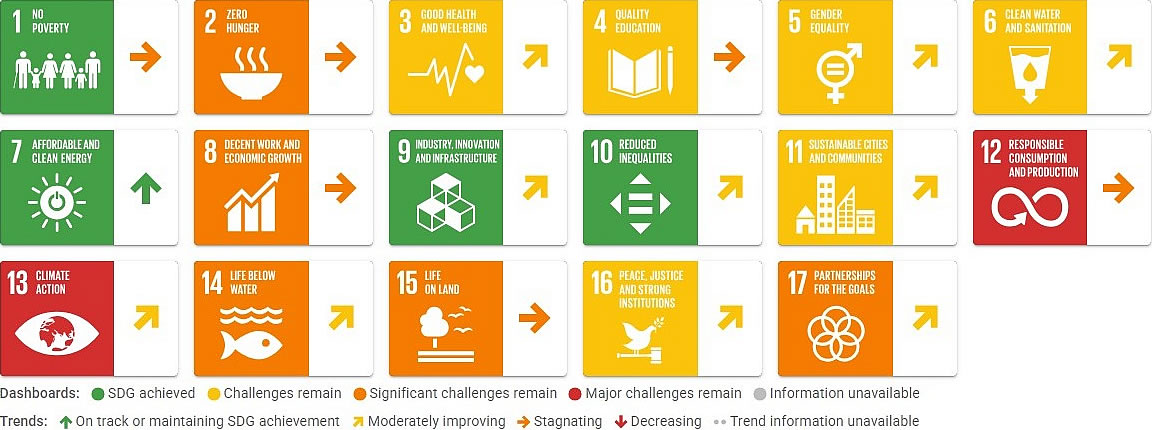
Finland’s overall score sits at 87.4 out of 100, ranking 1st out of 169 countries. Its spillover score sits at 66.9 out of 100, ranking 144th. The gap between those two rankings is the real story.
Why Finland’s Spillover Score Lags
This isn’t one weak indicator. It runs across several:
- Plastic waste exports rate orange. Finland exports 4.525 kg per capita, a middling score.
- Conventional weapons exports rate only yellow. Finland’s figure, 0.886 TIV per 100,000 people, is moderate, not strong.
- Tax architecture causes real harm elsewhere. Finland’s Corporate Tax Haven Score sits at 60 out of 100, where 100 is worst, and its Financial Secrecy Score sits at 50.
- Multilateral support is middling. Finland’s UN-based multilateralism score sits at 59.7 out of 100, respectable but unremarkable.
A useful contrast: RYB’s Brazil SDGs page tells almost the opposite story. Brazil ranks far lower overall, 53rd, but scores 96.6 on spillovers, 6th in the world, green across nearly every indicator that scores Finland orange, yellow, or worse. Wealth and spillover harm aren’t the same thing, and Finland is a clear example of how a global leader on one measure can still lag badly on the other.
International Cooperation
Finland continues to back the SDGs beyond its own borders:
- Development Assistance: Channelling financial and technical support to developing countries, primarily in Africa and fragile states, through the Ministry for Foreign Affairs.
- Bilateral and Multilateral Partnerships: Working through the EU and UN systems on equality, inclusive education, and digital innovation.
Where the Work Remains
Finland’s own institutions are candid about the gaps. Consumption and production patterns, climate action, and biodiversity conservation are flagged as the country’s most persistent SDG challenges, and official development assistance still falls short of the international 0.7%-of-GNI target. Gender equality, too, remains unfinished business: a gender pay gap and gender-based violence are both cited in Finland’s own national reporting.
Why These Numbers Matter
These pages matter more than their topic suggests on the surface. The SDGs are, in effect, the world’s working roadmap for its biggest shared problems, yet most citizens have never engaged with them directly. A Voluntary Local Review can change that at the scale where it’s most achievable: one city, one community, people who might otherwise never cross paths brought into the same conversation about what their home needs most.
Culture and the arts barely feature in that conversation today, in Finland or almost anywhere else. Finland’s own Ministry of Culture involvement in its VNR shows what it looks like when that starts to change.
RYB’s Place in This Picture
RYB tracks Finland because it is, right now, the strongest working example of what RYB’s own De Stijl-inspired premise argues: that culture belongs at the centre of development, not its edges. The spillover gap is the honest counterweight to that story, proof that no country, however well it ranks, gets to skip the harder questions.
Looking Forward
Finland’s position at the top of the 2026 rankings is not a finish line. A Culture Goal, if adopted into the post-2030 framework, would formalise something RYB has argued from its first principles: that culture is not a footnote to development, but one of its engines. Watch whether Finland’s spillover rank improves alongside its overall score, or whether the two keep moving in opposite directions.
Two Reports, Two Numbers
A separate Europe-only edition of the same project also covers Finland. On its 2026 interactive map, Finland, Sweden, and Denmark lead the entire continent, and Finland places third on the report’s Leave-No-One-Behind Index, behind only Norway and Iceland. The global and European reports do not use identical methodology, so Finland’s score on each is not the same number, even though Finland leads both. Leading both rankings under two different methodologies is, if anything, a stronger result than leading just one.
Sustainable Development Report Finland →
Europe Sustainable Development Report Finland →
UNDP
Human Development Report — Finland
The Human Development Index measures something narrower and older than the SDGs: life expectancy, education, and income, combined into a single score, with no 2030 deadline attached. It is a different lens on the same country, worth reading alongside the SDG data above rather than instead of it.
Finland’s Human Development Index data →
What is the difference between the HDI and the SDGs? →
Sources
- Sustainable Development Report 2026 — dashboards.sdgindex.org
- UNESCO, MONDIACULT 2025 — unesco.org/en/mondiacult
- La Moncloa, Final Declaration of MONDIACULT 2025 — lamoncloa.gob.es/20251001-mondiacult-final-declaration
- #Culture2030Goal campaign, “Culture in the 2025 Voluntary National Reviews” — culture2030goal.net/resources
- #Culture2030Goal Roadmap 2025 — culture2030goal.net/roadmap
- UN Chronicle, “A Realistic Goal? Culture in the Sustainable Development Agenda” — un.org/en/un-chronicle/realistic-goal-culture-sustainable-development-agenda
- Finland Ministry for Foreign Affairs, 2030 Agenda — um.fi/agenda-2030-sustainable-development-goals
- KEMUT network — sinfoniaorkesterit.fi/en/project/kemut-toolkit-for-a-more-sustainable-music-industry