

Bulgaria Sustainable Development Goals (SDGs)
41
SDG Index rank, out of 169 countries
76.19
SDG Index score, out of 100
121
Spillover rank, out of 169 countries
77.08
Spillover score, out of 100
Source: Sustainable Development Report 2026, SDSN / Dublin University Press
Most people have never heard of the Sustainable Development Goals in any real detail. Surveys across the US, UK, France, and Germany find only 8–12% of people can actually say what the SDGs are. RYB exists to close that gap, looking at the same reports and reviews the UN and researchers use, and explaining them as we go.
Bulgaria ranks a solid 41st out of 169 countries overall, ahead of every other country RYB has covered on this site except the UK and the Netherlands. Its spillover rank tells a very different story: 121st, not far off Finland’s notoriously weak 144th, despite Bulgaria sitting nowhere near Finland’s position at the top of the overall table. And where Bosnia and Herzegovina’s most distinctive local story was a single city’s unconventional Voluntary Local Review, Bulgaria’s own government reporting marks that entire category “not applicable.”
Bulgaria — Sustainable Development Report 2026
BG
Voluntary National Reviews: A Five-Year Gap, Then a Second Try
Bulgaria presented its first Voluntary National Review (VNR) at the High-Level Political Forum in 2020. Alongside it, the Council of Ministers moved to adopt the National Development Programme Bulgaria 2030, built around 13 national priorities across five pillars, Innovative and Intelligent Bulgaria, Green and Sustainable Bulgaria, Connected and Integrated Bulgaria, Responsive and Just Bulgaria, and Spirited and Vital Bulgaria, each explicitly mapped to specific SDGs.
The second VNR followed five years later, in 2025. Its main messages lead with a genuinely large claim: Bulgaria reports that the share of its population living below the international poverty line has fallen fivefold since 2015, with the share at risk of poverty nearly halved over the same period. The review also points to increased investment in education and healthcare, growing use of green technologies, and continued progress on gender equality as through-lines of the past decade.
Voluntary Local Reviews: Not Applicable, By the Government’s Own Description
Bulgaria’s own 2020 national report to the Global Observatory on Local Democracy and Decentralization addresses Voluntary Local and Subnational Reviews directly, and answers with two words: “Not applicable.” Unlike Bosnia and Herzegovina, where a single city built an unconventional review from scratch, Bulgaria hasn’t produced a VLR of any kind at national or municipal level.
The same government report does point to one piece of subnational SDG-linked work already underway: a cross-border ecotourism route, “Protected Natural Heritage within the Cross-Border Region Romania-Bulgaria,” connecting 60 protected sites and touching on partnership, biodiversity, and local development goals. It’s a real example of SDG-aligned local cooperation, just not one built as a formal review of progress.
What the Sustainable Development Report Shows: A Solid Score, A Weak Spillover Rank
The Sustainable Development Report scores every country two ways. The overall score measures how well a country is doing for its own people. The spillover score measures how much harm a country’s economy causes everyone else.
Bulgaria’s overall score sits at 76.19 out of 100, ranking 41st out of 169 countries, a genuinely solid mid-upper result. Its spillover score sits at 77.08 out of 100, but that only ranks 121st, a rank far weaker than the score alone suggests, and closer to Finland’s 144th than to a country with Bulgaria’s overall position would typically post.
Why Bulgaria’s Spillover Score Lags
- Tax architecture causes real harm elsewhere. Bulgaria’s Corporate Tax Haven Score sits at 56 out of 100, worse than Brazil’s 38, similar to Finland’s 60, though still better than the Netherlands’ 72.3 or the UK’s 86.25.
- Weapons exports rate as a moderate concern. At 0.35 TIV per 100,000 people, Bulgaria’s figure is higher than Bosnia and Herzegovina’s 0.14 or Brazil’s 0.038, though still well below the UK’s 1.553, the Netherlands’ 2.15, or the US’s 3.773.
- Plastic waste exports sit in the middle of the pack. At 2.507 kg per capita, Bulgaria exports more than Bosnia and Herzegovina (0.905 kg) or Brazil (0.025 kg), but far less than the Netherlands (30.162 kg) or the UK (11.966 kg).
- Multilateral support is moderate, not strong. Bulgaria’s UN-based multilateralism score sits at 60.0 out of 100, behind Bosnia and Herzegovina (69.0) and Brazil (81.6), though ahead of the UK (54.9) and far ahead of the US (1.7).
Where the Work Remains
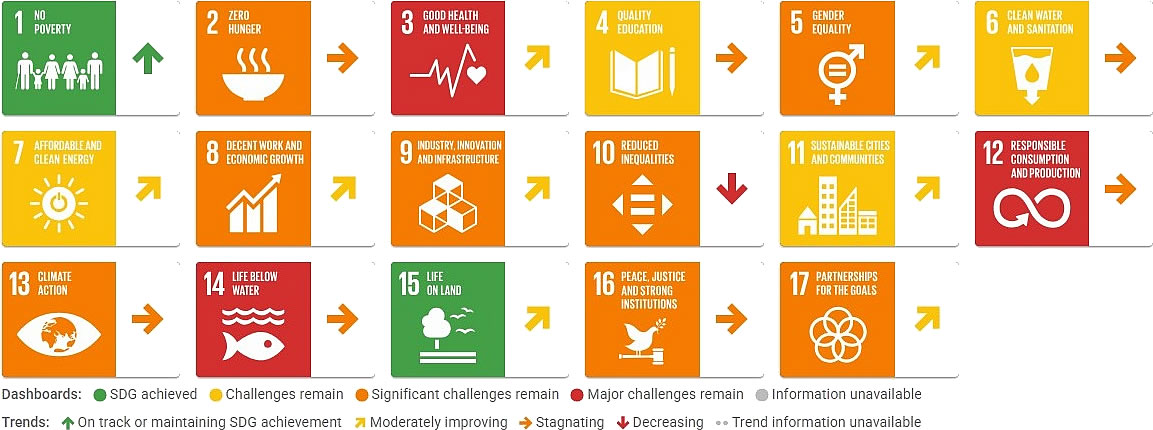
Bulgaria’s Statistical Performance Index sits at 83.6 out of 100, considerably stronger than Bosnia and Herzegovina’s 68.6, a real institutional strength. Its Corruption Perceptions Index score, however, sits at just 40 out of 100, a persistent weak point mirrored in its own domestic reporting. Inequality is the clearest area of real backsliding: Bulgaria’s Gini coefficient stands at 39.5, and on the Sustainable Development Report’s own dashboard, Reduced Inequalities (SDG 10) is the one goal currently trending in the wrong direction rather than stagnating or improving. Two other goals rate as the dashboard’s worst color, red: Responsible Consumption and Production (SDG 12), and Life Below Water (SDG 14), notable for a country with its own Black Sea coastline.
Bulgaria’s spillover rank sits alongside every other country RYB tracks on the Global Responsibility page, where rankings like these are shown together across all the countries covered on this site.
Why These Numbers Matter
These pages matter more than their topic suggests on the surface. The SDGs are, in effect, the world’s working roadmap for its biggest shared problems, yet most citizens have never engaged with them directly. A Voluntary Local Review can change that at the scale where it’s most achievable: one city, one community, people who might otherwise never cross paths brought into the same conversation about what their home needs most.
Culture and the arts barely feature in Bulgaria’s own SDG reporting so far, its cross-border heritage route among the closest things to an exception. RYB tracks Bulgaria because that space, and the fact that no city has yet stepped up the way Bijeljina did in Bosnia and Herzegovina, is exactly where a Culture of Peace lens still has room to make a real difference.
RYB’s Place in This Picture
RYB tracks Bulgaria because its numbers don’t line up the way its overall ranking suggests they should. A country doing this well domestically, 41st out of 169, would typically also post a stronger spillover rank than 121st. Bulgaria’s case argues that a solid domestic score and a low-harm footprint abroad are two separate achievements, not one that follows automatically from the other.
Looking Forward
Watch whether any Bulgarian city or region produces the country’s first Voluntary Local Review, following the pattern several of its neighbors have already set. Watch the SDG 10 inequality trend specifically, the one goal on Bulgaria’s dashboard currently moving backward rather than holding steady. And watch the 2027 SDG Summit, where the gap between Bulgaria’s solid overall score and its weak spillover rank will be a fair test of whether that pattern is closing or widening.
UNDP
Human Development Report — Bulgaria
The Human Development Index measures something narrower and older than the SDGs: life expectancy, education, and income, combined into a single score, with no 2030 deadline attached. It is a different lens on the same country, worth reading alongside the SDG data above rather than instead of it.
Bulgaria’s HDI reached 0.845 in 2023, up from 0.799 the year before, a genuinely large single-year gain, and now ranks 55th out of 193 countries, “very high human development.” Bulgaria has held that “very high” tier since at least the early 2020s, though its rank dipped as low as 68th during the pandemic-era report before recovering. Adjusted for inequality, the picture softens: Bulgaria’s Inequality-adjusted HDI (IHDI) drops to 0.748, a fall to 52nd, worth reading in full on UNDP’s own page.
Bulgaria’s Human Development Index data →
What is the difference between the HDI and the SDGs? →
Sources
- SDG Index database, Sustainable Development Report 2026 — Fuller, G., Iablonovski, G., Lafortune, G. and Sachs, J.D. (2026), SDSN / Dublin University Press, DOI:10.82163/225
- Sustainable Development Report 2026, Bulgaria profile — dashboards.sdgindex.org
- Voluntary National Review 2020, Bulgaria — sustainabledevelopment.un.org
- Voluntary National Review 2025, Bulgaria, Main Messages — hlpf.un.org
- Bulgaria National Report, Global Observatory on Local Democracy and Decentralization (GOLD), UCLG — gold.uclg.org
- Human Development Index, Bulgaria, UNDP data — hdr.undp.org
- Economy of Bulgaria, background reference — en.wikipedia.org