

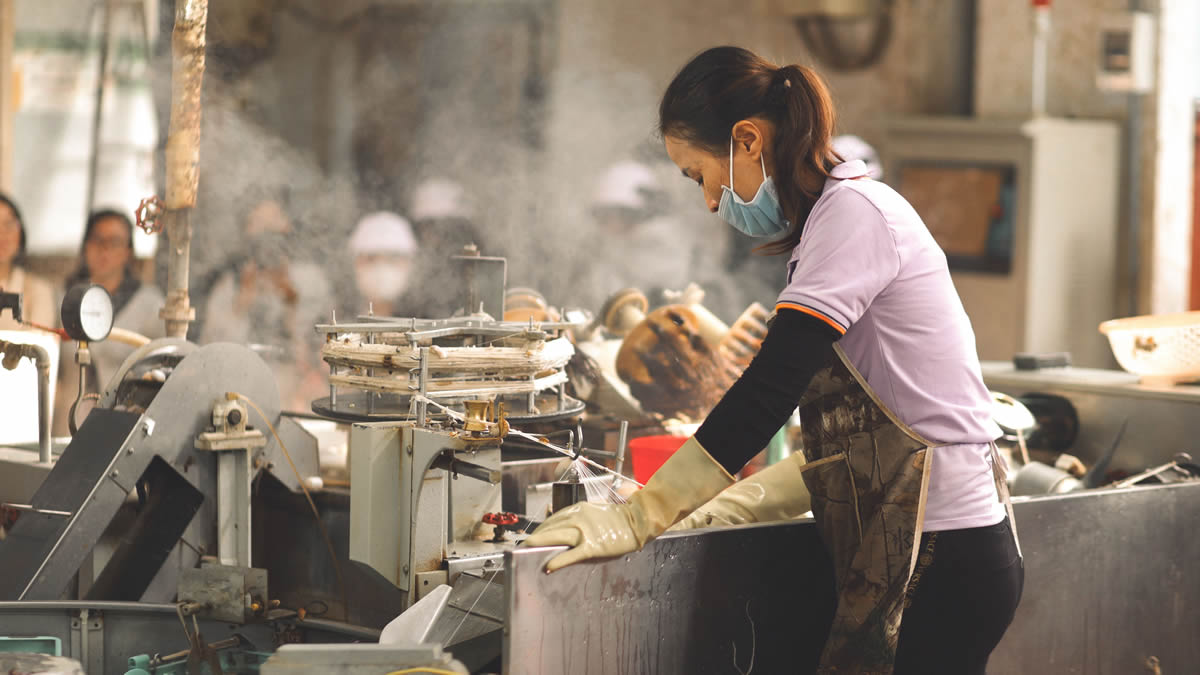
Gender Gap China — A Strong Economy, a Political Glass Ceiling
China ranks 103rd out of 148 countries. Its Political Empowerment subindex ranks 111th, the weakest of its four scores.
CN
Gender Gap China — A Country Split Between the Economy and Politics
China’s overall score rose slightly in 2025, reaching 68.6%, its best result in over a decade. That lifted China three places, to 103rd out of 148 countries. Look inside the four subindexes, though, and China splits sharply, in the opposite direction from many countries this site covers.
On economic participation, China performs well by global standards, closing roughly three-quarters of its gap. On political empowerment, China ranks 111th out of 148, near the bottom of the entire index. A country can build real economic inclusion while its political system still shuts women out almost entirely. China, right now, is doing both at once.
This page follows the same structure as Gender Gap Nepal and Gender Gap Finland: pay, power, safety, and education, each checked against the relevant UN target.
Pay — SDG Target 5.4
China’s labour market looks stronger than most, on paper. Female labour force participation sits at 59.6%, well above the United States (56.5%) and Japan (55.3%). Male participation runs at 71.1%, leaving an 11.5-point gap.
Wage equality tells an even better story. The 2025 WEF report ranks China 31st globally on this measure, ahead of the United States (40th), the UK (54th), and Japan (93rd). Still, income gaps run deep. Chinese women earned roughly $11,000 less than men in 2023, a 41% gap that has widened from 34.7% in 1990.
China’s Economic Participation and Opportunity subindex has closed around three-quarters of its gap, a genuinely strong result. It advanced 10.5 percentage points since 2006. Even so, the subindex slipped slightly in 2025, as wage parity fell and income parity failed to offset it. Women also remain scarce in corporate leadership. Only 8% of senior executive posts at China’s central state-owned enterprises were held by women as of August 2025.
Power — SDG Target 5.5 and SDG 16.7
Here the picture reverses sharply. China’s Political Empowerment subindex ranks 111th out of 148 countries, its weakest result by far. Female ministerial representation nearly doubled in 2025, from 4.7% to 8.3%, yet the subindex score still sits at just 13.5%.
The numbers at the very top are stark. Since 1949, only six women have ever sat on the Politburo, the Communist Party’s top decision-making body. The current Politburo, seated in 2022, has none. No woman has ever sat on the Politburo Standing Committee, nor on the Central Military Commission. As of August 2025, women held just 13 of the 203 seats on the Party’s Central Committee.
Representation thins further down the ladder, not just at the top. Women hold two of 26 ministerial posts and three of 31 provincial governorships. No woman holds any of the 31 provincial party secretary posts, the most powerful role in each province. Only four women have ever reached that post since 1949.
SDG Target 5.5 calls for women’s full and effective participation in leadership at every level. China’s constitution promises equal rights, but its political structure has not delivered on that promise.
Safety
China enacted its first domestic violence law in December 2016. Reported prevalence has since fallen: an estimated 8.6% of married women experienced domestic violence in 2021, down from 13.8% in 2010. That rate now sits below India, the United States, and Japan, according to 2023 OECD estimates.
Official figures likely understate the real picture. Courts often favour keeping marriages intact over protecting victims, and police frequently issue only verbal warnings; nearly 100,000 were issued in 2023 alone. This page keeps that story brief on purpose. A dedicated VAWG China page will cover the fuller picture: policy response, reporting gaps, and the specific forms of violence Chinese women and girls face.
Education
China’s Educational Attainment subindex sits close to full parity, and in one respect leads the world. The WEF ranks China first globally for gender balance in tertiary education, with women enrolling 11.47% more than men. Female literacy has also risen, from 86.5% in 2000 to 95% in 2020, though it still trails male literacy by three points.
China’s elite universities tell a different story than the national numbers do. Peking University enrolled 46 women for every 54 men in 2022; at Tsinghua, the ratio ran 34 to 66. Rural girls face a steeper drop-off, too: 96.1% enrol in primary school, but only 79.3% continue to secondary level.
Health tells the most unusual story on this page. China’s Health and Survival subindex closed 94.7% of its gap in 2025, helped by narrowing sex ratios at birth. Yet China still ranks 146th out of 148 countries on that specific measure, a legacy of the one-child policy and long-standing cultural preference for sons. The imbalance has left 30 million more men than women in China as of 2024, a demographic reality now shaping national policy far beyond the gender gap index.
RYB’s Place in This Picture
RYB does not produce the WEF index or China’s own gender policy documents. The World Economic Forum, China’s National Bureau of Statistics, and UN Women do that work. What RYB does is connect it to the same global framework used across this site. SDGs China tracks all seventeen UN goals; this page is the deep dive into the two goals concerning women and girls specifically.
One thread worth naming here, rather than leaving out: China’s sex ratio imbalance is now reshaping the country’s own demographic policy, well beyond anything the gender gap index alone can capture. It sits at the intersection of gender equality and a national fertility crisis, two stories that are increasingly hard to separate in China today.
This is also the data a Culture Women’s Day for China exists to surface. Visit Culture Women’s Day China to see how this picture connects to the country’s own suffrage history and the wider Women, Culture and Peace framework RYB is built around.
Looking Forward
China’s next Global Gender Gap Report will show whether 2025’s gains hold. Three things are worth watching. First, whether the modest rise in female ministerial representation continues, or proves to be a one-year blip. Second, whether the Economic Participation and Opportunity subindex recovers from its 2025 dip. Third, whether China’s shrinking sex ratio imbalance keeps narrowing, now that the country actively wants more births, not fewer.
The bigger question sits underneath all three. China has shown that economic inclusion and political inclusion do not have to move together. Whether they eventually do, in either direction, will shape this page’s story for years to come.
World Economic Forum
Global Gender Gap Report China
2025
Rank: 103 (out of 148 countries)
Score: 0.686
› report
2024
Rank: 106 (out of 148 countries)
Score: 0.684
2023
Rank: 107 (out of 146 countries)
Score: 0.678
2020
Rank: 106 (out of 153 countries)
Score: 0.676
2016
Rank: 99 (out of 144 countries)
Score: 0.676
UN ESCAP / UN Women
Asia-Pacific Regional Data
Asia has no single ranked gender equality index comparable to the EU’s EIGE. Instead, UN ESCAP and UN Women track regional progress through periodic reviews, most recently the 2024 Beijing+30 report.
› Charting New Paths for Gender Equality and Empowerment: Asia-Pacific
Sources
- World Economic Forum, “Benchmarking gender gaps, 2025” — weforum.org
- ChinaPower Project, CSIS, “Has China’s Progress Toward Women’s Equality Stalled?” — chinapower.csis.org/china-gender-inequality
- ChinaPower Project, CSIS, “WEF Global Gender Gap Report” tracker — chinapower.csis.org/data/wef-gender-gap-report
- “The Long and Winding March to Gender Equality in Mainland China” — europeanguanxi.com
- World Bank Gender Data Portal, China — genderdata.worldbank.org/en/economies/china
- UN Department of Economic and Social Affairs, SDG 5 Targets and Indicators — sdgs.un.org/goals/goal5#targets_and_indicators
- UN Department of Economic and Social Affairs, SDG 16 Targets and Indicators — sdgs.un.org/goals/goal16#targets_and_indicators