

SDGs China - Sustainable Development Goals
49
SDG Index Rank, out of 169 countries
74.7
SDG Index Score, out of 100
93
Spillover Rank, out of 169 countries
88.9
Spillover Score, out of 100
Source: Sustainable Development Report 2026, SDSN / Dublin University Press
Most people have never heard of the Sustainable Development Goals in any real detail. Surveys across the US, UK, France, and Germany find only 8–12% of people can actually say what the SDGs are. RYB exists to close that gap, looking at the same reports and reviews the UN and researchers use, and explaining them as we go.
China sits in the middle of the 2026 Sustainable Development Report, ranked 49th out of 169 countries. That is a modest headline number for the world’s second-largest economy. But the second number tells a more interesting story. China’s spillover score, which measures how much harm a country’s economy causes beyond its own borders, sits at 88.9 out of 100. On paper, that only ranks 93rd. Look at the individual indicators behind it, though, and most read green. The gap between that strong underlying profile and the middling rank is this page’s starting point.
China — Sustainable Development Report 2026
CN
Why China’s Spillover Rank Undersells Its Own Numbers
The Sustainable Development Report scores spillovers on a tight curve. Dozens of countries cluster near the very top of the scale. A small gap in the raw score can therefore shift a country’s rank by 50 places or more. That is largely what happens to China.
Look past the rank and the underlying indicators tell a cleaner story:
- Plastic waste exports are close to zero. China exports just 0.043 kg per capita, a green score on the dashboard.
- Fossil fuel export emissions are minimal. CO₂ embodied in China’s fossil fuel exports comes to 0.022 tonnes per capita, also green.
- Conventional weapons exports rate yellow, not red. China’s figure, 0.12 TIV per 100,000 people, is low by global standards.
- Corporate tax haven exposure scores green on the dashboard, despite a raw score of 59.5 out of 100, where 100 is worst.
One indicator pulls the average down. Support for UN-based multilateralism scores only 55.97 out of 100, an orange result on the dashboard. That single weak spot, more than any export or emissions figure, explains most of the gap between China’s clean component profile and its mid-table spillover rank.
For comparison, RYB’s Brazil SDGs page covers a country that ranks lower overall but scores near the very top on spillovers. RYB’s Finland SDGs page shows the reverse: a country that leads the overall table yet ranks poorly on spillovers. China’s profile does not match either extreme. It sits closer to Brazil’s clean-indicator pattern than to Finland’s weaker one, even though its overall spillover rank looks unremarkable.

National Implementation and Monitoring
China has built a large, multi-layered structure for tracking the SDGs:
- The National Development and Reform Commission (NDRC): Coordinates national efforts and aligns SDG work with domestic five-year plans.
- The National Bureau of Statistics (NBS): Monitors SDG indicators and supplies the data behind China’s official reporting.
- Local Governments and Municipalities: Translate national targets into local action, with a small but growing group of cities publishing their own reviews.
Two Voluntary National Reviews, and a Third Still to Come
China presented its first Voluntary National Review (VNR) in 2016, one of only 22 countries to do so that year. It returned with a second VNR in 2021, reporting steady growth and pandemic recovery alongside deeper integration of the Belt and Road Initiative with the 2030 Agenda. China is not among the 36 countries scheduled to present at the 2026 High-Level Political Forum. Its next review, most likely a third, remains pending.
The Local Layer: A Handful of Pioneers
Voluntary Local Reviews (VLRs) are still a young practice in China, unlike Finland’s network of seventeen. Two cities lead the way. Shenzhen published a full SDG report with UNDP support, covering its transition to a high-tech, low-carbon economy. Yiwu, the world’s largest wholesale market city, published its own VLR in 2021, linking small-commodity trade to sustainable urban growth. More Chinese cities are expected to follow as the practice spreads globally.
What the Sustainable Development Report Shows: Two Scores That Don’t Match
The Sustainable Development Report scores every country two ways. The overall score measures how well a country is doing for its own people. The spillover score measures how much harm a country’s economy causes everyone else.
China’s overall score sits at 74.7 out of 100, ranking 49th out of 169 countries. Its spillover score sits at 88.9 out of 100, ranking 93rd. Unlike Finland, where a top overall rank hides a weak spillover record, China’s gap runs the other way: solid indicators, but a rank that undersells them.
Where China’s Goal Scores Lead and Lag
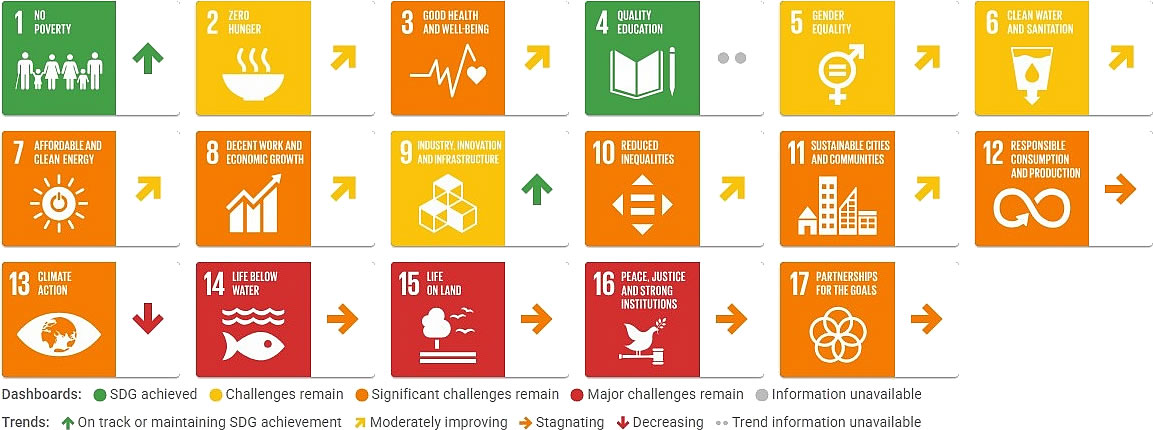
China’s strongest results sit in the basics of national development. Goal 4, Quality Education, scores 99.8. Goal 1, No Poverty, scores 98.7. Goal 9, Industry, Innovation and Infrastructure, scores 89.6.
The weaker results cluster around ecosystems and governance. Goal 15, Life on Land, scores just 52.3. Goal 17, Partnerships for the Goals, scores 53.3. Goal 14, Life Below Water, scores 55.8. Goal 16, Peace, Justice and Strong Institutions, scores 62.4.
International Cooperation
China’s 15th Five-Year Plan, approved in March 2026, sets the country’s sustainability direction through 2030:
- A 17% cut to carbon emissions per unit of GDP between 2026 and 2030, alongside a push to peak emissions on schedule.
- Forest coverage targeted to reach 25.8%, with water consumption intensity cut by 10% and urban PM2.5 kept below 27 micrograms per cubic metre.
- Mandatory ESG disclosure, including Scope 3 emissions, now required on the Shanghai and Shenzhen stock exchanges from April 2026.
- Clean electricity capacity overtook fossil fuel capacity for the first time in February 2026, reaching 52% of the national total.
Beyond its borders, China continues to link the Belt and Road Initiative to the 2030 Agenda, and expands South-South cooperation on agriculture, health, and infrastructure with other developing countries.
Where the Work Remains
China’s own goal scores point to the gaps. Biodiversity and life on land need the most attention, alongside ocean health and institutional partnerships. On gender, progress is real but incomplete: women hold 24.9% of parliamentary seats, and China ranks 106th out of 146 countries on the 2024 Global Gender Gap Report. Multilateral cooperation, the one clear weak point in China’s spillover profile, also remains an open question for the years ahead.
Why These Numbers Matter
These pages matter more than their topic suggests on the surface. The SDGs are, in effect, the world’s working roadmap for its biggest shared problems, yet most citizens have never engaged with them directly. A closer look at the data, beyond the headline rank, often tells a fuller story than either number alone.
RYB’s Place in This Picture
RYB tracks China because its numbers resist a simple story. A mid-table overall rank sits next to a spillover profile that, indicator by indicator, looks far cleaner than its rank suggests. That kind of nuance is exactly what these pages are built to surface, rather than flatten into a single score.
UNDP
Human Development Index — China
The Human Development Index measures something narrower and older than the SDGs: life expectancy, education, and income, combined into a single score, with no 2030 deadline attached. China’s story here is striking on its own terms. In 1990, China’s HDI stood at 0.484, ranking 104th out of 142 countries. By 2023, it had climbed to 0.797, ranking 77th out of 192. That makes China the only country in UNDP history to move from “low” to “high” human development. A 2025 UNDP report on China’s human development adds a further layer: cities with very high human development now cover 442 million people, 31.7% of the national total, though regional gaps between provinces persist.
China’s Human Development Index data →
What is the difference between the HDI and the SDGs? →
Looking Forward
China’s next Voluntary National Review, whenever it arrives, will be the first real test of how the 15th Five-Year Plan’s green targets translate into SDG progress. Watch three things: whether the multilateralism score improves, whether forest coverage and clean electricity targets hold, and whether more Chinese cities follow Shenzhen and Yiwu into the Voluntary Local Review process.
Sources
- Sustainable Development Report China 2026 — dashboards.sdgindex.org
- China Voluntary National Review 2021, HLPF — hlpf.un.org/countries/china/voluntary-national-review-2021
- HLPF 2026 VNR country list — hlpf.un.org/2026/vnrs
- China’s 15th Five-Year Plan, green transition analysis — greenfdc.org
- China’s 15th Five-Year Plan, ESG and clean energy — the-esg-institute.org
- UNDP report on China’s human development, 2025 — pekingnology.com
- Global Gender Gap Report data, RYB Gender Gap China page — redyellowblue.org/data/cn/gender-gap-china