

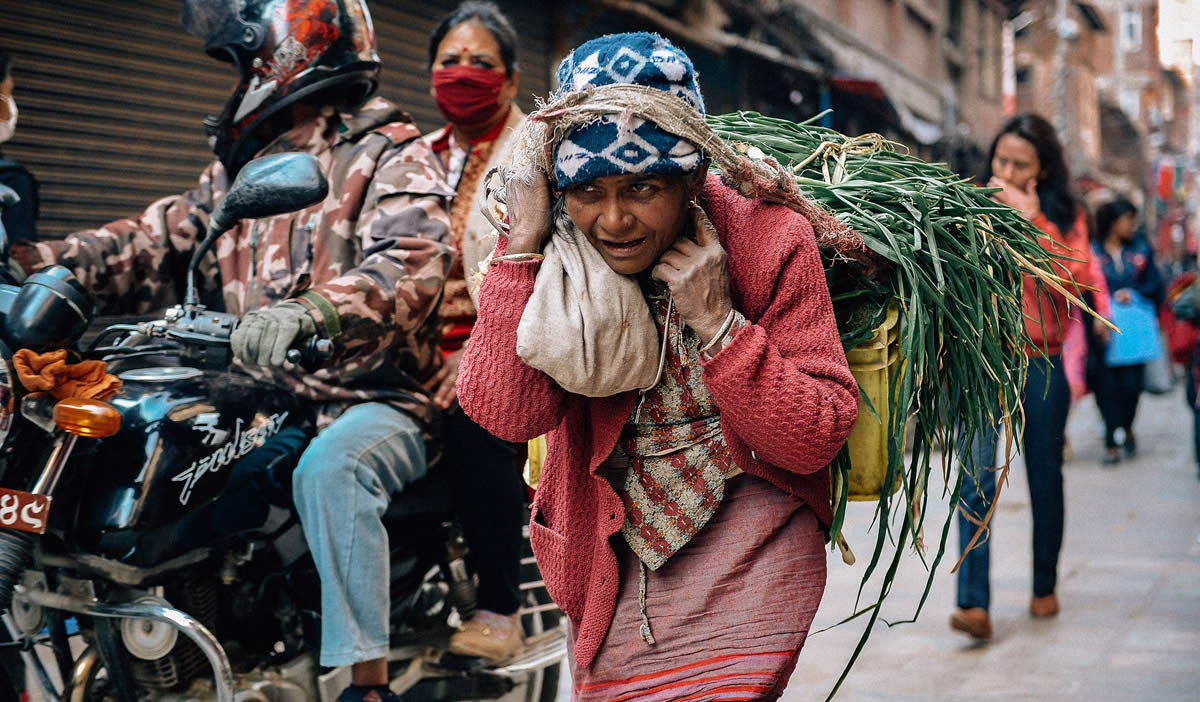
A woman carries a bundle of vegetables on a busy urban street, Kathmandu, Nepal - photo: Ding Lei
Gender Gap Nepal — Strong Quotas, an Economy That Leaves Women Behind
Nepal ranks 125th out of 148 countries. One number explains most of it: economic participation ranks 140th.
NP
Gender Gap Nepal — A Country Split Between Politics and the Economy
Nepal’s overall score has been sliding. It stood at 0.692 in 2022, ranked 96th. By 2025, it had fallen to 0.648, ranked 125th out of 148 countries. That drop tells only part of the story, though. Look inside the four subindexes, and Nepal splits sharply in two.
On political representation, constitutional quotas have made Nepal one of the stronger performers in South Asia. On economic participation, Nepal ranks 140th out of 148, near the very bottom of the entire index. A country can build real political inclusion by law while its economy still shuts women out. Nepal, right now, is doing both at once.
This page follows the same structure as Gender Gap Netherlands and Gender Gap Finland: pay, power, safety, and education, each checked against the relevant UN target.
Pay — SDG Target 5.4
Nepal’s labour market splits sharply by gender. Women’s labour force participation sits around 27–29%. Men’s participation runs near 54%. That gap has barely moved in years.
Most working Nepali women land in agriculture or informal work. The 2023/24 Economic Survey puts that figure at 55%. Access to credit, land, and formal jobs stays limited for these women. A 2023 study found only 17% of women in remote districts own land or property in their own name.
The wage gap itself runs close to 30%, per the same Economic Survey. Vulnerable employment, work without contracts, security, or benefits, affects 91.2% of working women. Among men, that figure is 71.5%. Both numbers are high by global standards, but the gap between them is where Nepal’s Economic Participation and Opportunity subindex ranks 140th out of 148 countries, one of the weakest results anywhere in the report.
Power — SDG Target 5.5 and SDG 16.7
Here the picture flips. Nepal’s 2015 constitution reserves at least one-third of parliamentary seats for women, a quota held steady since 2010. Women hold 33.1% of seats today, well above South Asia’s regional average of 18.2%, and above the average for lower-income countries generally.
That number stands out globally, too. In the WEF’s 2024 report, Nepal was the only country in Southern Asia whose parliamentary parity score topped the global average. But seats are not the same as power. Cabinets tell a harder story: Prime Minister K.P. Sharma Oli’s July 2024 cabinet included just two women among 25 ministers. Even after Sushila Karki became Nepal’s first female prime minister in September 2025, her cabinet expansions still placed men in most senior portfolios, home affairs, finance, and energy among them.
SDG Target 5.5 calls for women’s full and effective participation in leadership at every level. Nepal’s quota has delivered seats. It has not yet delivered proportional decision-making power, the same gap visible in Nepal’s SDGs page, where Goal 16 carries a red rating.
Safety
More than a third of Nepali women, 36%, report experiencing some form of gender-based violence in their lifetime, according to the Department of Women and Children’s 2023 Annual Report. Domestic violence is the most common form. The government now runs 84 One-Stop Crisis Management Centers nationwide, offering legal, medical, and psychosocial support to survivors.
This page keeps that number brief on purpose. Nepal’s own VAWG page will cover the fuller picture: policy response, reporting gaps, and the specific forms of violence Nepali women and girls face.
Education
Nepal’s Educational Attainment subindex ranks 129th out of 148, scoring 0.910, moderate rather than strong. The headline gap is literacy. Nepal’s literacy parity score sits below 75%, and adult female literacy still trails male literacy by roughly 18 percentage points, one of the wider literacy gaps in the region.
Enrolment tells a more hopeful story than literacy does. More girls attend school today than in past generations. But that gain has not yet carried through into the workforce. Health tells a similarly mixed story: Nepal’s Health and Survival subindex ranks a comparatively strong 91st, scoring 0.966, helped by a real drop in maternal mortality, from 504 deaths per 100,000 live births in 2000 to 174 in 2020. That figure still sits above the regional average of 138, and adolescent fertility remains high, at 64 births per 1,000 girls aged 15 to 19.
RYB’s Place in This Picture
RYB does not produce the WEF index, Nepal’s Economic Survey, or the Department of Women and Children’s annual report. The World Economic Forum, Nepal’s National Planning Commission, and UN Women do that work. What RYB does is connect it to the same global framework used across this site. SDGs Nepal tracks all seventeen UN goals; this page is the deep dive into the two goals concerning women and girls specifically.
One more thread worth naming here rather than leaving out entirely: Nepal recently became the first country in South Asia to register a same-sex marriage. It sits outside what the Global Gender Gap Index measures, but it’s a genuinely notable, recent marker of how quickly some parts of Nepali law are moving, even as the labour market moves far more slowly.
This is also the data a Culture Women’s Day for Nepal exists to surface. Visit Culture Women’s Day Nepal to see how this picture connects to the country’s own suffrage history and the wider Women, Culture and Peace framework RYB is built around.
World Economic Forum
Global Gender Gap Report Nepal
2025
Rank: 125 (out of 148 countries)
Score: 0.648
› report
2024
Rank: 117 (out of 146 countries)
Score: 0.664
2023
Rank: 116 (out of 146 countries)
Score: 0.659
2022
Rank: 96 (out of 146 countries)
Score: 0.692
UN ESCAP / UN Women
Asia-Pacific Regional Data
Asia has no single ranked gender equality index comparable to the EU’s EIGE. Instead, UN ESCAP and UN Women track regional progress through periodic reviews, most recently the 2024 Beijing+30 report.
› Charting New Paths for Gender Equality and Empowerment: Asia-Pacific
Sources
- “Assessing Gender Equality in Nepal: A Comparative Study of Progress and Disparities” — nepjol.info
- Grokipedia, “Gender inequality in Nepal” — grokipedia.com/page/Gender_inequality_in_Nepal
- The Kathmandu Post, “Nepal’s climate-gender nexus” — kathmandupost.com
World Economic Forum, “Benchmarking gender gaps, 2024” — weforum.org - World Economic Forum, “Benchmarking gender gaps, 2025” — weforum.org
- World Bank Gender Data Portal, Nepal — genderdata.worldbank.org/en/economies/nepal
- UN Department of Economic and Social Affairs, SDG 5 Targets and Indicators — sdgs.un.org/goals/goal5#targets_and_indicators
- UN Department of Economic and Social Affairs, SDG 16 Targets and Indicators — sdgs.un.org/goals/goal16#targets_and_indicators