

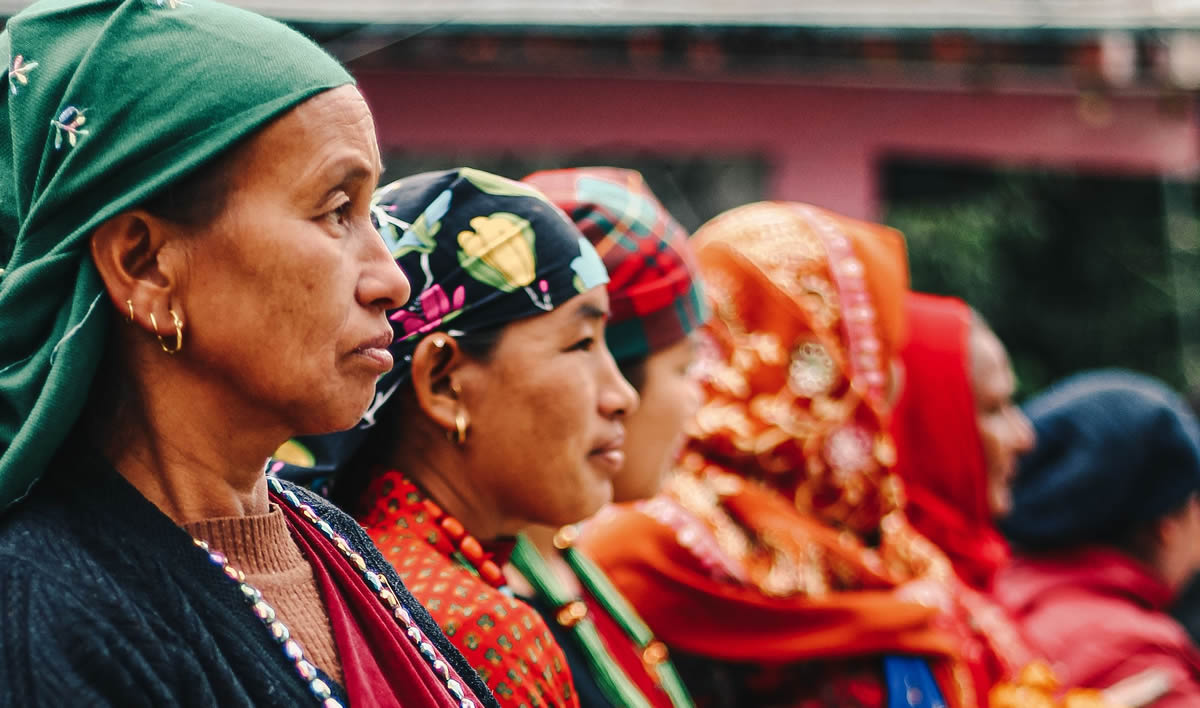
A group of women in vibrant traditional attire participate in a cultural festival | photo by Saroj Gajurel
Women, Culture and Peace > Women’s Days for Culture of Peace > Calendar > Culture Women’s Day Nepal > Nepal
Culture Women's Day Nepal
Women's Right to Vote / April 11, (1951)
One of 193 national Women’s Days for Culture of Peace — a day for every UN member state. See the full calendar.
NP
When did Nepali women get the right to vote?
On April 11, 1951, the Interim Government of Nepal Act came into force, ending 104 years of Rana family autocracy and establishing Nepal’s first Election Commission. The Act followed King Tribhuvan’s proclamation of February 18, 1951, and it made no distinction between men and women in its language on suffrage: both were citizens of the new democracy in principle, from day one.
That principle was not self-executing. Nepal’s very first election, a Kathmandu municipal vote in June 1947, had excluded women outright, despite direct appeals to the Rana Prime Minister. The 1951 Act finally wrote universal suffrage into law, but it would still take a women’s protest movement to make that promise real at the ballot box.
How did Nepali women win the vote?
Nepal’s suffrage story runs in three distinct stages: a legal promise in 1951, women forcing its enforcement in 1952, and the first woman elected to national parliament in 1959.
- 1918. Yogmaya Neupane, a religious poet and spiritual leader, formed a Women’s Committee, becoming the first Nepali woman to organise publicly around women’s rights. Her campaigning helped push Rana rulers to abolish the practice of sati.
- 1947. Nepal held its first-ever election, a Kathmandu municipality vote. Only men were granted voting rights. Women’s appeals to Prime Minister Padma Shumsher Rana were rejected.
- 1948. Mangala Devi Singh founded the Nepal Women’s Association, campaigning against child marriage and polygamy, and for women’s suffrage.
- 1951. The Revolution of 1951 ended Rana rule. The Interim Government of Nepal Act, in force from April 11, 1951, established universal adult suffrage in law.
- 1952. Nepal’s first election under the new democracy, a municipal vote, arrived, and Prime Minister Mohan Shumsher’s government moved to deny women the vote in practice. Singh’s Nepal Women’s Association organised protests. The government backed down. Sadhana Pradhan Adhikari was elected a municipal member, becoming Nepal’s first-ever elected woman.
- 1959. Nepal’s first national parliamentary election, held February 18 to March 11, elected Dwarikadevi Thakurani from Dadeldhura-Baitadi, the first woman in Nepal’s national parliament. She became Nepal’s first female deputy minister on May 20, 1959.
The gap between law and practice, a right granted on paper in 1951 but won at the polling booth only through organised protest in 1952, is the defining shape of Nepal’s suffrage story.
Key Women in the Nepali Women’s Movement
Yogmaya Neupane (1867–1941)
A religious guru and poet, Neupane formed Nepal’s first Women’s Committee in 1918. Her activism is widely credited with pressuring Rana rulers to end the practice of sati and forms of bonded servitude.
Mangala Devi Singh (1916–2011)
Founder of the Nepal Women’s Association in 1948, Singh led the 1952 protest movement that forced Nepal’s first post-revolution government to honour women’s voting rights at the municipal level.
Sadhana Pradhan Adhikari
Elected a municipal representative in 1952, Adhikari became the first woman ever elected to public office in Nepal, the direct result of the protest Singh’s association organised that year.
Dwarika Devi Thakurani (1928–2000)
A Nepali Congress candidate from Dadeldhura-Baitadi, Thakurani became the first woman elected to Nepal’s national parliament in 1959, and its first female deputy minister that same year.
Sahana Pradhan (1927–2014)
One of the women who protested for voting rights in 1952, Pradhan went on to a six-decade political career, becoming Nepal’s first female Minister of Foreign Affairs and Deputy Prime Minister in 2007.
Sushila Karki (1952– )
A former Chief Justice of Nepal’s Supreme Court, Karki was sworn in as Nepal’s first female Prime Minister in September 2025, leading the interim government that followed the Gen Z uprising.
Cultivating a Culture of Peace
“Cultivating a Culture of Peace” was the theme of the UN’s International Day of Peace on September 21, 2024, marking the 25th anniversary of the UN Declaration and Programme of Action on a Culture of Peace. The theme carries forward UNESCO’s founding principle: peace must be built in minds, through cooperation, understanding, and education, not just maintained through the absence of conflict. See this milestone on our Culture and Peace Timeline →
Culture Women’s Day Nepal borrows that same spirit for a single day and a single country. Nepal’s own suffrage story, a law in 1951, a protest in 1952, is one small, specific example of what “cultivating” peace and equality actually requires: not just a right granted, but a right built, together.
Why this day matters today — for women and men
Nepal’s 2015 constitution guarantees women at least one-third representation in federal and provincial legislatures. Whether that guarantee becomes real influence is still an open question, the same question Mangala Devi Singh’s generation asked in 1952.
That question belongs to men as well as women. Gender inequality shapes expectations placed on Nepali men and boys too, in politics, in family life, in what leadership is assumed to look like. A more equal Nepal isn’t something women achieve alone or for themselves; it’s something built when men and boys actively take part in changing the norms and structures involved. Culture Women’s Day Nepal is a day for everyone in Nepal, not a day about women observed by everyone else.
Nepal also marks International Women’s Day on March 8 alongside the rest of the world, a tradition with its own century-long history rooted in early-1900s labour movements. Read more about International Women’s Day →. Culture Women’s Day Nepal doesn’t replace that global day. It adds a second, nationally rooted date to the calendar, one tied specifically to Nepal’s own suffrage story.
Culture Women’s Day within Women, Culture and Peace
Culture Women’s Day Nepal is part of a larger framework: Women, Culture and Peace (WCP). WCP builds on UNESCO’s Culture of Peace programme and the UN’s Women, Peace and Security agenda.
WCP works through culture, art, and community rather than formal institutions alone. It follows a women-centered organizing model, developed by scholars Stall and Stoecker. This model builds relationships and shared leadership, instead of competing for power.
Women’s Days for Culture of Peace is one expression of WCP. The initiative marks a day for every UN member state, 193 in total. Each day recognizes a nation’s path toward women’s political voice. Each day also opens space to reflect on peacebuilding, gender equality, and sustainable development still ahead.
What could Culture Women’s Day Nepal become?
This day is still young. Its meaning is not fixed. It can grow as more people discover it and decide what it should hold.
A national Women’s Day could become a moment to trace the line from Mangala Devi Singh’s 1952 protest to Sushila Karki’s 2025 premiership. It could become an occasion to celebrate Nepali women’s contributions to culture, peace, and society. It could become a small, yearly habit of attention, a pause that returns each April 11.
None of this is prescribed from above. Like WCP itself, the day grows through shared leadership, not instruction.
Ideas for celebration and reflection
These are starting points, not a program. Pick what resonates. Leave the rest. Add your own.
- Online. Share a post or story using #CultureWomensDay or #WCP, and name a woman from Nepal, who inspired you.
- In schools. Start a classroom dialogue about women’s suffrage in Nepal, paired with a question: what does political voice mean today?
- In culture. Organize a library display, a small exhibition, or a reading group built around women’s history in Nepal.
- In organizations. Pause during a team meeting to mark Culture Women’s Day Nepal and connect it to ongoing equality work.
- At home or with friends. Share one story about a woman, who shaped your own family or community history.
- In communities. Host a local PeaceTable-style gathering, open to anyone with a story, a question, or an idea to bring.
Some of these need an afternoon. Others need only a sentence shared with a colleague. Both matter.
A growing network, one country at a time
Nepal is one node in a global pattern. As Nepali women shape what this day means here, women in other countries do the same with their own 192 days.
Over time, these national days can connect into something larger. Shared stories. Shared questions. Shared momentum, built locally and felt globally.
RYB does not direct this growth. It offers the framework, the calendar, and the connection back to WCP. What happens next depends on the people, who discover it.
Looking Forward
Culture Women’s Day Nepal marks April 11, 1951, when Nepal’s Interim Government Act put universal suffrage into law. But its more instructive date may be 1952, when women had to organise and protest to make that law real at a ballot box.
Its future is still open. As more people, especially Nepali women, discover Women, Culture and Peace and this national day, new traditions can form around it.
The invitation stands open, without pressure and without a deadline. Explore the Women, Culture and Peace framework, browse the calendar of 193 national days, and discover what Culture Women’s Day Nepal could mean to you.
Sources and Links
- 1951 Nepalese Revolution — Wikipedia | en.wikipedia.org/wiki/1951_Nepalese_revolution
- The Interim Government of Nepal Act, 1951 — International Center for Not-for-Profit Law | icnl.org/research/library/nepal_theinterim
- A Historical Glimpse of Constitutional Amendment in Nepal — Nepal Law Review, NepJOL | nepjol.info/index.php/nlr/article/download/57620/43130/170733
- Century-long history of Nepali women’s struggle leads to increasing participation in policy-making — Republica | myrepublica.nagariknetwork.com
- Women’s Political Participation in Federal Nepal — Democracy Resource Center Nepal | democracyresource.org
- Sahana Pradhan — Wikipedia | en.wikipedia.org/wiki/Sahana_Pradhan
Nepal, Historical data on women — IPU Parline | data.ipu.org/parliament/NP - International Women’s Day: A Comprehensive Guide — RYB Global Development | redyellowblue.org/organizations/igos/un/un-women/iwd/
- Women, Culture and Peace (WCP): A New Framework for Cultural Peacebuilding — RYB Global Development | redyellowblue.org/women-culture-and-peace/
- Calendar of Women’s Days for a Culture of Peace — RYB Global Development | redyellowblue.org/womens-days-for-culture-of-peace/calendar/
- Nepal — Global Development — RYB Global Development | redyellowblue.org/data/np/