

Nepal: Violence Against Women and Girls
One of the busiest trafficking routes on Earth runs through Nepal. Nepal's own police recorded 38 domestic-violence murders last year. And the country's most visible anti-violence advocate carries her own attacker's scars on her face.
NP
RYB’s place in this picture
RYB does not run shelters, investigate trafficking cases, or draft legislation. That work belongs to Nepal Police, WOREC Nepal, Maiti Nepal, and UN agencies on the ground. RYB’s role is to hold the picture together: to place Nepal’s suffrage history, its Gender Gap standing, and its violence data on one connected map. This page sits alongside Culture Women’s Day Nepal and Gender Gap Nepal, which briefly flagged the 36% lifetime gender-based-violence figure this page now expands into full detail.
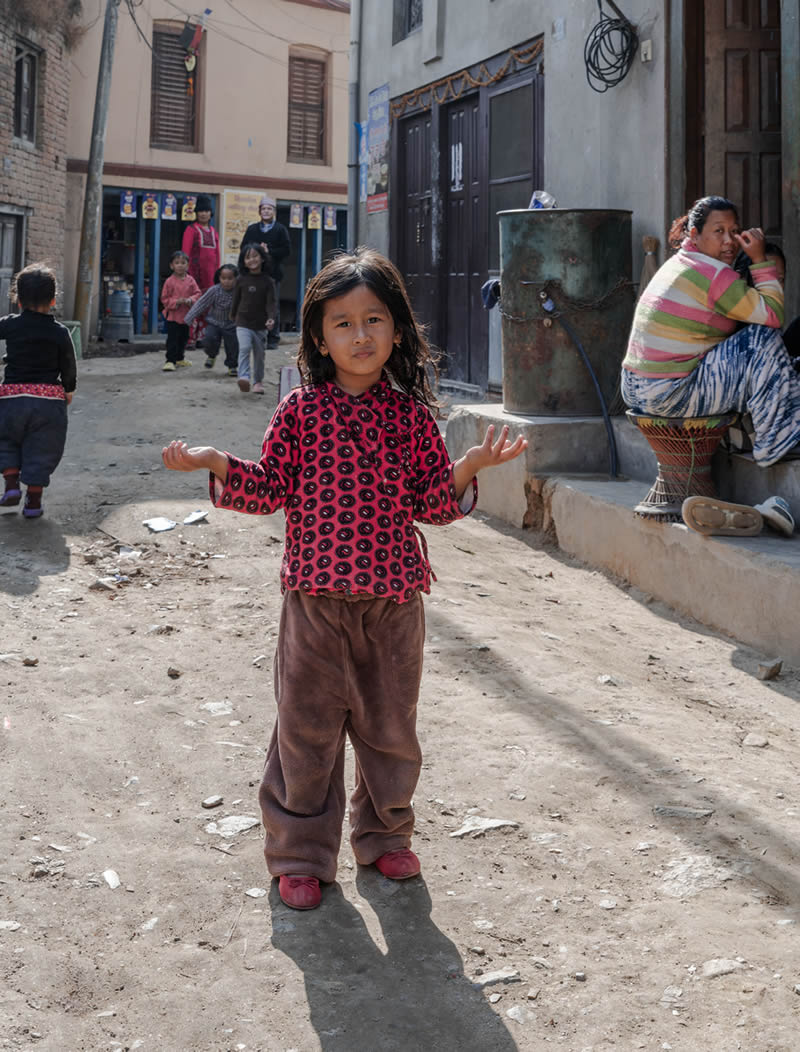
A young girl stands confidently in a vibrant Kathmandu street, surrounded by local community life, Катманду, Багмати, Непал - photo: Roman Saienko
VAWG in Nepal: The Scale, in Current Numbers
Key figures
38 women
were murdered in domestic violence cases in Nepal in the 2024–25 fiscal year, per Nepal Police’s annual report, plus 4 murdered following rape and 2 in dowry disputes
5,000–10,000
women and girls are trafficked from Nepal to India annually, mostly for prostitution, on what researchers call one of the busiest trafficking routes in the world
35% of girls
in Nepal marry before age 18, despite the legal minimum age of 20 for both sexes
60,000–65,000
burn cases, including acid attacks, are recorded in Nepal every year, with no dedicated national burns hospital until 2024
These four numbers point at four different fronts in the same underlying problem: patriarchal control over women’s bodies, choices, and safety, expressed through violence at home, exploitation across a border, forced marriage before adulthood, and, in its most visible form, disfiguring attacks meant to punish women who say no.
Legal Framework: What Nepal Has Written Into Law
Nepal’s legal architecture against gender-based violence built up over roughly two decades, often in response to a specific case or public outcry rather than as a single coordinated plan.
- 2007. The Human Trafficking and Transportation (Control) Act criminalised trafficking and forced prostitution, prescribing five to twenty years’ imprisonment. It remains, in 2026, not fully aligned with the international definition of trafficking: it does not require a demonstration of force, fraud, or coercion for the base offence, and does not explicitly address forced labour.
- 2009. The Domestic Violence (Offence and Punishment) Act criminalised physical, mental, sexual, and economic abuse within the home, for the first time giving Nepali courts a specific domestic violence charge to bring.
- 2015. Nepal’s new constitution named child marriage a punishable violation of children’s rights for the first time in the country’s constitutional history.
- 2017. Nepal raised the legal minimum marriage age from 18 to 20 for both sexes, aiming to keep girls in school longer and reduce early pregnancy risk.
- 2020. President Bidya Devi Bhandari signed two ordinances regulating the sale of acid and criminalising acid attacks, following six years of lobbying by activist Ujjwal Bikram Thapa and survivors including Bindabasini Kansakar.
- 2025. Nepal’s National Strategy to End Child Marriage, with a fully costed implementation plan, was formally approved, following years of delay after the 2015 earthquake disrupted the original 2016 strategy’s rollout.
Two things stand out across this timeline. First, nearly every law followed a specific case or campaign, rather than arriving as part of a planned legislative programme. Second, enforcement consistently lags behind the law itself, a pattern that repeats across every section below.
CSE, Trafficking, and Prostitution: The India Corridor
Nepal shares a 1,850-kilometre open border with India, with no immigration checkpoints under the 1950 Indo-Nepal Peace and Friendship Treaty. Researchers and Nepal’s own National Human Rights Commission describe the result as one of the busiest trafficking corridors anywhere in the world: an estimated 5,000 to 10,000 Nepali women and girls are trafficked into India every year, the large majority pushed into prostitution. Estimates for the total number of Nepali women and girls currently held in Indian brothels range from 100,000 to 200,000. A 2019 National Human Rights Commission report put a further 1.5 million Nepalis at risk of trafficking overall, citing the disruption and displacement caused by the 2015 earthquake as one contributing factor.
How the corridor works. Birgunj-Raxaul, known as the “gateway of Nepal,” along with Bhairahawa and Nepalgunj, are the busiest crossing points, chosen because heavy legitimate trade traffic makes it easy for traffickers to move victims unnoticed. Traffickers increasingly recruit through social media rather than door-to-door approaches used in past decades: fake profiles, encrypted messaging, and long grooming conversations that promise marriage, jobs, or a better life. Around 41% of trafficked women report they were promised marriage during recruitment. Nepal’s own internet access has grown from under 10% of the population in the early 2010s to 55% by early 2025, widening the pool of girls traffickers can reach in remote villages.
A parallel, growing internal problem. Trafficking inside Nepal’s own borders is rising sharply. Nepal Police’s Human Trafficking Investigation Bureau rescued 1,679 survivors, internal and cross-border combined, between 2019 and January 2026. Of 1,148 total cases logged in that period, 404 involved sexual offences, the largest single category. One especially troubling shift: cases officially registered as prostitution and trafficking jumped from just 5 in fiscal year 2024/25 to 27 in fiscal year 2025/26, a pattern investigators read as traffickers increasingly using “entertainment sector” jobs, hotels, restaurants, spas, and guesthouses, as cover. Maiti Nepal, a leading anti-trafficking organisation, rescued 337 people from the Kathmandu Valley in 2025 alone; 44% were minors. Girls between 13 and 18 are named as being at the highest risk.
A January–March 2025 field study of the border town of Nepalgunj found that 92% of 50 surveyed spas functioned as fronts for prostitution, with workers mostly aged 16 to 26.
Where accountability stands. The U.S. State Department’s 2025 Trafficking in Persons Report kept Nepal on its Tier 2 Watch List for a second consecutive year. Nepal’s government has not adopted draft amendments to close the gaps in its 2007 trafficking law for ten consecutive years running, and standard operating procedures for identifying and referring victims to care remain unfinished for a sixth consecutive year. The report also flagged continuing concerns about official complicity in trafficking crimes.
Who is doing something about it. Alongside Nepali organisations like Maiti Nepal, one international NGO has made Nepal a specific focus: Free a Girl, a Dutch foundation founded in 2008 by Arjan Erkel, Evelien Hölsken, Roelof van Laar, and actress Yolanthe Cabau. Free a Girl runs undercover rescue operations against child prostitution across nine countries, including Nepal, India, Brazil, and Laos, and has rescued more than 9,000 children globally since its founding. Its School for Justice programme, launched in 2017, supports rescued girls into further education, with graduates going on to become lawyers, social workers, and activists themselves. Cabau has personally taken part in undercover rescue operations in Kathmandu, documented in her Netflix series Yolanthe, and has used her public profile as an actress to build awareness of child prostitution far beyond the Netherlands, work recognised with a Lifetime Achievement Award from the New York City Bar Association in 2026.
Acid Attacks: A Uniquely Documented Form of Violence
Few countries have a sitting Member of Parliament whose own body carries the evidence of the violence she now legislates against. Nepal does.
What happened to Bindabasini Kansakar. On April 22, 2013, at age 19, Kansakar was working at her family’s shop in Hetauda when a man she had rejected, after weeks of stalking and an unwanted marriage proposal, threw acid on her face. It took her family fifteen million rupees and dozens of surgeries, including procedures in Tamil Nadu, India, to partially restore her appearance; her face was never fully restored.
From survivor to legislator. Kansakar became a Member of Parliament for the Rastriya Swatantra Party in 2023, entering politics, by her own account, only because she wanted the government to act for burn victims, not out of any prior political ambition. Makwanpur District Court ordered her attacker, arrested in 2019, six years after the attack, to pay her medical expenses, over 11.4 million rupees, roughly $85,000, with the government responsible for the sum if he could not pay. That ruling went unenforced for years. Even as a sitting MP, Kansakar had to file a formal complaint with a parliamentary committee and lobby extensively before finally receiving the compensation she was owed, a telling detail: if a lawmaker had to fight this hard, what chance does an ordinary citizen have? During the years the ruling sat unenforced, one of her family’s two houses in Hetauda was auctioned to cover treatment costs already spent.
On August 15, 2024, she introduced the Burn Injury Prevention and Punishment Bill in Parliament. Two months later, the Cabinet agreed to build dedicated burn treatment centres in all seven provinces, up from just one, in Kathmandu. Nepal records 60,000 to 65,000 burn cases a year from fire, hot oil, electricity, acid, boiling water, and hot milk, and had no dedicated national burns hospital until this expansion began.
The legal response, and its gap. Nepal’s acid-attack law arrived in September 2020, when President Bidya Devi Bhandari signed ordinances regulating acid sales and criminalising attacks, a victory credited largely to years of lobbying by activist Ujjwal Bikram Thapa. Kansakar herself points to the gap that remains: “buyers are required to present legal documents for purchase, but enforcement is weak,” she said in 2025, noting acid remains easy to obtain despite the law.
Kansakar is not an isolated case. Sangita Magar and Seema Basnet were attacked in Kathmandu’s Basantapur area in February 2015. Samjhana and Sushmita Das were attacked by a neighbour in Rautahat district in September 2018; Samjhana died of her injuries twelve days later. Jenny Khadka was attacked by her own husband in May 2019 after a domestic dispute. The pattern across these cases is consistent: acid attacks in Nepal target mostly young women, are frequently committed by rejected suitors or intimate partners, and have historically drawn far less state compensation and support than the severity of the injury would suggest.
Child Marriage: A Legal Age Nepal Keeps Debating
Nepal has one of the highest child marriage rates in Asia, for both girls and boys, ranking eighth globally and third in South Asia. Roughly 35% of Nepali girls marry before age 18, and 6% before age 15, down from 55% in 1997, real progress, but still among the region’s highest rates. Rural girls marry young far more often than urban girls, 40% against 33%, and the practice concentrates heavily among Terai and Madheshi communities, Dalits, and other historically disadvantaged groups. Province 2 (Madhesh) records the country’s highest rate, 53%, followed by Karnali (48%) and Sudurpaschim (45%).
The consequences are severe and well documented. A UNICEF study found one in three married Nepali girls had experienced sexual violence from their husband, and one in six had experienced physical violence. Married girls are ten times more likely to be out of school than unmarried peers. Just over one in eight Nepali women give birth before age 18, raising their risk of death or injury during childbirth.
A law under active threat. Nepal raised its legal marriage age from 18 to 20 in 2017, aiming to keep girls in school and reduce early pregnancy. On January 15, 2025, a parliamentary subcommittee recommended lowering the age back to 18, arguing the higher threshold created “legal complexities” out of step with rural social reality. Human rights groups and advocacy organisations, including Plan International Nepal, argued the real effect would be to protect men who marry underage girls from prosecution, not to advance gender equality, and their coalition-building helped halt the rollback. Nepal’s National Strategy to End Child Marriage, with a fully costed implementation plan, was finally approved in 2025, nine years after the original 2016 strategy stalled, delayed first by the 2015 earthquake and later by the federalism transition.
Femicide: The Data Nepal Is Only Beginning to Track
Nepal Police’s 2024–25 annual report recorded 38 women murdered in domestic violence cases, four more killed following rape, and two killed in dowry-related disputes. WOREC Nepal, an independent monitoring organisation, recorded 308 gender-based violence cases nationally between April and June 2025 alone, including 21 murders and 3 attempted murders. Of those 21 murder victims, over half were between 18 and 35, women in their most economically and socially active years, and four were girls under 18. WOREC’s own analysis is blunt: this reflects “a control-oriented mindset born of patriarchy,” most visible when women assert independence or make choices their families or partners resist.
Globally, UN Women and UNODC estimate that around 50,000 women and girls were killed by an intimate partner or family member in 2024, an average of 137 a day. Asia’s regional femicide rate, 0.7 per 100,000 women, is the second-lowest of any world region, but Asia’s sheer population size still means it recorded the second-highest absolute total globally, 17,400 killings, after Africa’s 22,600. Nepal does not yet have its own standardised, government-run femicide count in the way its police report domestic-violence murders; WOREC’s independent monitoring currently fills a gap similar to the one the UK’s Femicide Census has filled for over a decade.
How Nepal Compares Regionally and Globally
Nepal’s position across these measures is genuinely mixed, not uniformly weak or strong.
- On child marriage, Nepal ranks 8th worst globally and 3rd worst in South Asia, a clear regional outlier even among neighbours with their own serious child marriage problems.
- On trafficking response, the U.S. State Department places Nepal on Tier 2 Watch List, below India and Bangladesh, which sit on Tier 2, reflecting weaker enforcement and a decade of stalled legal reform.
- On political representation, covered in more depth on Gender Gap Nepal, Nepal’s constitutional quota outperforms most of South Asia, a reminder that strong protections in one domain, political voice, do not automatically extend to safety in another.
- On femicide data infrastructure, Nepal is roughly where the UK was before 2009: relying on independent monitors like WOREC rather than a standardised state count, the same gap the Femicide Census was built to close in Britain.
Looking Forward
Watch three things on this page over the next year. First, whether the 2025 National Strategy to End Child Marriage survives contact with implementation better than its 2016 predecessor did, and whether the campaign to lower the legal marriage age back to 18 resurfaces. Second, whether Nepal’s ten-year failure to amend its 2007 trafficking law finally breaks, particularly as hydropower and LDC graduation reshape the economy that currently pushes so many young women toward the India corridor in the first place. Third, whether Bindabasini Kansakar’s Burn Injury Prevention and Punishment Bill becomes law, a next test of whether the same persistence that finally won her own compensation can now be written into a system that protects the next survivor automatically.
Sources
- Nepal Police, Annual Fact Sheet on Gender-Based Violence, FY 2024–25 — nepalpolice.gov.np
- The Annapurna Express, “Violence against women on the rise” — theannapurnaexpress.com
- UN Women / UNODC, “Femicides in 2024: Global estimates” — unwomen.org
- U.S. Embassy in Nepal, 2025 Trafficking in Persons Report: Nepal — np.usembassy.gov
- Wikipedia, “Human trafficking in Nepal” — en.wikipedia.org
- Global Press Journal, “Social Media Fuels Expansion of Human Trafficking in South Asia” — globalpressjournal.com
- Centre for Investigative Journalism Nepal, “The Silent Crisis of Internal Trafficking” — cijnepal.org
- Doon Journal of Multidisciplinary Research, “Crossing Lines: A Critical Study of Indo-Nepal Human Trafficking in Women” — djmr.co.in
- Free a Girl, official website — freeagirl.com
Deadline, “Free A Girl Founder Yolanthe Cabau On Child Trafficking Rescue Work” — deadline.com - Business Wire, “Yolanthe Cabau Honoured With Lifetime Achievement Award” — businesswire.com
- OnlineKhabar, “Burn victim turned lawmaker: Bindabasini Kansakar’s fight for justice” — english.onlinekhabar.com
- HimalPress, “Acid attack survivor Bindabasini crafting law to combat attacks” — en.himalpress.com
- Kantipur, “Even the MP who suffered from acid did not get compensation” — ekantipur.com
- Nepali Times, “Nepal’s acid attack survivors find a saviour” — nepalitimes.com
- UNICEF Nepal, “Child marriage” — unicef.org/nepal
- Al Jazeera, “Nepal’s girls face new child marriage fears amid debate to change law” — aljazeera.com
- Girls Not Brides, Nepal country profile — girlsnotbrides.org
- Plan International Nepal, “Ending child, early and forced marriage in Nepal” — plan-international.org
This page is part of RYB’s Nepal country data series. See also: Culture Women’s Day Nepal · Gender Gap Nepal · Women, Culture and Peace Framework