

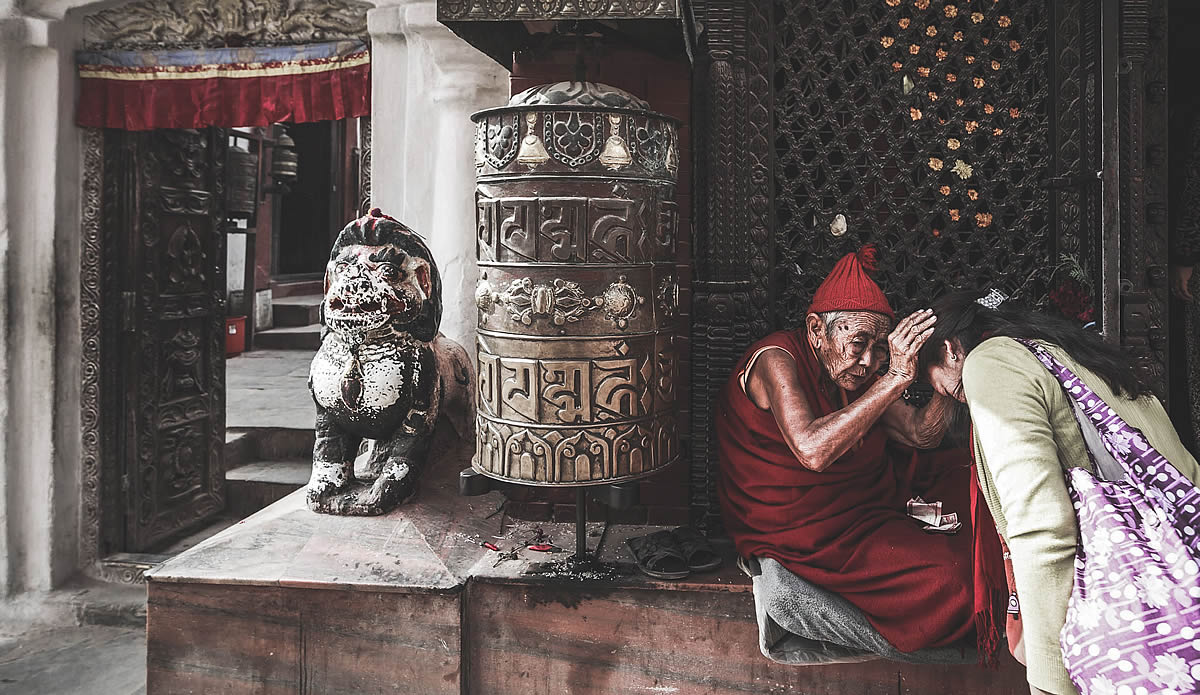
An elderly monk performs a traditional ritual with a visitor at an ancient temple shrine | photo: Mehmet Turgut Kirkgoz
Nepal - Global Development
Nepal graduates from least-developed status in November 2026, arriving there through a youth uprising that toppled its government
Nepal sits at the meeting point of two enormous stories at once. On November 24, 2026, it graduates from the United Nations’ Least Developed Country category, a landmark reached after more than fifty years on that list. It arrives there just fourteen months after Gen Z protesters burned down its parliament, forced out a prime minister, and installed the country’s first female head of government. For RYB, a country changing its formal development status and its political generation in the same year is exactly the kind of layered story worth reading closely.
A Graduation Without Precedent
Nepal was first found eligible to graduate from LDC status in 2015, but deferred after the earthquake that year. It deferred again in 2018, then accepted a five-year preparatory period in 2021, setting November 2026 as the final date. What makes Nepal’s case unusual is that it clears two of the three graduation thresholds, the Human Assets Index and the Economic Vulnerability Index, while its income per person has hovered right at the line for years. Nepal will become the first country in LDC history to graduate without ever meeting the income criterion on its own terms.
- GNI per capita (2025): roughly US$1,404, just above the $1,306 threshold
- Human Assets Index: 77.58, comfortably above the required 66
- Economic Vulnerability Index: 28.1, still elevated due to earthquake and pandemic shocks
- Poverty rate: down from over 40% two decades ago to roughly 17% today
Source: UN Committee for Development Policy, Nepal Smooth Transition Strategy 2024
Graduation brings real costs alongside the milestone. Nepal loses duty-free, quota-free market access and shifts to commercial lending rates. The International Trade Centre estimates export losses of around US$59 million in the first year, and the International Labour Organization has warned that up to 132,000 jobs could be at risk over five years without careful preparation. The Federation of Nepalese Chambers of Commerce has formally asked government for a further extension, arguing the transition now collides with a politically fragile, election-year moment. Whether Nepal graduates on schedule or requests one more deferral is still an open question as of mid-2026.
An Economy Built on Remittances
Nepal’s macroeconomic stability rests almost entirely on money sent home by its own citizens working abroad. Remittances now account for roughly 30% of GDP, and inflows rose nearly 38% year-on-year in the first eight months of the 2025–26 fiscal year alone, reaching close to US$9.7 billion. Every day, more than 1,500 Nepalis leave for foreign employment, mostly to the Gulf states and Malaysia. This income has driven down poverty and kept foreign exchange reserves at record highs, but it comes with a structural cost economists describe as a form of Dutch disease: remittance inflows push up the real exchange rate, prices out domestic agriculture and manufacturing, and leave imports outweighing exports by nearly seven to one. The result is a country whose people are prospering individually while its productive economy stays thin.
A Year That Rewrote Nepali Politics
In September 2025, the government’s decision to ban major social media platforms, layered on top of years of frustration over corruption and youth unemployment, ignited the largest youth-led uprising in Nepal’s modern history. Protesters, organised almost entirely through Discord and VPNs rather than any political party, set fire to the parliament building and forced the resignation of Prime Minister K.P. Sharma Oli. On September 12, former Chief Justice Sushila Karki was sworn in as interim prime minister, becoming the first woman to lead Nepal’s government, with elections brought forward to March 2026.
Those elections, held peacefully on March 5, 2026, delivered a sweeping win to the Rastriya Swatantra Party under Balendra “Balen” Shah, the former mayor of Kathmandu. Sworn in on March 27, 2026, Shah became Nepal’s youngest-ever prime minister at 35, propelled almost entirely by the same young voters who had taken to the streets six months earlier. Nepal became the third South Asian country this decade, after Sri Lanka and Bangladesh, to see a government fall to youth-led protest. For a country now also navigating LDC graduation, that political reset arrives at a genuinely consequential moment.
Foreign Aid and Nepal’s Donor Landscape
Nepal has relied on foreign aid since 1951, when the United States signed the country’s first development agreement. India, China, and Japan followed within the decade, and aid has shaped Nepal’s roads, hospitals, and power plants ever since. Today, multilateral institutions supply 60-65% of total disbursements, led by the World Bank and Asian Development Bank.
Among bilateral partners, the United States remains Nepal’s largest donor overall, having provided roughly $1.6 billion in grants between 2010 and 2022. China ranks second, at approximately $1 billion over the same period, followed closely by India at just under $1 billion. The United Kingdom, Japan, and Germany round out Nepal’s other major bilateral partners.
China and India have both expanded their footprint sharply over the past decade, partly as strategic competition for influence in Kathmandu. Norway, Switzerland, and other smaller European donors focus more narrowly on governance, education, and gender programmes.
Nepal’s government targeted $2.05 billion in foreign assistance for fiscal year 2024/25, split between $397 million in grants and $1.65 billion in loans. This aid still represents about 14.5% of Nepal’s national budget, down from 20% a decade ago, even as its absolute value keeps growing.
That shift matters. Loans made up just 24% of aid in 2010/11, but reached 60% by 2023/24. Energy projects receive the largest share of new aid commitments, at nearly 28%, followed by infrastructure, agriculture, and direct budget support.
The 2025 US aid freeze hit Nepal directly. More than 300 Nepali NGOs, consultancies, and nonprofits lost funding when USAID paused operations. For a country already managing LDC graduation, the timing could hardly have been worse.
Domestic Revenue Mobilization: Nepal’s Tax Challenge
Where wealthy nations often face criticism for enabling tax avoidance abroad, Nepal faces the opposite problem: collecting enough tax revenue at home. This challenge grows more urgent as LDC graduation approaches and concessional aid becomes harder to secure.
In 2024, Nepal’s Ministry of Finance launched a five-year Domestic Revenue Mobilization Strategy, running through 2028/29. Its goal is straightforward: reduce dependence on foreign grants and loans by strengthening the country’s own tax base before graduation removes preferential financing options.
This challenge connects directly to Nepal’s remittance economy. Billions of dollars flow into Nepali households every year, yet these funds are rarely taxed as productive income, and mostly go toward consumption rather than investment. Strengthening formal tax collection could help convert remittance wealth into a more sustainable revenue base.
Illicit financial flows compound the problem globally. Research shows developing countries that strengthen compliance with international anti-money-laundering standards consistently collect more domestic tax revenue than those that do not. For Nepal, joining these frameworks more fully could meaningfully offset the aid it stands to lose after graduation.
Hydropower and the Next Economy
Nepal’s most concrete long-term opportunity lies underground, or rather, in its rivers. The country holds an estimated 43,000 megawatts of technically feasible hydropower capacity, one of the highest endowments per capita anywhere in the world, yet had only around 3,422 megawatts installed as of March 2025. India’s own electricity deficit creates steady, structural demand next door. If development accelerates, hydropower exports could become a major foreign exchange earner by the end of this decade, offering Nepal something remittances alone cannot: an income source tied to production rather than migration.
Melting at the Roof of the World
Nepal’s hydropower ambitions face a direct threat from the same mountains that make them possible. Glacial lakes across the Himalayas are expanding rapidly as warming accelerates ice melt. Imja Lake, once a small pool, now covers 1.28 square kilometres and reaches nearly 150 metres deep.
Glacial lake outburst floods, or GLOFs, are becoming more frequent and more destructive as a result. In September 2024 alone, extreme rainfall and flooding killed more than 230 people, displaced over 10,800 households, and caused upward of $335 million in economic damage.
The risk to hydropower specifically is severe. Researchers estimate a single worst-case GLOF event at Imja Tsho could destroy hydropower infrastructure worth nearly $9 billion. Similar
risks apply to the Tsho Rolpa and Thulagi lakes, both sites of existing or planned energy projects.
Nepal is responding. In 2025, the Green Climate Fund approved a $36.1 million grant for early-warning systems across the Koshi and Gandaki river basins, expected to benefit 2.3 million people. This builds on Nepal’s earlier success reducing risk at Imja and Tsho Rolpa lakes.
Nepal also used 2025’s inaugural Sagarmatha Sambaad, a new biannual climate dialogue named for Mount Everest, to launch its third Nationally Determined Contribution. For the first time, Nepal’s NDC includes a dedicated section on loss and damage, calling for stronger early-warning systems and fairer access to international climate finance.
Living with Risk
Nepal’s Economic Vulnerability Index stays elevated for a specific reason: geography. The country sits on one of the most active fault lines on Earth, and the April 2015 earthquake, which killed almost 9,000 people and caused damage equivalent to a third of GDP, remains the reference point for why Nepal keeps deferring graduation timelines in the first place. The National Statistics Office worked directly with UN agencies after 2015 to build the damage assessments that shaped the country’s recovery, and that same disaster-data infrastructure now feeds into Nepal’s climate adaptation planning as glacial and monsoon risk continues to grow across the Himalayan region.
Culture, Heritage, and the Kathmandu Valley
For a network built on the idea that culture carries development forward, Nepal offers an unusually dense case. The Kathmandu Valley alone holds a UNESCO World Heritage listing spanning seven monument zones, home to Newar art and architecture built up over more than a thousand years of trade along the Himalayan branch of the Silk Road. Lumbini, the birthplace of the Buddha, and the mountain landscapes around Sagarmatha, the Nepali name for Everest, complete a heritage and tourism base that predates any of Nepal’s current development statistics by centuries. Tourism collapsed during the pandemic and again briefly after the 2025 protests, but it remains one of the clearest paths to income that does not depend on remittances or foreign aid.
Women, Federalism, and a Constitution Under Review
Nepal’s 2015 constitution restructured the country into seven provinces and wrote gender-inclusion requirements directly into its federal parliament, reserving seats for women in both chambers. That framework faced its first real test in the aftermath of the 2025 protests, when Nepal’s Gen Z movement, in which women played a visibly prominent organising role, pushed the country toward its first female head of government. Reporting since the March 2026 election has also raised a harder question: political parties still gave women a strikingly small share of the directly-contested seats, even as the country’s most visible recent leadership moment was a woman’s. The constitutional review process opened after the 2025 unrest is expected to revisit representation questions alongside its broader look at federalism and accountability.
Trade Preferences and Tariffs After Graduation
Nepal’s trade relationship with the US illustrates the wider risk graduation carries. The Nepal Trade Preference Program, granting duty-free access for 77 products since the 2015 earthquake, expired on December 31, 2025, with no renewal in sight.
That expiry lands alongside a new US baseline tariff of 10%, applied globally since April 2025. Even so, Nepal fared better than regional competitors: Bangladesh faces 37%, Sri Lanka 44%, and Vietnam 46% under the same reciprocal tariff system.
Economists at SAWTEE, a Kathmandu-based trade think tank, estimate the direct GDP impact will be small, around 0.01%. Nepal’s exports to the US, worth roughly $12 million under the expired preference programme, were always a modest share of its trade.
Still, the symbolism matters more than the numbers. As LDC graduation removes concessional trade terms globally, and as the US retreats from preferential arrangements specifically, Nepal loses two overlapping layers of trade protection at almost the same moment. Some exporters see opportunity in this disruption: with rivals facing steeper tariffs, Nepal could attract manufacturers relocating away from higher-tariff competitors, if it can fix chronic infrastructure and customs bottlenecks fast enough.
Finland’s Nepal Partnership
Nepal connects directly to RYB’s existing Finland page. Under Finland’s 2024 development policy, the country narrowed its list of programme partner countries from nine to five: Ethiopia, Nepal, Syria, Tanzania, and Ukraine. Finland’s aid approach, built around gender equality, local democracy, and rights-based partnership, has made Nepal one of its longest-standing bilateral relationships in Asia. For RYB, that gives two country pages already built, Finland and Nepal, a genuine and traceable connection beyond the shared UN development framework.
How This Connects to the SDGs
Nepal’s overlapping transitions touch nearly every Sustainable Development Goal at once. Falling aid-to-budget ratios test SDG 17, on global partnerships, just as graduation removes preferential financing. Domestic revenue mobilization efforts speak directly to SDG 1, ending poverty, by building a sustainable, non-aid financing base.
Climate risk connects hydropower ambitions to SDG 7, affordable clean energy, and SDG 13, climate action, simultaneously. Trade preference loss threatens SDG 8, decent work, in export-dependent sectors like garments and carpets. The Gen Z movement’s push for representation ties directly into SDG 5, gender equality, and SDG 16, strong institutions.
Because Nepal faces so many of these transitions together, in the same eighteen-month window, it offers an unusually clear picture of how the SDGs interconnect in practice, rather than as separate, siloed goals.
Looking Forward
Nepal’s story right now is really two clocks ticking at once. One counts down to November 24, 2026, when a fifty-five-year LDC classification ends, whether or not the country asks for one more delay. The other started ticking in September 2025, when a generation with no interest in old party structures forced its way into government within six months. Neither clock has fully run out yet.
A third, quieter clock runs underneath both. Nepal must replace shrinking aid and vanishing trade preferences with stronger domestic revenue, functioning hydropower exports, and climate resilience, all at once, and largely without the concessional support that shaped its development for seventy years. What happens between these clocks, whether hydropower and tax reform can convert remittance wealth into productive industry, and whether Balendra Shah’s government can hold the trust of the youth that put him there, will likely define how this page reads a year from now.
How we build this page
This page is part of the RYB five-page country profile for Nepal, covering Global Development, SDGs, Culture Women’s Day, Gender Gap, and VAWG. Our country pages methodology explains the sources, reports, and research approach behind every page in this series.
Sources
- East Asia Forum, “Nepal’s LDC graduation is a structural stress test” — eastasiaforum.org
- OnlineKhabar, “Nepal’s inflection point: 2025’s institutional reckoning” — english.onlinekhabar.com
- OnlineKhabar, “Foreign assistance to Nepal: Trends, challenges and opportunities” — english.onlinekhabar.com
- UN LDC Portal, Nepal graduation status — un.org/ldcportal
- National Planning Commission, Nepal Smooth Transition Strategy 2024 — undp.org
- OECD, Development Co-operation Profile: Finland — oecd.org
- Kathmandu Post, “Shifts in international cooperation” — kathmandupost.com
- Nepal Economic Forum, “Foreign Aid and FDI in Nepal: A Brief Overview” — nepaleconomicforum.org
- Government of Nepal Ministry of Finance, Domestic Revenue Mobilization Strategy 2024/25-2028/29 — giwmscdnone.gov.np
- UNDP Climate Promise, “Building climate resilience in Nepal’s mountains and plains” — climatepromise.undp.org
- UNDP, “From Melting Glaciers to Global Action: Loss and Damage in Nepal” — undp.org
- UNDP, “Green Climate Fund approves $36.1 million to help Nepal” — undp.org
- Nepal NDC 3.0, UNFCCC submission — unfccc.int
- Kathmandu Post, “Nepal’s US trade preference at risk amid growing tariff tensions” — kathmandupost.com
- Kathmandu Post, “US trade preference for Nepal expires, but exports unlikely to be hit hard” — kathmandupost.com
- OTEXA, Nepal Trade Preference Program — trade.gov
- Wikipedia, “2025 Nepalese Gen Z protests” — en.wikipedia.org
- Britannica, “2025 Nepalese Gen Z Protests” — britannica.com
- Human Rights Watch, Nepal coverage — hrw.org

Nepal
Federal Democratic Republic of Nepal
सङ्घीय लोकतान्त्रिक गणतन्त्र नेपाल
Population
29.7 million (2025 est., UN World Population Prospects)
29,164,578 (2021)
26,494,504 (2011)
Capital: Kathmandu
Internet country code: .np
Government
Official portal: nepal.gov.np
National Planning Commission: npc.gov.np
National Statistics Office: nsonepal.gov.np
UN
Office of the UN High Commissioner for Human Rights, Nepal: ohchr.org
Universal Periodic Review: ohchr.org/en/hr-bodies/upr/np-index
LDC Graduation status: un.org/ldcportal/content/nepal-graduation-status
Background
In the mid-18th century, the Gorkha king Prithvi Narayan Shah unified the principalities of the central Himalayas into the Kingdom of Nepal, taking the Kathmandu Valley in 1768 and 1769. Nepal preserved its independence through the Anglo-Nepalese War of 1814–16, never falling under colonial rule, and later supplied Gurkha regiments to the British Indian Army. Autocratic Rana family rule governed the country from 1846 until a 1951 revolution restored the monarchy to executive power. A Maoist insurgency from 1996 to 2006 ended with a peace accord, and following a 2008 Constituent Assembly election, Nepal abolished its 240-year monarchy and declared itself a federal democratic republic. A new constitution, promulgated in 2015 after a decade of political transition, divided the country into seven provinces. In September 2025, a youth-led uprising against corruption and a social media ban toppled the government, installing Sushila Karki as Nepal’s first female prime minister on an interim basis. Elections on March 5, 2026 brought Balendra Shah, Nepal’s youngest-ever prime minister, into office.