

SDGs Nepal
90
SDG Index rank, out of 169 countries
68.7
SDG Index score, out of 100
40
Spillover rank, out of 169 countries
94.4
Spillover score, out of 100
Source: Sustainable Development Report 2026, SDSN / Dublin University Press
Most people have never heard of the Sustainable Development Goals in any real detail. Surveys across the US, UK, France, and Germany find only 8–12% of people can actually say what the SDGs are. RYB exists to close that gap, looking at the same reports and reviews the UN and researchers use, and explaining them as we go.
Nepal ranks 90th out of 169 countries on overall SDG progress, 3rd in South Asia behind Bhutan and the Maldives, and ahead of India, Sri Lanka, Bangladesh, and Pakistan. The SDSN’s own researchers have singled Nepal out by name as one of the fastest-improving countries on Earth relative to its region, gaining an estimated 11.1 points since 2015. A country graduating from Least Developed Country status this November is also, by this measure, one of the report’s genuine success stories. Its Spillover rank tells an even stronger story, and we’ll get to why.
Nepal — Sustainable Development Report 2026
NP
Voluntary National Reviews: A Steady, Three-Review Record
Nepal has reported to the UN’s High-Level Political Forum three times since the SDGs launched, in 2017, 2020, and most recently 2024. That’s a more consistent pattern than Brazil’s, which had a formal gap after 2017, and roughly matches the cadence of most mid-sized reporting countries.
The 2024 review, Nepal’s third, was prepared jointly with line ministries, sub-national governments, the private sector, cooperatives, civil society, the National Human Rights Commission, and marginalised-group representatives, and it leaned specifically into acceleration: decent work and social protection, food-system transformation, health and education, resilient urbanisation, gender equality, social inclusion, climate action, and digital transformation. It landed at a pointed moment, one year before Nepal’s LDC graduation and one year before the Gen Z protests that would reshape its government.

Voluntary Local Reviews: Smaller Cities, and a Child-Led First
Nepal’s local SDG reporting doesn’t run through a single capital-city flagship the way Amsterdam’s does for the Netherlands. Instead, it runs through a handful of smaller municipalities, and one genuinely unusual national exercise.
Dhulikhel, a hillside city east of Kathmandu known for its Mount Everest views and university hospital, launched its VLR process in January 2021 with technical support from UNESCAP and ICLEI South Asia, publishing its final report in 2022. Chandragiri Municipality, on Kathmandu’s southwestern edge, launched its own VLR on World Habitat Day, October 7, 2024, focused on health, education, gender equality, water and sanitation, and sustainable cities.
The most distinctive entry, though, is not a city at all. Nepal’s National Child Advocate Council coordinated a child-led Voluntary Local Review, run across all seven provinces, with community consultations held in ten districts and ten municipalities, from Deumai and Biratnagar in Koshi Province to Birendranagar in Karnali, plus a dedicated Kathmandu Valley session. Children were briefed on the SDGs and the VNR process, then asked directly what problems they saw in their own families and communities. RYB hasn’t come across a comparable child-led VLR process anywhere else on this site so far, and it’s worth its own feature at some point.
What the Sustainable Development Report Shows: Two Scores That Rarely Move Together
The overall score measures how well a country is doing for its own people. The spillover score measures how much harm, or help, a country’s economy causes everyone else. These two numbers usually diverge in opposite directions depending on how developed and export-heavy a country is, and Nepal’s case is unusually clean.
Nepal doesn’t yet export at the scale that generates the spillovers researchers track: no recorded exports of plastic waste, no exports of major conventional weapons, no shifted multinational profits, and a Corporate Tax Haven Score of zero, the best possible result. Compare that to the Netherlands, where large-scale plastic and weapons exports drag its spillover rank down to 167th, or Finland, whose Nordic wealth still generates enough international impact to land it at 144th. Nepal’s clean sheet here isn’t a policy triumph so much as a reflection of where its economy currently sits, small, import-dependent, and not yet industrialised at scale. That’s also, not coincidentally, the exact same story behind Nepal’s LDC graduation this November: not producing much also means not harming much.
Where Nepal’s 17 Goals Stand
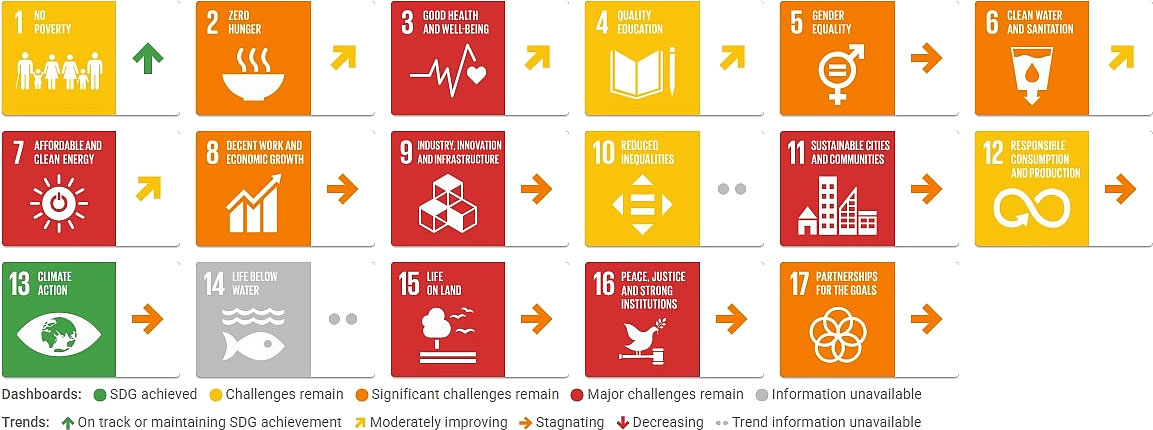
Nepal’s goal-by-goal picture is more uneven than its topline score suggests, and one result stands out immediately: Nepal’s strongest goal, by a wide margin, is Goal 13, Climate Action, scoring 97.5, and rated green. Its weakest is Goal 9, Industry, Innovation and Infrastructure, scoring just 37.4, consistent with the road density and R&D gaps already visible in Nepal’s own national SDG assessments.
- On track (green): Goal 13, Climate Action
- Major challenges (red): Goal 3 (Health), Goal 7 (Energy), Goal 9 (Industry & Infrastructure), Goal 11 (Cities), Goal 15 (Life on Land), Goal 16 (Peace, Justice & Institutions)
- No data (grey): Goal 14, Life Below Water — Nepal is landlocked, so this indicator doesn’t apply
- Significant challenges (orange): Goal 2 (Hunger), Goal 5 (Gender), Goal 6 (Water & Sanitation), Goal 8 (Decent Work), Goal 17 (Partnerships)
- Challenges remain (yellow): Goal 1 (Poverty), Goal 4 (Education), Goal 10 (Inequality), Goal 12 (Consumption)
Nepal’s Goal 16 red rating is worth reading alongside the Gen Z protests that toppled its government in September 2025. Corruption and weak institutional accountability were the protests’ central grievance, and it shows up directly in the same year’s Index.
Source: Sustainable Development Report 2026, SDR2026 Data, SDSN / Dublin University Press
UNDP
Human Development Report — A Different Lens, A Harder Ranking
The Human Development Index measures something narrower and older than the SDGs: life expectancy, education, and income, combined into a single score, with no 2030 deadline attached. Nepal ranks 145th out of 193 countries with an HDI value of 0.622, placing it in the “medium human development” category. That is a harder position than Nepal’s SDG Index rank of 90th out of 169 suggests, and worth reading side by side rather than instead of.
The gap between the two rankings comes down to what each measures. The SDG Index rewards Nepal for indicators like electricity access and internet use, both moving fast, alongside dozens of health, environment, and institutional targets. The HDI weighs income far more heavily, and Nepal’s GNI per capita, while finally clearing the LDC graduation threshold this year, remains one of the lowest in Asia. Nepal’s HDI value has still climbed 54% over the past 35 years, a real gain even from a rank that looks static.
Nepal’s Human Development Index data →
What is the difference between the HDI and the SDGs →
RYB’s Place in This Picture
Nepal is RYB’s newest South Asian country page, and its first genuine LDC-graduation story. The Netherlands and Finland pages show what SDG reporting looks like from inside a wealthy, high-ranking country with a mature local-review culture, and a Spillover rank that punishes exactly that wealth. Brazil showed what it looks like from a large, mid-ranked economy with an unusually strong spillover record.
Nepal shows something different again: a country whose national score keeps climbing, whose spillover record is nearly as clean as Brazil’s for entirely different reasons, whose local reviews come from small cities and a child-led council rather than a capital-city flagship, and whose weakest goal, institutions and peace, is the same grievance that put its youngest-ever prime minister in office. That combination, genuine progress, a light international footprint, and open domestic strain, is worth reading as its own kind of case study.
Looking Forward
Watch the 2027 SDG Summit, where Brazil’s ethnic-racial equality proposal and UNESCO’s culture goal will both compete for space in whatever comes next. And watch whether Brazil’s strong spillover position holds as its economy grows, since results like this can shift quickly as trade patterns change.
Sources
- Sustainable Development Report 2026, Nepal — dashboards.sdgindex.org/profiles/nepal
- High-Level Political Forum, Nepal Voluntary National Review 2024 — hlpf.un.org/countries/nepal/voluntary-national-reviews-2024
- Nepal’s second VNR, 2020, UN Mission statement — un.int/nepal
- Dhulikhel, Nepal Voluntary Local Review, IGES / UN-Habitat — unhabitat.org
- Chandragiri Municipality VLR launch, UN-Habitat Localizing the SDGs — sdglocalization.org
- Sustainable Development Goal and Child-Led Voluntary Local Review Report, Consortium Nepal — consortium.org.np
- Nepal’s SDGs – Needs Assessment, Costing and Financing Strategy: An Update, National Planning Commission — npc.gov.np
- UNDP, “Nepal ranks 145th on Human Development Index for 2025,” The Kathmandu Post — kathmandupost.com
- “Nepal scales back key SDG health targets,” The Kathmandu Post — kathmandupost.com
- National Planning Commission, “Nepal achieves only 41.7 percent progress in SDGs,” Republica — myrepublica.nagariknetwork.com