

Serbia Sustainable Development Goals (SDGs)
36
SDG Index rank, out of 169 countries
78.17
SDG Index score, out of 100
110
Spillover rank, out of 169 countries
85.63
Spillover score, out of 100
Source: Sustainable Development Report 2026, SDSN / Dublin University Press
Most people have never heard of the Sustainable Development Goals in any real detail. Surveys across the US, UK, France, and Germany find only 8–12% of people can actually say what the SDGs are. RYB exists to close that gap, looking at the same reports and reviews the UN and researchers use, and explaining them as we go.
Serbia presented its first, and so far only, Voluntary National Review in 2019. Seven HLPF cycles have passed since then, through 2025, with no second review, and Serbia isn’t on the list of countries presenting in 2026 either. Bulgaria, its neighbor two countries away, has already presented twice. Serbia’s SDG Index numbers, meanwhile, are genuinely strong, 36th out of 169 overall, better than every other country RYB has covered on this site except the UK and the Netherlands. The two facts sit oddly together: a country doing this well by the numbers, with only one formal check-in on record.
Serbia — Sustainable Development Report 2026
RS
Voluntary National Reviews: One Review, Seven Years Ago
Serbia’s only Voluntary National Review to date was presented at the High-Level Political Forum in July 2019. It described an Inter-Ministerial Working Group, established in 2015, coordinating SDG implementation across all ministries and state institutions, and a “Serbia and the 2030 Agenda” document mapping the country’s national strategic framework directly onto the Goals, produced together with the Statistical Office of the Republic of Serbia.
No second VNR has followed. Of the countries that first reported alongside Serbia in 2019, including Bosnia and Herzegovina, most have returned at least once since. Serbia has not yet confirmed a return date, and it isn’t among the 36 countries scheduled to present at the 2026 HLPF.
Voluntary Local Reviews: Niš Leads the Way
The City of Niš published Serbia’s first Voluntary Local Review, initiated in July 2023 and released in late 2024, developed with support from UN-Habitat, UN DESA, UNECE, and UCLG. It’s the first VLR in Serbia and only the third in Southeast Europe, and it established a dedicated SDG-monitoring unit inside the city administration, something Serbia hadn’t had systematically at the local level before. The review’s early success has already sparked interest at the national level, with plans to scale up SDG localization through a joint programme backed by UNICEF, UNEP, and UN-Habitat.
What the Sustainable Development Report Shows: A Strong Score, A Mid-Table Spillover Rank
The Sustainable Development Report scores every country two ways. The overall score measures how well a country is doing for its own people. The spillover score measures how much harm a country’s economy causes everyone else.
Serbia’s overall score sits at 78.17 out of 100, ranking 36th out of 169 countries, its strongest position of any country RYB has covered from the region so far. Its spillover score sits at 85.63 out of 100, translating to a rank of 110th, weaker than the score alone suggests, though notably less severe than Bulgaria’s 121st or Finland’s 144th.
Why Serbia’s Spillover Score Holds Up Better Than Its Neighbors
- Weapons exports sit in the middle of the pack. At 0.297 TIV per 100,000 people, Serbia’s figure is close to Bulgaria’s 0.35 and higher than Bosnia and Herzegovina’s 0.14 or Brazil’s 0.038, but well below the UK’s 1.553, the Netherlands’ 2.15, or the US’s 3.773.
- Plastic waste exports are genuinely low. At 0.477 kg per capita, Serbia exports less than Bosnia and Herzegovina (0.905 kg) or Bulgaria (2.507 kg), and a fraction of the Netherlands’ 30.162 kg or the UK’s 11.966 kg.
- Support for UN-based multilateralism is moderate. Serbia’s score sits at 58.1 out of 100, close to Bulgaria’s 60.1, behind Bosnia and Herzegovina’s 69.0 and Brazil’s 81.6, but still ahead of the UK’s 54.9 and far ahead of the US’s 1.7.
Where the Work Remains
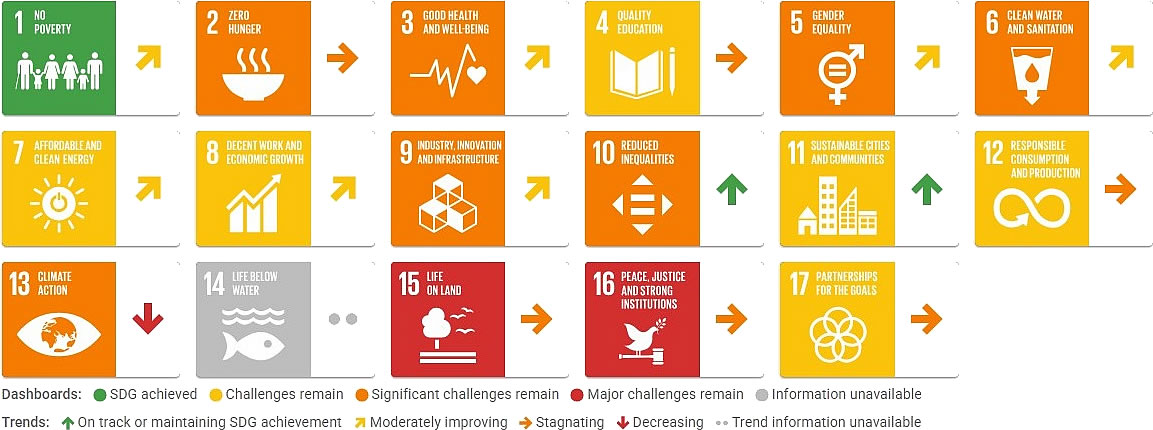
Serbia’s Statistical Performance Index sits at 80.5 out of 100, solid, and stronger than Bosnia and Herzegovina’s 68.6. Its Corruption Perceptions Index score is a different story: just 33 out of 100, the weakest of any country RYB has covered on this site so far, narrowly below Bosnia and Herzegovina’s 34. On the dashboard itself, Climate Action (SDG 13) is the one goal currently moving in the wrong direction rather than stagnating or improving, and Life on Land (SDG 15) and Peace, Justice and Strong Institutions (SDG 16) both rate the dashboard’s worst color, red. Life Below Water (SDG 14) carries no color at all, rated “insufficient data,” a reflection of Serbia’s geography as much as its reporting: it’s landlocked, one of the few countries on this site’s list where that indicator simply doesn’t apply.
Serbia’s spillover rank sits alongside every other country RYB tracks on the Global Responsibility page, where rankings like these are shown together across all the countries covered on this site.
Why These Numbers Matter
These pages matter more than their topic suggests on the surface. The SDGs are, in effect, the world’s working roadmap for its biggest shared problems, yet most citizens have never engaged with them directly. A Voluntary Local Review can change that at the scale where it’s most achievable: one city, one community, people who might otherwise never cross paths brought into the same conversation about what their home needs most.
Culture and the arts barely feature in Serbia’s one VNR, or in the municipal programmes running since. RYB tracks Serbia because a seven-year gap between national reviews, on a country performing this well by the numbers, is itself worth naming, and because a Culture of Peace lens has something real to add to a country whose progress is happening with remarkably little public reporting to show for it.
RYB’s Place in This Picture
RYB tracks Serbia because its numbers and its reporting record tell two different stories. A country ranking 36th out of 169, ahead of most of Europe, would typically also have a recent track record of reporting that progress back to the UN. Serbia’s has not, not since 2019. Read together with the Corruption Perceptions Index score, the weakest RYB has recorded so far, and a capital region whose own HDI runs noticeably ahead of the rest of the country, the overall SDG Index rank tells a less complete story on its own than it does alongside everything around it.
Looking Forward
Watch whether Serbia confirms a second Voluntary National Review before the current HLPF cycle closes in 2027. Watch the SDG 13 climate trend specifically, the one goal on Serbia’s dashboard currently moving backward. And watch whether any Serbian city builds on programmes like “Green Futures, Brighter Beginnings” into the country’s first formal Voluntary Local Review.
Human Development Report — Serbia
The Human Development Index measures something narrower and older than the SDGs: life expectancy, education, and income, combined into a single score, with no 2030 deadline attached. It is a different lens on the same country, worth reading alongside the SDG data above rather than instead of it.
Serbia’s HDI reached 0.833 in 2023, up from 0.805 the year before, and now ranks 62nd out of 193 countries, “very high human development.” The national figure hides a real regional gap worth reading in full on UNDP’s own page: Belgrade’s own HDI runs close to 0.87, noticeably ahead of the rest of the country. Adjusted for inequality, Serbia’s IHDI falls to 0.772, a meaningful discount on the headline number.
Serbia’s Human Development Index data →
What is the difference between the HDI and the SDGs? →
Sources
- SDG Index database, Sustainable Development Report 2026 — Fuller, G., Iablonovski, G., Lafortune, G. and Sachs, J.D. (2026), SDSN / Dublin University Press, DOI:10.82163/225
- Sustainable Development Report 2026, Serbia profile — dashboards.sdgindex.org
- Voluntary National Review 2019, Serbia — serbia.un.org
- VNRs, High-Level Political Forum 2026 — hlpf.un.org
- Green Futures, Brighter Beginnings, UN in Serbia — serbia.un.org
- Human Development Report 2025, Statistical Annex — hdr.undp.org
- List of Serbian regions by Human Development Index, background reference — en.wikipedia.org
- Economy of Serbia, background reference — en.wikipedia.org