

Singapore Sustainable Development Goals (SDGs)
59 / 169
SDG Index Rank, 2026
59 / 169
SDG Index Rank, 2026
59 / 169
SDG Index Rank, 2026
59 / 169
SDG Index Rank, 2026
Source: Sustainable Development Report 2026, Sachs, J.D., Lafortune, G., Fuller, G., Iablonovski, G. Paris: SDSN, Dublin: Dublin University Press.
Most people have never heard of the Sustainable Development Goals in any real detail. Surveys across the US, UK, France, and Germany find only 8-12% of people can actually say what the SDGs are. RYB exists to close that gap, looking at the same reports and reviews the UN and researchers use, and explaining them as we go.
Singapore ranks 59th out of 169 countries on the 2026 SDG Index — respectable for a wealthy, high-functioning economy, though well behind its regional peers on this list. Its spillover rank is the most extreme number RYB has found in this entire series: 169th out of 169. Dead last. Not just worse than Denmark’s 157th, the previous worst RYB had recorded — the single worst spillover score of any country in the world’s SDG Index.
Singapore — Sustainable Development Report 2026
SG
Singapore’s SDG Story
Singapore’s 73.82 score reflects a country that has solved the basics decisively — universal water, sanitation, and electricity, a life expectancy of 84.0 years among the highest RYB has recorded, and a homicide rate of just 0.17 per 100,000, the lowest RYB has found anywhere. Its Corruption Perceptions Index of 84 and its innovation numbers — R&D spending, patent output, and the highest university research score RYB has recorded — round out a picture of a small, extremely well-run state.
Two goals with no data at all
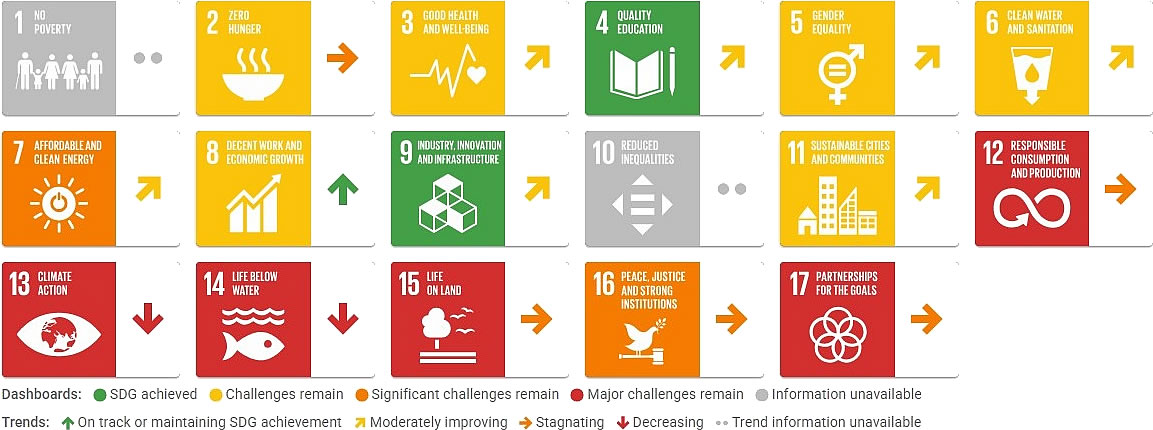
Goal 1 (Poverty) and Goal 10 (Inequality) both carry no color rating on Singapore’s dashboard — not red, not green, simply grey for missing data. Singapore doesn’t publish an official poverty line or submit standard Gini coefficient data in the form this index uses, a genuine policy choice rather than a data-collection failure, and one that leaves two of the report’s seventeen goals impossible to score.
A press freedom score that stands out from everything else on this page
Set against Singapore’s clean, high-functioning profile, one number breaks the pattern: a Press Freedom Index score of 44.6, rated red. It’s a sharp contrast with the near-uniform green ratings across health, infrastructure, and rule of law elsewhere on this page, and a reminder that a country can score exceptionally well on public services while still restricting a free press.
Renewable energy and ocean protection: genuine structural limits
Renewable energy makes up just 1.3% of Singapore’s final energy consumption, rated red and the lowest figure RYB has recorded in this series. Only 3.25% of marine sites important to biodiversity are protected, also red and the lowest RYB has found by a wide margin. Both numbers trace back to the same root cause: Singapore is a city-state of roughly 730 square kilometers with almost no room for solar or wind infrastructure at scale, and one of the busiest, most heavily used stretches of water in the world, the Singapore Strait, running along its coast.
Voluntary National Reviews and National Implementation
Two VNRs, framed around an island’s own vulnerability
Singapore presented its first Voluntary National Review in 2018 and its second in 2023, with no third as of 2026. Its 2023 VNR opened by describing Singapore as “a small, low-lying island state” for which climate change is “an existential threat,” and focused specifically on SDG 6 (Clean Water), SDG 7 (Clean Energy), SDG 9 (Industry and Infrastructure), SDG 11 (Sustainable Cities), and SDG 17 (Partnerships). That SDG 7 was one of the five goals Singapore chose to highlight is notable, given renewable energy is also one of its weakest measured indicators on this page — a sign the government has identified the same gap this data shows, even without a low score to point to yet.
Why there’s no city-level review to report
Unlike every other country RYB has covered, Singapore has no Voluntary Local Review to report — and there’s a structural reason for that. VLRs exist to give cities and municipalities a way to localize a national review that otherwise speaks for an entire country. Singapore is a city-state: its national government already governs at city scale, and its VNR already functions as the review a VLR would otherwise provide. There’s no separate local tier left to localize to.

What the Sustainable Development Report Shows: International Spillovers
The Sustainable Development Report scores every country two ways. The overall score measures how well a country is doing for its own people. The spillover score measures how much harm a country’s economy causes everyone else.
Singapore’s spillover score of 28.99 and rank of 169th out of 169 are the most extreme figures RYB has documented in this series — worse than Denmark’s 157th, the previous low point. Almost every import-linked indicator in the report is rated red for Singapore, and several score at or near zero on the report’s normalized scale.
A financial hub with the numbers to match
Singapore’s Corporate Tax Haven Score is 87 out of 100 (0 = best) — a real, measured figure, rated red, among the highest in the world. Its shifted profits of multinationals figure — $126.99 billion — is also real rather than imputed, and dwarfs every comparable figure RYB has recorded for any other country, most of which show this indicator as an imputed zero. Singapore’s role as one of the world’s major corporate and financial hubs shows up directly in this data.
A trade economy’s import footprint, maxed out
Greenhouse gas emissions embodied in imports run to 20.07 tonnes CO2-equivalent per capita, scoring zero on the normalized scale. Nitrogen emissions embodied in imports reach 153.68 kg per capita, also scoring zero. Imported deforestation comes to 48.5 square meters per capita, among the highest RYB has recorded, and marine biodiversity threats embodied in imports score zero as well. These aren’t scattered weak points — they’re a near-complete sweep of every import-linked indicator the report tracks, a direct reflection of Singapore’s economic model: a tiny, densely populated trading and re-export hub through which an enormous volume of goods, energy, and capital flows relative to its population of under 6 million.
Why These Numbers Matter
A high overall SDG score measures how a country treats its own people. It says nothing about what that country’s economy asks of everyone else — the profits that pass untaxed through its financial system, the emissions embedded in what it imports, the resources consumed on the other side of its supply chains. Singapore is the most extreme version RYB has found of a genuinely different story from Denmark’s: where Denmark’s footprint traces to what it produces and exports, Singapore’s traces to what it imports, refines, transships, and finances — the structural cost of running one of the world’s busiest trade and financial hubs on a landmass smaller than New York City.
RYB’s Place in This Picture
Singapore’s spillover rank of 169th is the worst RYB has recorded — a full step beyond Denmark’s 157th, which had itself been the previous low point. See the full picture, ranked side by side, on RYB’s Global Responsibility page.
UNDP
Human Development Report — Singapore
The Human Development Index measures something narrower and older than the SDGs: life expectancy, education, and income, combined into a single score, with no 2030 deadline attached. It is a different lens on the same country, worth reading alongside the SDG data above rather than instead of it.
Singapore’s HDI is 0.946 (2023 data) — the highest in Asia and among the highest in the world, placing it around 12th globally, though the figure ticked down slightly from 0.949 the year before, its first recorded decline in recent years. Adjusted for inequality, Singapore’s IHDI of 0.823-0.825 is the highest in ASEAN by a wide margin, suggesting the country’s development gains are unusually evenly distributed for its income level — a genuinely different story from the concentrated wealth its Corporate Tax Haven Score points to in the section above.