

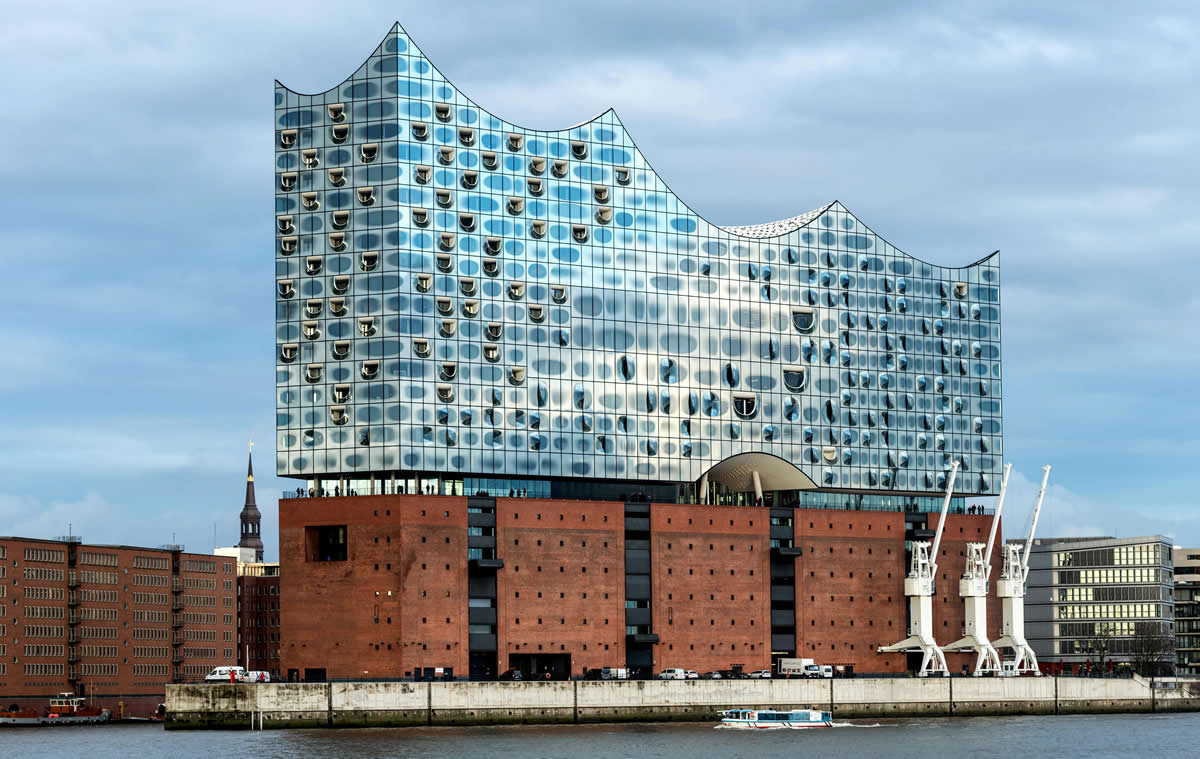
Elbphilharmonie in Hamburg – Photo: Wolfgang Weiser
Germany - Global Development
DE
Germany’s ODA falls 17% in 2025, its forests stop absorbing carbon, and Merz puts competitiveness before climate
Germany has long positioned itself as Europe’s development leader, second only to the United States by aid volume. Yet 2025 and 2026 marked a genuine turning point. Aid fell sharply, climate ambition slowed under a new government, and old tax transparency gaps remain unresolved. This article covers aid, tax, climate, and trade, the four threads shaping Germany’s global development role today.
From Record Donor to Record Cuts
Germany provided $29.1 billion in ODA in 2025, still ranking first among DAC donors by volume. However, this represented a 17.4% real-terms decrease from 2024, driven mainly by falling humanitarian aid and refugee costs.
Germany’s ODA/GNI ratio fell to 0.56% in 2025, missing the international 0.7% target for the second year running. Germany first hit that target in 2016 and exceeded it every year from 2020 to 2023, before falling short in 2024 and 2025.
The decline continues by design, not accident. The Federal Ministry for Economic Cooperation and Development’s budget fell to €10.3 billion in 2025, down roughly €1 billion from 2024. The 2026 draft budget cuts a further 3%, to €9.9 billion.
Long-term projections point lower still. Germany’s development budget is set to shrink to €9.3 billion by 2029, pushing the ODA/GNI ratio down to just 0.43%. Humanitarian funding absorbed the sharpest single cut, falling 47% between 2024 and 2025.
Political turbulence shaped this shift directly. Chancellor Friedrich Merz took office in May 2025 after a snap election, inheriting a federal deficit that reached €171 billion. Development spending became one of several casualties in the resulting budget consolidation.
Seventeen major aid organisations, including Oxfam and Welthungerhilfe, publicly condemned the cuts as a threat to both vulnerable communities abroad and Germany’s international standing. The BMZ’s 2026 reform plan responds partly to this pressure, shifting toward loans for emerging economies while concentrating grants on the least developed countries.
Despite the cuts, Germany still leads in specific areas. It committed the highest DAC volume for biodiversity funding and gender equality programming in 2024, and remained the top ODA provider addressing violence against women specifically.
Tax Transparency: A Quiet Contradiction
Germany’s tax policies sit awkwardly alongside its development rhetoric. The Tax Justice Network’s Financial Secrecy Index ranks Germany sixth globally among the world’s biggest enablers of financial secrecy, just behind Hong Kong and ahead of the Netherlands.
This ranking reflects Germany’s high tax rates paired with weak transparency tools, not a conventional tax haven profile. Foreign corporations do not relocate to Germany purely to avoid tax, but German financial secrecy still shields wealth extracted from developing countries.
Public country-by-country reporting illustrates the gap between rhetoric and practice. Germany delayed implementing this transparency requirement after business associations lobbied against it, limiting developing countries’ ability to assess German corporate tax practices fairly.
German tax treaties with developing countries add a further layer. Some agreements limit partner countries’ source-taxation rights, reducing government revenue exactly where domestic resource mobilisation matters most for financing the SDGs.
Climate Ambition Meets a New Government’s Priorities
Germany’s climate law commits the country to net greenhouse gas neutrality by 2045, with interim targets of a 65% emissions cut by 2030 and 88% by 2040. These targets remain legally binding, following a landmark constitutional court ruling in 2021.
The Merz government, in office since May 2025, has left the legal targets unchanged while shifting priorities elsewhere. Its coalition contract explicitly places competitiveness ahead of climate ambition, and Climate Action Tracker still rates German policy “Insufficient” against global 1.5°C goals.
A specific technical problem now complicates matters further. German forests, once a reliable carbon sink, turned into a net emissions source, removing a buffer the government’s 2045 neutrality plan had relied on to offset roughly 40 million tonnes of residual emissions.
Renewables expansion remains genuinely strong. Renewable sources supplied about 60% of electricity in 2025, and Germany stays broadly on track for its 2030 power-sector goals. Onshore wind, offshore wind, and solar capacity targets are all rising through 2040.
Other sectors lag badly. Transport and buildings remain furthest from their targets, and the government is retracting the previous administration’s electric vehicle sales target while weakening emissions compliance rules for carmakers.
The coal phase-out, legally set for 2038 at the latest, appears unlikely to move earlier despite past ambitions for a 2030 exit. Germany’s next official assessment of coal-exit progress is due in August 2026.
Trade Pressure: Tariffs Meet Carbon Costs
Germany’s export-driven economy felt 2025’s tariff shifts more sharply than most European peers. The EU-US trade agreement settled most tariffs at 15%, but German carmakers, chemical firms, and machinery exporters absorbed real, direct costs.
Volkswagen, BMW, and Mercedes-Benz already faced structural pressure from slow EV adoption and Chinese competition before the tariffs arrived. US tariffs compounded an already difficult transition for an industry central to German manufacturing employment.
A second cost pressure now compounds the first. The EU’s Carbon Border Adjustment Mechanism enters its financial phase in 2026, raising costs on carbon-intensive imports and exports alike, just as German industry manages tariff pressure from Washington.
Germany’s subsidised “industrial electricity price,” introduced in 2026, offers some relief to energy-intensive manufacturers. Even so, industry groups describe 2026 as a year of mounting pressure from tariffs, rising carbon costs, and stricter EU supply-chain rules simultaneously.
What Germany Still Contributes
Despite the cuts, Germany’s development architecture remains substantial. The GIZ deploys thousands of technical advisors worldwide, and KfW Development Bank continues financing infrastructure and climate projects across partner countries.
Africa remains Germany’s stated development priority. The Marshall Plan with Africa and Compact with Africa initiatives promote private investment alongside traditional aid, and 18.8% of gross bilateral ODA went to African countries in 2024, Germany’s largest regional allocation.
Germany’s gender equality commitments stand out among major donors. It remains the top DAC provider addressing violence against women, and committed $13.5 billion in 2024 toward programming with a gender equality policy marker, a genuinely distinctive record among G7 economies.
How This Connects to the SDGs
Falling ODA directly threatens SDG 17, on global partnerships, just as Germany’s own peer reviews have praised its historical development leadership. Financial secrecy connects to SDG 16, strong institutions, and SDG 10, reducing inequality, by shielding wealth that developing countries could otherwise tax.
The weakening forest carbon sink undermines SDG 13, climate action, at a structural level, removing a buffer Germany’s own climate law depended on. Slow progress on transport and buildings emissions works against the same goal from a different angle.
Germany’s strong gender-equality ODA performance supports SDG 5 directly, even as overall aid volumes decline. Because these dynamics pull in different directions simultaneously, Germany illustrates how a single donor can advance some SDGs while straining others in the same budget cycle.
A Pattern, Not an Isolated Case
Germany’s 2025 cut sits alongside similar reductions in Belgium, France, the Netherlands, Sweden, Switzerland, the UK, and the US. This marks broad, simultaneous retrenchment among traditional donors, not a uniquely German policy choice.
Still, Germany’s scale makes its retreat unusually consequential. As the world’s second-largest bilateral donor, its 17.4% real-terms cut removes resources few other donors can realistically replace, even collectively.
This reinforces a pattern RYB tracks across country pages: ODA levels reflect domestic political and fiscal pressures, not fixed international commitments. They shift with elections, coalition agreements, and budget crises, in Berlin as much as anywhere else.
Looking Forward
Germany enters the second half of this decade balancing genuine fiscal constraints against a development reputation built over decades. Whether the 2029 budget projections hold, or whether political pressure forces a partial reversal, remains genuinely open.
Climate policy offers the clearest test ahead. Germany’s Climate Action Programme, due by March 2026, must show how the government will close a growing emissions gap without simply relying on sectors that are already overperforming to offset others that are not.
The forest carbon sink problem deserves particular attention. Without a functioning natural sink, Germany’s 2045 neutrality target increasingly depends on technologies like carbon capture that remain unproven at the scale required.
RYB will track whether Germany’s aid cuts stabilise or continue deepening through 2029, and whether the Merz government’s competitiveness-first climate approach narrows or widens the country’s emissions gap. This page will be updated as new budget and policy decisions emerge.
Sources
- OECD, Development Co-operation Profile: Germany — oecd.org
- DevelopmentAid, “Germany’s deep aid cuts threaten millions worldwide” — developmentaid.org
- DevelopmentAid, “Germany’s aid cuts under fire from expert community” — developmentaid.org
- Donor Tracker, “Germany publishes 2026 draft budget, signals decline in ODA” — donortracker.org
- Donor Tracker, “Germany’s draft 2025 budget: Downward ODA trends confirmed” — donortracker.org
- Welthungerhilfe, “Kompass 2025: German Development Aid at a Turning Point” — welthungerhilfe.org
- Tax Justice Network, Indexes & Tools (Financial Secrecy Index ranking) — taxjustice.net
- Climate Action Tracker, Germany country profile — climateactiontracker.org
- Climate Action Tracker, “REACTION: Germany’s latest projections” — climateactiontracker.org
- Clean Energy Wire, “Q&A: Germany’s greenhouse gas emissions and energy transition targets” — cleanenergywire.org
- Clean Energy Wire, “Preview 2026: Merz government must deliver on key energy projects as patience wears thin” — cleanenergywire.org
- Clean Energy Wire, “Germany’s gas exit under way as challenges in heating and industry linger” — cleanenergywire.org
- RYB, Official Development Assistance (ODA) — redyellowblue.org/finance/oda/

Germany
Federal Republic of Germany
Bundesrepublik Deutschland
Population
84,119,100 (2024 est.)
84,220,184 (2023)
79,903,481 (2021)
80,159,662 (2020)
80,594,017 (2017)
Capital: Berlin
Internet country code: .de
Government
Official website: bundesregierung.de
Portal of German tourism: germany.travel
The German Business Portal: german-business-portal.info
Background
As Europe’s largest economy and second most populous nation (after Russia), Germany is a key member of the continent’s economic, political, and defense organizations. European power struggles immersed Germany in two devastating World Wars in the first half of the 20th century and left the country occupied by the victorious Allied powers of the US, UK, France, and the Soviet Union in 1945. With the advent of the Cold War, two German states were formed in 1949: the western Federal Republic of Germany (FRG) and the eastern German Democratic Republic (GDR). The democratic FRG embedded itself in key Western economic and security organizations, the EC, which became the EU, and NATO, while the communist GDR was on the front line of the Soviet-led Warsaw Pact. The decline of the USSR and the end of the Cold War allowed for German unification in 1990. Since then, Germany has expended considerable funds to bring Eastern productivity and wages up to Western standards. In January 1999, Germany and 10 other EU countries introduced a common European exchange currency, the euro.
Germany’s postwar transformation into Europe’s leading economy also made it one of the world’s largest development donors, a role now being tested by budget pressure, coalition politics, and a changing climate consensus at home.