

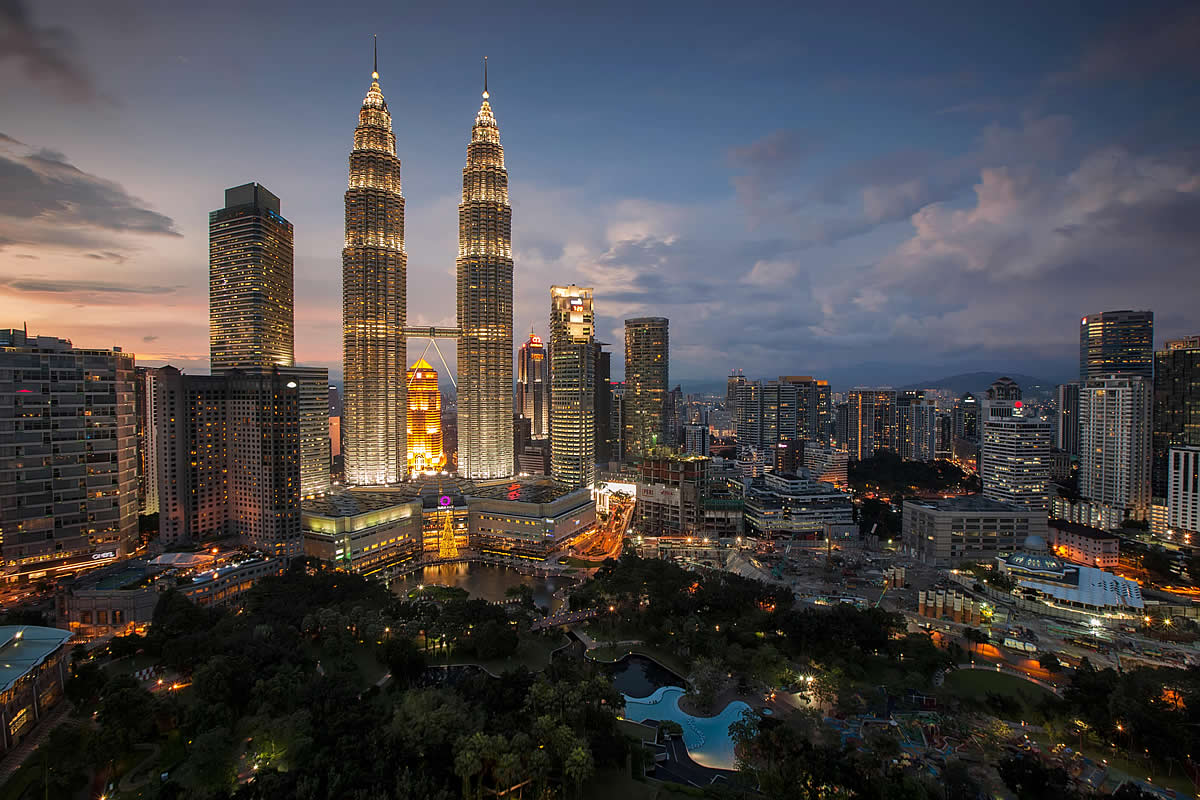
Kuala Lumpur, Malaysia - Photo: Zukiman Mohamad
Malaysia - Global Development
MY
Malaysia becomes the first country to declare its US tariff deal “null and void,” as a 2026 carbon tax approaches
Malaysia transformed from a colonial economy dependent on tin and rubber into an upper-middle-income nation within a single generation. Yet its 2025-26 trade relationship with Washington has swung from landmark deal to public repudiation within five months, a genuinely unusual episode even by this year’s volatile tariff standards. This article covers development financing, tax, climate, and trade, the same four threads RYB tracks across every country page.
Beyond Traditional Aid: A Self-Financed Development Model
Unlike many countries RYB covers, Malaysia is not meaningfully dependent on official development assistance. Its growth since independence has been financed overwhelmingly through foreign direct investment, export manufacturing, and the national oil company Petronas, rather than concessional aid flows. This self-financed model produced real results: GDP per capita rose from roughly $1,200 in 1970 to over $11,000 today, and absolute poverty fell from nearly 50% at independence to under 6% now.
That growth has not translated into equity. The top 20% of Malaysians control over 45% of national wealth, while the bottom 40% hold less than 15%, and the Gini coefficient sits around 0.4, among the higher levels in Asia. Government-linked companies dominate banking, telecommunications, energy, and transport, crowding out private competition and creating the patronage conditions behind scandals like 1MDB, which drained billions of dollars in public funds.
Tax: A Narrow Base, a Coming Carbon Levy
Malaysia’s tax base remains genuinely narrow: only about 15% of the workforce pays personal income tax, and a shadow economy estimated at 20-30% of GDP largely escapes taxation entirely. Oil and gas revenue has historically funded 30-40% of government budgets, a dependency that grows riskier as reserves decline.
The 2018 replacement of the broader Goods and Services Tax with the narrower Sales and Service Tax cut government revenue significantly, a political decision that has constrained fiscal space ever since. Malaysia’s generous tax incentives, pioneer status, investment allowances, and special economic zones, cost an estimated 6% of GDP annually, disproportionately benefiting large corporations and foreign investors over domestic small businesses.
A genuinely new development arrives with the 2026 budget: Malaysia’s first carbon tax, targeting the iron, steel, and energy sectors initially, aligned with the country’s upcoming national carbon market policy and climate change bill. The exact rate has not yet been disclosed, but its introduction marks a real shift for a tax system that has historically avoided pricing carbon at all.
Climate: A 2050 Target, Built on a Slow Start
Malaysia targets net-zero emissions by 2050, with its National Energy Transition Roadmap setting a goal of 70% renewable generation capacity by that date. Recent solar auctions have made real, if modest, progress: the LSS6 large-scale solar round targets almost 2 gigawatts of new capacity, following two similarly sized rounds in 2024 and 2025 that were both nearly fully subscribed.
Deforestation remains a persistent drag on Malaysia’s climate credibility. The country has lost roughly 30% of its forest cover since 1990, driven by commercial logging and palm oil expansion, particularly in Sarawak and Sabah, where indigenous communities’ customary land rights receive limited legal recognition or protection.
The coming carbon tax and national carbon market represent Malaysia’s most concrete climate policy shift in years, though starting with just three sectors leaves the bulk of the economy, including transport and the palm oil sector driving much of the deforestation, untouched for now.
Trade: From Landmark Deal to “Null and Void”
Malaysia’s 2025-26 trade story is genuinely without parallel among the countries RYB has covered this year. On October 25, 2025, at the ASEAN Summit in Kuala Lumpur, which Malaysia chaired that year, Prime Minister Anwar Ibrahim signed a Reciprocal Tariff Agreement with President Trump, setting a 19% US tariff while exempting 1,711 tariff lines, worth $5.2 billion and 12% of Malaysia’s total exports, including palm oil, rubber, and pharmaceuticals.
The path to that deal was unusually diplomatic. Anwar had personally mediated a ceasefire between Thailand and Cambodia in July 2025, at the US’s request, before securing his own tariff reduction in a phone call with Trump days later, an approach analysts described as linking regional stability directly to trade leverage, a genuinely novel negotiating template among ASEAN nations.
The agreement did not hold. A February 2026 US Supreme Court ruling found the president lacked authority to impose tariffs under the emergency powers law underpinning the entire deal. On March 16, 2026, Malaysia’s trade minister Johari Abdul Ghani declared the agreement “null and void,” the only one of the US’s tariff-deal partners to do so publicly, before appearing to retreat from that statement the very next day, saying Malaysia had not actually heard from Washington about any cancellation.
Trade tension continues on a separate track. The US raised steel and aluminium tariffs from 25% to 50% in June 2025, and Section 301 investigations into electronics, machinery, and steel overcapacity, with public hearings held in April and May 2026, could reinstate similarly steep rates regardless of how the broader agreement’s status is resolved. Malaysia has already imposed its own two-year steel production capacity suspension order in response.
Anwar has been explicit about the strategic response: Malaysia intends to reduce its US exposure and diversify toward China and the wider region, telling reporters “we cannot be compelled to follow” any single major power, even as the US had, by 2025, surpassed China as Malaysia’s largest export market and top foreign investor.
Governance, Inequality, and Institutional Strain
Malaysia’s institutional weaknesses run alongside its economic story. Political considerations frequently override technical decision-making, and the Official Secrets Act continues to shield government information from public scrutiny. Nearly 70% of Employees Provident Fund contributors reach retirement age with insufficient savings, and roughly 1.5 million Malaysians, disproportionately skilled professionals, now work abroad, mostly in Singapore.
What Malaysia Still Contributes
Malaysia’s diplomatic role in 2025 stood out genuinely: its ASEAN chairmanship included brokering the Thailand-Cambodia ceasefire, a rare case of a middle power converting regional mediation directly into trade leverage. Petronas remains a technically sophisticated national oil company that has avoided the worst excesses of resource dependency seen elsewhere, and Malaysia’s semiconductor manufacturing base gives it genuine strategic relevance in the US-China technology competition.
How This Connects to the SDGs
Malaysia’s narrow tax base and heavy reliance on tax incentives limit the domestic resource mobilisation central to SDG 17, while persistent inequality, a Gini coefficient near 0.4 despite decades of affirmative action, works directly against SDG 10. Deforestation in Sarawak and Sabah undermines SDG 15, life on land, and the rights of indigenous communities affected by it connect to SDG 16, strong institutions.
The incoming carbon tax offers a genuine, if narrow, step toward SDG 13, climate action, while the collapse and disputed status of Malaysia’s US trade agreement illustrates the same trade volatility now testing SDG 8, decent work, across export-dependent economies covered elsewhere on RYB’s country pages.
Looking Forward
Malaysia’s trade relationship with Washington remains genuinely unresolved. Whether the “null and void” declaration was a negotiating position or a real rupture will likely become clear once Section 301 tariff determinations land, expected before the Section 122 authority underlying current rates expires in July 2026.
The carbon tax’s actual rate and sectoral expansion beyond iron, steel, and energy will show whether Malaysia’s 2050 net-zero target rests on genuine policy or aspiration alone. RYB will track how Malaysia balances its US and China relationships going forward, whether its carbon pricing regime expands meaningfully, and whether governance reforms address the patronage dynamics that have long constrained its development model. This page will be updated as new data and policy decisions emerge.
Sources and References
- Fulcrum, “Malaysia-US Agreement on Reciprocal Tariffs: Calm Before Another Storm?” — fulcrum.sg
- Malay Mail, “New US-Malaysia trade deal maintains tariff rate at 19pc, exempts over 1,700 key Malaysian exports” — malaymail.com
- TechWire Asia, “Does Malaysia-US tariff deal signal new tech diplomacy era in Southeast Asia?” — techwireasia.com
- The Conference Board, “Asian Summits and Tariff Agreements: Finality or a Pause?” — conference-board.org
- Argus Media, “Malaysia unveils 2026 budget, to implement carbon tax” — argusmedia.com
- Laotian Times, “ASEAN Summit in Malaysia Highlights 0% US Tariff, Regional Cooperation, Myanmar” — laotiantimes.com
- RYB, Indonesia — Global Development — redyellowblue.org/data/id/
- RYB, Official Development Assistance (ODA) — redyellowblue.org/finance/oda/

Malaysia
Population
34,219,975 (2023 est.)
33,519,406 (2021)
31,381,992 (2017)
Capital: Kuala Lumpur
Internet country code: .my
Government
Official website: malaysia.gov.my
Official Tourism website: tourism.gov.my
Background
The adoption of Islam in the 14th century saw the rise of a number of powerful sultanates on the Malay Peninsula and island of Borneo. The Portuguese in the 16th century and the Dutch in the 17th century were the first European colonial powers to establish themselves on the Malay Peninsula and Southeast Asia. However, it was the British who ultimately secured their hegemony across the territory and during the late 18th and 19th centuries established colonies and protectorates in the area that is now Malaysia. These holdings were occupied by Japan from 1942 to 1945. In 1948, the British-ruled territories on the Malay Peninsula except Singapore formed the Federation of Malaya, which became independent in 1957. Malaysia was formed in 1963 when the former British colonies of Singapore, as well as Sabah and Sarawak on the northern coast of Borneo, joined the Federation. The first several years of the country’s independence were marred by a communist insurgency, Indonesian confrontation with Malaysia, Philippine claims to Sabah, and Singapore’s withdrawal in 1965. During the 22-year term of Prime Minister MAHATHIR Mohamad (1981-2003), Malaysia was successful in diversifying its economy from dependence on exports of raw materials to the development of manufacturing, services, and tourism. Prime Minister MAHATHIR and a newly-formed coalition of opposition parties defeated Prime Minister Mohamed NAJIB bin Abdul Razak’s United Malays National Organization (UMNO) in May 2018, ending over 60 years of uninterrupted rule by UMNO. MAHATHIR resigned in February 2020 amid a political dispute. King ABDULLAH then selected Tan Sri MUHYIDDIN Yassin as the new prime minister.