

Morocco Sustainable Development Goals (SDGs)
Morocco — Sustainable Development Report 2026
MA
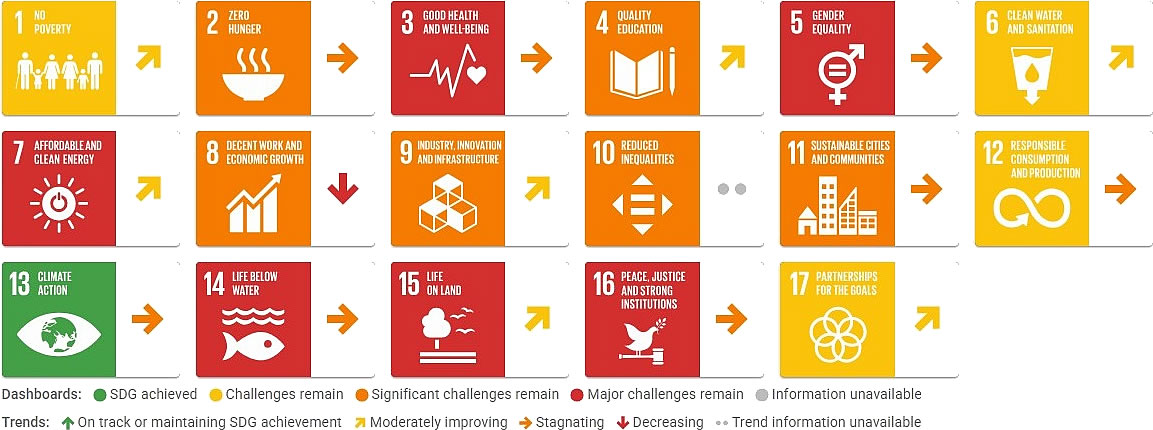
Sustainable Development Goals in Morocco: Progress and Challenges
Morocco adopted the Sustainable Development Goals in 2015 with ambitious commitments. The 17 goals became central to the country’s national development strategy. However, progress has been uneven across different sectors and regions.
Under the High Directives of His Majesty King Mohammed VI and with His active engagement, the Kingdom of Morocco by subscribing in 2015, with the community sustainable development goals, from the outset, considered these objectives to be one of the structuring dimensions of its model national development. This high-level commitment shaped Morocco’s approach to sustainable development.
Historical Context: From MDGs to SDGs
Morocco’s experience with the Millennium Development Goals (2000-2015) provided important lessons. The country achieved significant progress in education and child mortality reduction. However, challenges remained in poverty reduction and environmental sustainability.
The transition to SDGs in 2015 marked a new phase. Morocco integrated the goals into existing national strategies early. This integration distinguished Morocco from many other developing countries.
The National Development Strategy incorporated SDG targets systematically. Government agencies aligned their programs with specific goals. Furthermore, monitoring systems tracked progress regularly.

Early Implementation and Institutional Framework
Morocco established the National Committee for Sustainable Development in 2017. This committee coordinates SDG implementation across government departments. It reports directly to the Prime Minister’s office.
The High Commission for Planning leads data collection and monitoring. This institution publishes annual progress reports regularly. Additionally, it coordinates with international organizations on methodology.
Regional committees support local implementation efforts. These bodies adapt national strategies to local contexts. They also facilitate community participation in development programs.
Morocco submitted its first Voluntary National Review in 2020. This report highlighted achievements and identified key challenges. Subsequently, the country committed to regular reporting cycles.
Progress Assessment SDGs Morocco: Achievements and Gaps
SDG 1: No Poverty
Morocco has made substantial progress in poverty reduction. The national poverty rate fell from 15.3% in 2001 to 4.8% in 2014. However, rural poverty remains significantly higher than urban poverty.
Multidimensional poverty affects approximately 8.2% of the population. This includes lack of access to education, healthcare, and basic services. Regional disparities persist across the country.
Social protection programs have expanded considerably. The government launched universal healthcare coverage in 2022. Additionally, direct cash transfer programs support vulnerable households.
SDG 2: Zero Hunger
Food security has improved through agricultural modernization programs. The Green Morocco Plan transformed agricultural practices significantly. Crop yields increased through improved irrigation and technology.
However, malnutrition remains a concern in rural areas. Stunting affects 15% of children under five nationally. This rate reaches 20% in some rural regions.
Small-scale farmers still face significant challenges. Access to credit and markets remains limited. Climate change threatens agricultural productivity increasingly.
SDG 3: Good Health and Well-being
Healthcare access has expanded dramatically over the past decade. The number of health facilities increased by 40% since 2015. Rural areas received particular attention in health infrastructure development.
Life expectancy reached 76.9 years in 2022. Maternal mortality decreased significantly over the past decade. Child vaccination rates exceed 95% for most vaccines.
Nevertheless, non-communicable diseases pose growing challenges. Diabetes and cardiovascular diseases affect increasing numbers of Moroccans. Mental health services remain underdeveloped nationally.
SDG 4: Quality Education
Education enrollment rates have improved across all levels. Primary education enrollment reaches nearly 100% nationally. Secondary education enrollment increased to 85% in 2022.
However, education quality remains a significant concern. International assessments show poor learning outcomes consistently. Many students complete schooling without acquiring basic skills.
Rural-urban disparities persist in education access and quality. Girls’ enrollment improved but challenges remain in retention. Vocational training programs need substantial expansion.
SDG 5: Gender Equality
Women’s political participation has increased through legal reforms. The constitution guarantees gender equality in principle. Women hold 22% of parliamentary seats currently.
Economic participation by women remains limited however. Only 22% of women participate in the labor force. This represents one of the lowest rates globally.
Violence against women continues to be widespread. Legal frameworks exist but enforcement remains weak. Cultural attitudes change slowly despite government efforts.
SDG 6: Clean Water and Sanitation
Water access has improved significantly through infrastructure investments. Rural water access increased from 14% in 1995 to 95% in 2022. Urban areas have near-universal access.
Sanitation coverage reached 85% nationally in 2022. However, wastewater treatment remains inadequate in many areas. Rural sanitation lags behind urban areas significantly.
Water scarcity poses increasing challenges due to climate change. Droughts have become more frequent and severe. Desalination projects aim to address coastal water needs.
SDG 7: Affordable and Clean Energy
Morocco has made remarkable progress in renewable energy. Solar and wind capacity increased dramatically since 2015. The country aims for 52% renewable energy by 2030.
The Noor Solar Complex represents the world’s largest solar installation. This project demonstrates Morocco’s commitment to clean energy. Additionally, wind farms operate across the country.
However, rural electrification still faces challenges. Some remote areas lack reliable electricity access. Energy affordability remains a concern for poor households.
SDG 8: Decent Work and Economic Growth
Economic growth has been moderate but stable. GDP growth averaged 3.2% annually between 2015-2022. However, this rate falls short of job creation needs.
Unemployment remains high, especially among youth. University graduates face particular challenges finding employment. The informal economy employs approximately 50% of workers.
Labor productivity has improved through technological adoption. Export-oriented industries have grown significantly. Nevertheless, wage levels remain low by international standards.
SDG 9: Industry, Innovation and Infrastructure
Infrastructure development has accelerated under royal initiatives. The high-speed rail line connects major cities efficiently. Port facilities have expanded to serve African markets.
Internet penetration reached 88% in 2022. Mobile phone coverage extends to remote areas. However, digital divides persist between urban and rural areas.
Industrial development focuses on automotive and aerospace sectors. These industries have attracted significant foreign investment. However, technology transfer remains limited.
SDG 10: Reduced Inequalities
Income inequality has decreased modestly over the past decade. The Gini coefficient fell from 0.408 in 2007 to 0.397 in 2014. However, significant disparities persist.
Regional inequalities remain substantial across the country. Coastal regions significantly outperform interior areas economically. This pattern reinforces rural-urban migration.
Social mobility opportunities have expanded through education and programs. However, elite capture limits access for marginalized groups. Structural barriers persist for many citizens.
SDG 11: Sustainable Cities and Communities
Urban planning has improved through new legislation and programs. The National Urban Strategy guides city development. Public transportation systems have expanded in major cities.
However, unplanned settlements continue to grow around cities. Basic services often lag behind population growth. Environmental challenges affect urban air quality.
Historic preservation efforts have received international recognition. Morocco’s medinas attract millions of tourists annually. These efforts balance development with cultural preservation.
SDG 12: Responsible Consumption and Production
Waste management has improved through new facilities and programs. Recycling initiatives have expanded in major cities. Industrial waste treatment capacity has increased.
However, plastic pollution remains a significant challenge. Single-use plastics are widespread throughout the country. Consumer awareness of environmental issues remains limited.
Circular economy principles are slowly being adopted. Some industries have implemented resource efficiency measures. Government policies increasingly promote sustainable practices.
SDG 13: Climate Action
Morocco has demonstrated strong climate leadership internationally. The country hosted COP22 in Marrakech in 2016. It has committed to ambitious emission reduction targets.
National climate adaptation strategies address key vulnerabilities. Water scarcity receives particular attention in planning. Agricultural adaptation programs support farmer resilience.
However, climate impacts are already visible across sectors. Droughts affect agricultural production regularly. Rising temperatures threaten public health in summer months.
SDG 14: Life Below Water
Marine conservation efforts have expanded along Morocco’s coastlines. Protected areas cover approximately 8% of territorial waters. Fishing quotas aim to prevent overfishing.
However, pollution threatens marine ecosystems significantly. Plastic waste affects beaches and marine life. Industrial discharge continues to pollute coastal waters.
Sustainable fisheries management faces enforcement challenges. Small-scale fishers struggle with changing regulations. Climate change affects fish populations and distributions.
SDG 15: Life on Land
Forest cover has increased through national reforestation programs. The Green Belt program aims to combat desertification. Biodiversity conservation efforts protect endangered species.
However, deforestation continues in some areas. Overgrazing affects rangeland quality in rural areas. Urban expansion threatens natural habitats around cities.
Protected areas cover approximately 10% of national territory. These areas preserve important ecosystems and species. However, management capacity remains limited.
SDG 16: Peace, Justice and Strong Institutions
Governance reforms have strengthened democratic institutions gradually. The 2011 constitution expanded citizen rights significantly. Anti-corruption efforts have increased government transparency.
However, human rights concerns persist in certain areas. Press freedom faces restrictions according to international monitors. Civil society organizations report harassment occasionally.
Justice system reforms aim to improve access and efficiency. Courts have been modernized through digitalization efforts. However, case backlogs and delays remain problematic.
SDG 17: Partnerships for the Goals
Morocco has actively engaged in international development partnerships. South-South cooperation has expanded significantly with African countries. The country provides technical assistance to neighboring nations.
Development aid coordination has improved through institutional reforms. The government works closely with international donors. However, aid effectiveness remains a concern.
Private sector engagement in SDGs has increased gradually. Corporate social responsibility initiatives have expanded. However, business contributions to SDGs remain limited overall.
SDGs Morocco: Key Organizations and Institutions
Government Institutions
High Commission for Planning (HCP)
The HCP leads SDG monitoring and evaluation efforts. It produces annual progress reports and coordinates data collection. The institution also conducts national surveys regularly.
Ministry of Economy and Finance
This ministry coordinates development finance and budgeting. It ensures SDG integration into national budget processes. Additionally, it manages relationships with international financial institutions.
Ministry of Interior
The Interior Ministry oversees regional SDG implementation. It coordinates with local authorities on program delivery. This ministry also manages decentralization reforms.
International Organizations
United Nations Development Programme (UNDP)
UNDP provides technical assistance for SDG implementation. It supports capacity building for government institutions. The organization also facilitates knowledge sharing regionally.
World Bank
The World Bank finances major development projects in Morocco. It provides policy advice on economic reforms. However, its conditionalities sometimes conflict with SDG priorities.
African Development Bank
This institution focuses on infrastructure and private sector development. It supports Morocco’s regional integration efforts. The bank also provides budget support for reforms.
Civil Society Organizations
Moroccan Association for Human Rights (AMDH)
AMDH monitors human rights aspects of SDG implementation. It advocates for marginalized groups’ inclusion in development programs. The organization also documents violations systematically.
Moroccan Organization for Human Rights (OMDH)
OMDH focuses on civil and political rights promotion. It provides legal aid to vulnerable populations. The organization also conducts human rights education programs.
Association of Moroccan Women
This organization advocates for gender equality in development. It implements programs supporting women’s economic participation. Additionally, it monitors gender-related SDG indicators.
Influential Leaders and Advocates
King Mohammed VI
The monarch has championed sustainable development since ascending the throne. His directives shape national development strategies significantly. Royal initiatives often set precedents for government policy.
The King’s speeches frequently emphasize social development priorities. He has launched major infrastructure and social programs. His leadership provides continuity across different governments.
Nadia Fettah Alaoui
As Economy and Finance Minister, she oversees SDG financing strategies. Nadia Fettah Alaoui describes Morocco’s experience working toward economic resilience and sustainable development. Her policies aim to balance fiscal sustainability with social objectives.
Chakib Benmoussa
The Interior Minister manages territorial development and decentralization. He coordinates regional SDG implementation efforts. His policies affect local governance and service delivery.
Abdeladim Lhafi
As High Commissioner for Planning, he leads SDG monitoring efforts. His institution produces key data on development progress. He also represents Morocco in international statistical forums.
Aziz Rabbah
The former Energy Minister championed renewable energy development. His policies established Morocco as a clean energy leader. These efforts contribute significantly to climate goals.
Challenges and Obstacles
Financial Constraints
SDG implementation requires substantial financial resources. Morocco faces fiscal pressures from competing development needs. External debt service limits available resources for social programs.
International aid has declined in recent years. Private sector investment in SDGs remains limited. Domestic resource mobilization needs significant improvement.
Institutional Capacity
Many government agencies lack adequate capacity for SDG implementation. Staff training and technical expertise remain insufficient. Monitoring systems need substantial strengthening.
Coordination between institutions remains challenging. Different agencies sometimes work at cross-purposes. Information sharing systems need improvement.
Regional Disparities
Development benefits concentrate in coastal urban areas. Rural and interior regions lag behind significantly. This pattern undermines national SDG achievements.
Infrastructure gaps persist in remote areas. Service delivery quality varies dramatically by location. Migration from rural to urban areas continues.
Climate Change Impacts
Rising temperatures and changing precipitation patterns threaten development gains. Agricultural productivity faces increasing risks. Water scarcity affects multiple sectors.
Extreme weather events have become more frequent. These events disrupt development programs and damage infrastructure. Adaptation costs are substantial.
Social and Cultural Barriers
Traditional attitudes sometimes conflict with SDG objectives. Gender equality faces resistance in conservative areas. Youth unemployment creates social tensions.
Education quality improvements face systemic challenges. Healthcare access remains limited in rural areas. Social protection systems need expansion.
COVID-19 Impact on SDG Progress
The pandemic disrupted many development programs significantly. School closures affected education progress. Healthcare systems faced unprecedented pressure.
Economic contraction reduced government revenues substantially. Many businesses closed permanently during lockdowns. Unemployment increased across all sectors.
However, the crisis also accelerated some reforms. Digital transformation advanced rapidly. Social protection systems expanded temporarily.
The government’s response demonstrated institutional capacity. Morocco produced vaccines locally during the pandemic. This achievement enhanced the country’s regional standing.
Looking Forward
Morocco’s SDG journey faces critical challenges in the remaining years to 2030. Current progress rates are insufficient for achieving most targets. Accelerated action is essential across all sectors.
Climate change adaptation must become central to all development planning. Water security requires urgent attention and investment. Agricultural transformation needs comprehensive support.
Digital transformation offers opportunities for leapfrog development. E-governance can improve service delivery efficiency. Digital financial services can expand inclusion.
Regional integration could unlock significant development potential. Morocco’s position as a gateway to Africa provides strategic advantages. South-South cooperation should expand further.
Youth employment requires immediate attention and innovative solutions. Skills development must align with labor market needs. Entrepreneurship support needs substantial expansion.
Gender equality progress must accelerate through comprehensive reforms. Women’s economic participation needs targeted interventions. Cultural change requires sustained effort.
Environmental sustainability must integrate into all development programs. Circular economy principles need widespread adoption. Biodiversity conservation requires increased funding.
Governance reforms should continue to strengthen democratic institutions. Transparency and accountability need continuous improvement. Civil society participation should expand.
International partnerships remain essential for SDG achievement. Development cooperation must become more effective. Private sector engagement needs dramatic expansion.
Ultimately, Morocco possesses the human and natural resources for SDG success. Political will and effective implementation will determine outcomes. The next five years are crucial for the country’s sustainable development future.
Sources
- Sustainable Development Solutions Network. (2024). Sustainable Development Report 2024. dashboards.sdgindex.org/profiles/morocco
- Brookings Institution. (2025). Morocco’s journey toward achieving the SDGs: Prioritizing economic resilience and social transformation. brookings.edu/moroccos-journey-toward-achieving-the-sdgs
- United Nations. (2024). The Sustainable Development Goals Report 2024. https://unstats.un.org/sdgs/report/2024/
- UN Sustainable Development Knowledge Platform. (2022). Morocco Country Profile. sustainabledevelopment.un.org/memberstates/morocco
- MDPI Sustainability Journal. (2022). Assessing National Progress in Achieving the Sustainable Development Goals: A Case Study of Morocco. mdpi.com/2071-1050/14/23/15582
- United Nations Development Programme. (2021). Morocco: SDG Implementation, Development of the National Evaluation System. nec.undp.org/Morocco%202017.pdf