
Nigeria Sustainable Development Goals (SDGs)
143
SDG Index rank, out of 169 countries
55.71
SDG Index score, out of 100
9
Spillover rank, out of 169 countries
96.26
Spillover score, out of 100
Source: Sustainable Development Report 2026, SDSN / Dublin University Press
Most people have never heard of the Sustainable Development Goals in any real detail. Surveys across the US, UK, France, and Germany find only 8–12% of people can actually say what the SDGs are. RYB exists to close that gap, looking at the same reports and reviews the UN and researchers use, and explaining them as we go.
Nigeria, Africa’s most populous country, ranks 9th out of 169 on international spillovers, the second-strongest position RYB has recorded after only Brazil. Its overall SDG Index rank, 143rd, tells almost the opposite story. Two figures explain why plainly: Nigeria’s life expectancy at birth, 54.8 years, and its maternal mortality ratio, 992.8 per 100,000 live births, are the lowest and highest, respectively, of any country RYB has covered on this site so far, worse even than Afghanistan’s.
Nigeria — Sustainable Development Report 2026
NG
Voluntary National Reviews: The Only African Country to Present Three
Nigeria presented its first Voluntary National Review in 2017, focused on institutional readiness and governance structures for SDG delivery, and its second in 2020, centered on poverty, an inclusive economy, health, education, gender equality, and peace and security. Government officials have repeatedly noted that Nigeria is the only African country to have presented a VNR more than once during this period, a distinction that held until its third review confirmed the pattern.
The third VNR was presented at the 2025 HLPF, built on nationwide consultations across Nigeria’s six geopolitical zones plus dedicated sessions with persons with disabilities, children, and youth. It focused in depth on five goals: Good Health and Well-Being (SDG 3), Gender Equality (SDG 5), Decent Work and Economic Growth (SDG 8), Life Below Water (SDG 14), and Partnerships for the Goals (SDG 17), and reported that Nigeria now plans biennial VNRs through 2030.
Voluntary Local Reviews: Lagos Leads, Twice
Lagos State published Nigeria’s first Voluntary Local Review in 2023, the first sub-national SDG review in the country, and one state officials credit with directly shaping policy and resource allocation since. In May 2025, Lagos began work on its second VLR, making it, so far, the only Nigerian state to have produced one review, let alone started a second. Lagos was also the first state in Nigeria to establish a dedicated Cabinet-level Office of SDGs, a structural head start most other states in the federation haven’t matched yet.

What the Sustainable Development Report Shows: The Strongest Spillover Position RYB Has Seen, Alongside the Weakest Domestic Indicators
The Sustainable Development Report scores every country two ways. The overall score measures how well a country is doing for its own people. The spillover score measures how much harm a country’s economy causes everyone else.
Nigeria’s overall score sits at 55.71 out of 100, ranking 143rd out of 169 countries. Its spillover score sits at 96.26 out of 100, ranking 9th, the second-strongest spillover position RYB has recorded on this site, behind only Brazil’s 6th.
Why Nigeria’s Spillover Score Is So Strong
- Weapons exports are close to zero. At 0.002 TIV per 100,000 people, Nigeria’s figure is among the lowest RYB has recorded, alongside Afghanistan’s literal zero and India’s 0.004.
- Plastic waste exports are minimal. At 0.08 kg per capita, Nigeria’s figure sits well below Indonesia’s 0.135 kg and far below the Netherlands’ 30.162 kg.
- Support for UN-based multilateralism is solid. Nigeria’s score sits at 70.5 out of 100, ahead of Bosnia and Herzegovina’s 69.0 and well ahead of the UK’s 54.9.
Where the Work Remains
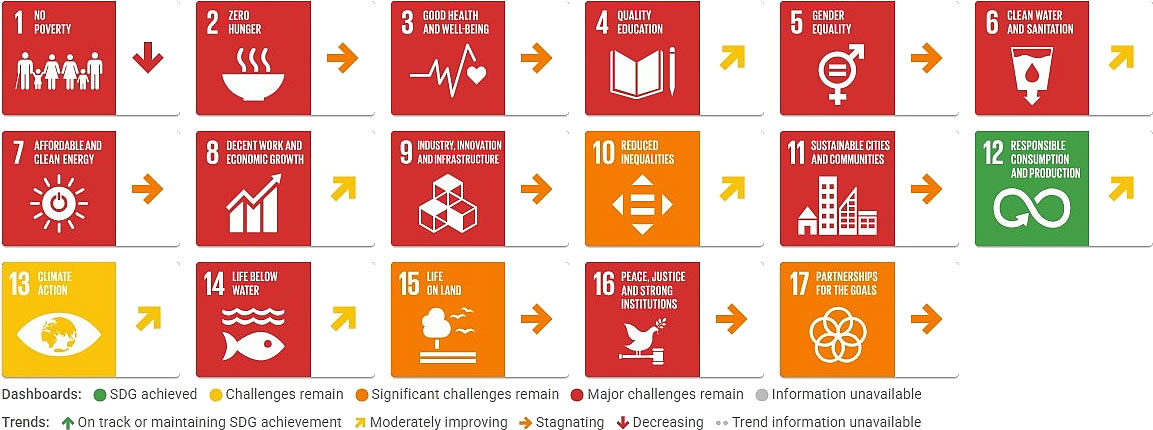
The domestic picture is the most severe RYB has covered on this site. Nigeria’s life expectancy at birth, 54.8 years, and maternal mortality ratio, 992.8 per 100,000 live births, are both worse than Afghanistan’s already stark figures. The lower secondary completion rate sits at 44.2%, and just 4.2% of national parliamentary seats are held by women, one of the lowest shares RYB has recorded anywhere. Nigeria’s Corruption Perceptions Index score, 26 out of 100, is among the weakest RYB has seen, and its PM2.5 figure, 44.9 μg/m³, sits close to India’s own severe reading. On the dashboard, twelve of seventeen goals rate the worst color, red, tied with Afghanistan for the most of any country RYB has covered, and No Poverty (SDG 1) is currently trending backward rather than holding steady. Responsible Consumption and Production (SDG 12) is the one green rating, a byproduct of low per-capita consumption rather than a policy achievement, the same caveat that applied to Pakistan’s and Afghanistan’s climate ratings.
Nigeria’s spillover rank sits alongside every other country RYB tracks on the Global Responsibility page, where rankings like these are shown together across all the countries covered on this site.
Why These Numbers Matter
These pages matter more than their topic suggests on the surface. The SDGs are, in effect, the world’s working roadmap for its biggest shared problems, yet most citizens have never engaged with them directly. A Voluntary Local Review can change that at the scale where it’s most achievable: one city, one community, people who might otherwise never cross paths brought into the same conversation about what their home needs most.
Culture and the arts barely feature in Nigeria’s VNRs, understandably crowded out by health, poverty, and gender priorities right now. RYB tracks Nigeria because a Culture of Peace lens has real room to build on what Lagos has already started, extending a genuinely pioneering local reporting model to a country of over 235 million people across 36 states.
RYB’s Place in This Picture
RYB tracks Nigeria because it’s the starkest version yet of a pattern this site keeps finding: a country’s low footprint abroad and its citizens’ quality of life are not the same measurement, and treating them as if they were would flatten one of the widest gaps RYB has recorded between the two. Nigeria ranks near the very top of the world on spillovers and near the very bottom on the indicators that describe daily life for its own people.
Looking Forward
Watch whether Nigeria’s planned biennial VNR schedule, next due in 2027, actually holds, given that its 2022 and 2024 reviews in the original biennial plan didn’t materialize. Watch the SDG 1 poverty trend specifically, the one goal currently moving backward on Nigeria’s dashboard. And watch whether any other Nigerian state follows Lagos’s lead, now two VLRs deep, with a first review of its own.
UNDP
Human Development Report — Nigeria
The Human Development Index measures something narrower and older than the SDGs: life expectancy, education, and income, combined into a single score, with no 2030 deadline attached. It is a different lens on the same country, worth reading alongside the SDG data above rather than instead of it.
Nigeria’s HDI reached 0.560 in 2023, up from 0.548 the year before, its highest level on record, though still “low human development,” the same tier as Afghanistan and Pakistan. Adjusted for inequality, UNDP estimates Nigeria’s HDI loss at 32.7%, one of the steeper discounts in the region, worth reading in full on UNDP’s own page alongside the persistent gap between male and female HDI values.
Sources
- SDG Index database, Sustainable Development Report 2026 — Fuller, G., Iablonovski, G., Lafortune, G. and Sachs, J.D. (2026), SDSN / Dublin University Press, DOI:10.82163/225
- Sustainable Development Report 2026, Nigeria profile — dashboards.sdgindex.org
- Nigeria’s 2025 Voluntary National Review, Main Messages — hlpf.un.org
- Nigeria Presents Third Voluntary National Review on SDGs, Nigeria SDGs — sdgs.gov.ng
- Lagos Commences Second Voluntary Local Review on SDGs, Environment Africa — environmentafricamag.com
- Valuable Insights and Findings of the 2023/2024 Human Development Report and Its Correlation to Nigeria’s HDI, UNDP — undp.org