

Philippines Sustainable Development Goals (SDGs)
80 / 169
SDG Index Rank, 2026
69.87
SDG Index Score (out of 100)
12 / 169
Spillover Rank, 2026
96.07
Spillover Score (out of 100)
Source: Sustainable Development Report 2026, SDSN / Dublin University Press
Most people have never heard of the Sustainable Development Goals in any real detail. Surveys across the US, UK, France, and Germany find only 8-12% of people can actually say what the SDGs are. RYB exists to close that gap, looking at the same reports and reviews the UN and researchers use, and explaining them as we go.
The Philippines ranks 80th out of 169 countries on the 2026 SDG Index — modest, and weighed down by a genuinely difficult governance and public health picture. But its spillover rank is 12th out of 169, the best RYB has recorded for any country so far, ahead of Malaysia’s 109th by a wide margin. A country still working through serious domestic problems is, by this measure, doing about as little harm to the rest of the world as any country RYB has reviewed.
Philippines — Sustainable Development Report 2026
PH
The Philippines’ SDG Story
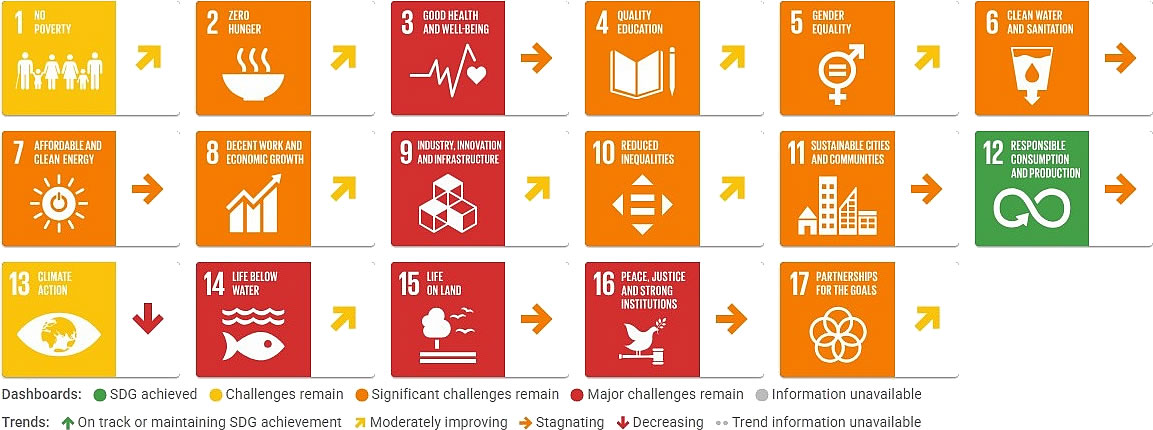
The Philippines’ overall score of 69.87 sits below every country RYB has reviewed so far, driven by three goals rated red for reasons that have little to do with each other: governance, innovation, and public health.
Governance: the single weakest goal on the dashboard
SDG 16 (Peace, Justice and Strong Institutions) has the lowest score of any of the Philippines’ 17 goals. The Corruption Perceptions Index sits at just 32 out of 100, rated red and declining. Press Freedom Index score is 46.8, also red and declining. Two-thirds of the prison population (65.2%) are unsentenced detainees awaiting trial, rated red, and both the timeliness of administrative proceedings and the fairness of expropriation compensation are rated red as well. Taken together, it’s the most difficult institutional picture RYB has documented in this series.
A tuberculosis burden that stands out even regionally
SDG 3 (Good Health and Well-being) is rated red. The starkest single figure behind it: a tuberculosis incidence rate of 625 cases per 100,000 population, which scores zero on the report’s normalized scale — the worst possible reading for that indicator. Life expectancy, at 70.1 years, is also the lowest RYB has recorded among the countries covered so far, and vaccine coverage and non-communicable disease mortality are both rated red. The Philippines’ own 2025 VNR devoted specific attention to reversing what it called “decelerating progress in health,” centered on strengthening the Universal Health Care Act.
Innovation capacity: a genuine structural gap
SDG 9 (Industry, Innovation and Infrastructure) is also red. Research and development spending comes to just 0.276% of GDP, and patent applications per capita are among the lowest RYB has recorded — both rated red. It’s a different kind of gap from the governance and health numbers above: not a crisis, but a structural constraint on how much of the country’s own growth translates into higher-value industries over time.
Where the numbers turn genuinely positive
Two goals cut sharply against the pattern above. SDG 12 (Responsible Consumption and Production) is rated green, driven by low per-capita municipal waste, low uncollected e-waste, and plastic waste exports of just 0.88 kg per capita — also green. And just 12.5% of the Philippines’ fish catch comes from overexploited or collapsed stocks, rated green and the healthiest fishery figure RYB has recorded — well ahead of Japan’s 60.9% and New Zealand’s 60.4%, both far larger and wealthier fishing nations.
Voluntary National Reviews and National Implementation
Four VNRs — the most frequent reporting cycle RYB has found
The Philippines has presented four Voluntary National Reviews — 2016, 2019, 2022, and 2025 — on a stated three-year cycle it committed to at the very start of the 2030 Agenda, the most disciplined and frequent VNR schedule RYB has documented for any country. The 2025 VNR narrowed its focus to five goals: SDG 3 (Health), 5 (Gender Equality), 8 (Decent Work), 14 (Life Below Water), and 17 (Partnerships) — a focus that lines up directly with two of the sharpest findings on this page, the TB burden under SDG 3 and the comparatively healthy fish stocks under SDG 14.
One of the earliest city-level reviews anywhere, and a fast-growing network since
Cauayan City published a VLR in 2017 — a year before the wave of VLRs from New York City and Japan’s Kitakyushu, Toyama, and Shimokawa that’s usually credited as the format’s global starting point, making it one of the very earliest local SDG reviews published anywhere. Naga City followed in 2022. In 2025, UNDP, UN-ESCAP, and UN-Habitat jointly supported three more cities — Baguio, Santa Rosa, and Surigao — through the process, each publishing its own review. Separately, the League of Cities of the Philippines submitted a national Voluntary Sub-National Review in 2020, focused on SDG 5 (Gender Equality) and SDG 11 (Sustainable Cities), giving the country a rare second, association-level layer of local reporting alongside individual city VLRs.

What the SDR Shows: International Spillovers
The Sustainable Development Report scores every country two ways. The overall score measures how well a country is doing for its own people. The spillover score measures how much harm a country’s economy causes everyone else.
The Philippines’ spillover rank of 12th out of 169 is the best RYB has recorded in this series — a striking reversal of the pattern seen in every wealthy country covered so far, where spillover rank falls well below overall rank. Here, a country with real domestic struggles causes almost no measurable harm to anyone else.
Consistently light footprint across every spillover measure
Plastic waste exports, at 0.88 kg per capita, are rated green. Imported deforestation, marine biodiversity threats embodied in imports, and CO2 emissions embodied in fossil fuel exports are all rated green as well. Weapons exports are recorded at zero, though flagged as an imputed rather than directly measured figure, so it isn’t cited as a confirmed data point here. The overall picture, real figures included, is consistent: the Philippines simply isn’t a major exporter of the raw materials, weapons, or waste that drag down spillover scores elsewhere in this series.
A tax haven figure that can’t be verified
As with Malaysia, the Philippines’ Corporate Tax Haven Score in the underlying database is flagged as imputed rather than measured, so it isn’t cited here, and its Financial Secrecy Score is missing from the dataset entirely.
Why These Numbers Matter
A high overall SDG score measures how a country treats its own people. It says nothing about what that country’s economy asks of everyone else — the waste it exports, the weapons it sells, the profits that pass untaxed through its financial system. The Philippines is the clearest case yet in this series of a country whose economy simply doesn’t generate that kind of harm at scale, even as its own governance, health, and innovation numbers show how much domestic work remains.
RYB’s Place in This Picture
The Philippines’ spillover rank of 12th is, by a wide margin, the best of any country RYB has reviewed — ahead of Malaysia’s 109th, Japan’s 128th, and every wealthy economy covered so far. See the full picture, ranked side by side, on RYB’s Global Responsibility page.
UNDP
Human Development Report — Philippines
The Human Development Index measures something narrower and older than the SDGs: life expectancy, education, and income, combined into a single score, with no 2030 deadline attached. It is a different lens on the same country, worth reading alongside the SDG data above rather than instead of it.
The Philippines’ HDI is 0.720 (2023 data), ranking 117th out of 193 — the “high” development tier, one level below every other country RYB has reviewed so far, all of which sit in the “very high” tier above 0.800. Life expectancy stands at 69.8 years and GNI per capita is $10,731. Regionally, the gap is significant: Metro Manila’s HDI (0.753) leads the country, while the Bangsamoro Autonomous Region, long affected by armed conflict, sits lowest at 0.639 — a 20-percentage-point range within a single country’s own regional data.