

Netherlands Sustainable Development Goals (SDGs)
19
SDG Index rank, out of 169 countries
81.0
SDG Index score, out of 100
167
Spillover rank — among the worst globally
41.2
Spillover score, out of 100
Source: Sustainable Development Report 2026, SDSN / Dublin University Press
Most people have never heard of the Sustainable Development Goals in any real detail. Surveys across the US, UK, France, and Germany find only 8–12% of people can actually say what the SDGs are. RYB exists to close that gap, looking at the same reports and reviews the UN and researchers use, and explaining them as we go.
Netherlands — Sustainable Development Report 2026
NL
The Sustainable Development Goals in the Netherlands
Most countries report to the UN on the Sustainable Development Goals once, at the national level. The Netherlands does it at three levels at once, and that layered structure is the most interesting thing about its SDG story.
At the top sits the Voluntary National Review (VNR), the Kingdom’s formal report to the UN. Below that sits a Voluntary Subnational Review (VSR), compiled by the Association of Netherlands Municipalities (VNG) on behalf of provinces and water authorities. And inside that, one city went further still: in 2022, Amsterdam became the first municipality in the Netherlands to publish its own Voluntary Local Review (VLR), reporting on the SDGs from the ground up, street by street, rather than from the top down. For RYB, building a concept like Amsterdam Creative City for a Culture of Peace, this three-layer structure is exactly the map worth understanding first.

The Voluntary National Review — Reporting as a Kingdom
The Netherlands does not report to the UN alone. Because Aruba, Curaçao, Sint Maarten, and the Netherlands together make up the Kingdom of the Netherlands, all four countries prepare their Voluntary National Review jointly. The Kingdom presented its first VNR in 2017 and its second in 2022, each one combining the European Netherlands’ priorities with the very different development realities of its three Caribbean partner countries.
The 2022 review found the European part of the Kingdom scoring well on reducing inequality, decent work, innovation, strong institutions, education, and water management, with its sharpest challenges in biodiversity restoration and the energy transition. It also recorded something specifically relevant to RYB’s work: more than a third of Dutch municipalities and several provinces had, by then, formally embraced the SDGs as a policy framework of their own, and the city of Amsterdam was named directly in the national review as the one about to present a Voluntary Local Review for the first time.
Amsterdam’s Voluntary Local Review — Reporting as a City
A VLR is what a Voluntary National Review looks like once it is scaled down to street level. Amsterdam’s first VLR, published in 2022, did not attempt all seventeen SDGs at once. It mapped six, chosen for direct relevance to Amsterdam’s own policy priorities around sustainable economic development and broad prosperity, and the research behind it was carried out by the Amsterdam University of Applied Sciences on behalf of the municipality, with input from the Ministry of Foreign Affairs and the VNG.
The report opens with an image that says more about Amsterdam’s approach than any statistic could: the city has more bicycles than people, and it uses cycling as a working metaphor for the SDGs themselves, one small, everyday choice that touches health, climate, mobility, and public space all at once, in exactly the way the seventeen goals are meant to interact rather than operate in isolation.
For RYB, this matters for a very practical reason. A Voluntary Local Review is, in UN language, precisely the kind of expert-and-citizen-built local assessment that a concept like Amsterdam Creative City for a Culture of Peace would need to sit alongside, reference, and eventually contribute back to, rather than duplicate.
The Wider Dutch VLR Movement
Amsterdam was first, but not alone for long. The Hague has since been studied directly by the international Culture2030Goal campaign as one of six cities worldwide, alongside Barcelona, Paris, Abidjan, Montreal, and Brussels, in a 2021 report specifically analysing how culture appears inside Voluntary Local Reviews.
RYB’s Finland SDGs page shows where this movement can go next. Five Finnish cities submitted VLRs in 2025 alone, and Finland has now produced seventeen in total, more than almost any other country, with a shared national guide so each city doesn’t start from zero. There is no equivalent shared structure yet among Dutch cities, although the VNG’s 2022 Voluntary Subnational Review already gathers municipal contributions into the national picture, and SDG Nederland now counts over 1,200 member organisations.
Are the Netherlands and Amsterdam Talking About a Culture Goal?
Not yet by name, but the door is open, held open by the same international networks Amsterdam and The Hague have already worked with directly. At MONDIACULT 2025 in Barcelona, 194 UNESCO member states agreed to push culture toward standalone-goal status in the post-2030 development agenda, and the Culture2030Goal campaign published Version 1 of an actual Culture Goal, with ten proposed targets and a set of indicators attached.
The campaign has been explicit that a Culture Goal does not need to wait for a formal UN vote to start being useful. Countries and cities can adopt it voluntarily now, and report against it ahead of any future agreement. That is a striking, practical opening for a city that has already shown, through its 2022 VLR, that it knows how to build a serious local SDG report from scratch.
Key Institutions
- Ministry of Foreign Affairs. Coordinates the Kingdom’s national SDG implementation through a National SDG Coordinator and SDG-team, with a Focal Point at every ministry.
- Statistics Netherlands (CBS). Publishes the annual Monitor of Wellbeing and the SDGs, the country’s primary evidence base for tracking all seventeen goals.
- SDSN Netherlands. Established in 2024 and hosted by Vrije Universiteit Amsterdam, this is the Dutch node of the same global research network, the UN Sustainable Development Solutions Network, that produces the annual Sustainable Development Report used on RYB’s Finland page. Its presence inside Amsterdam is a direct, underused link between the city and the global SDG research community.
- SDG Nederland. The civil-society platform connecting over 1,200 organisations and citizens working on the SDGs across the country.
- Association of Netherlands Municipalities (VNG). Produces the Voluntary Subnational Review and supports municipalities through its Gemeenten4GlobalGoals network.
What the Sustainable Development Report Shows: Two Very Different Scores
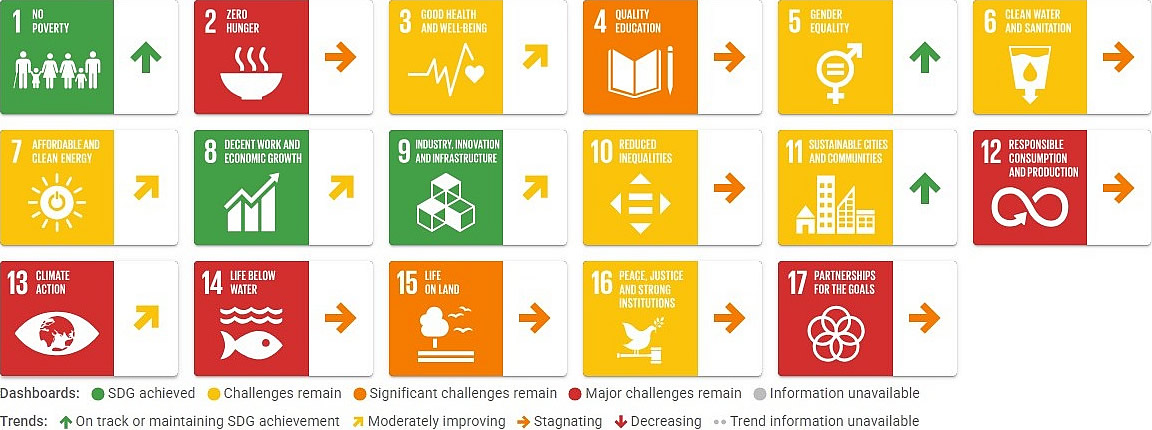
The Sustainable Development Report scores every country two ways. The overall score measures how well a country is doing for its own people. The spillover score measures how much harm a country’s economy causes everyone else. For the Netherlands, these two numbers tell sharply different stories.
The Netherlands sits among the strongest-performing countries on the SDG Index, ranking 19th out of 169 countries with a score of 81.0. Its spillover score sits at just 41.2 out of 100, ranking 167th, among the very worst in the world, just two places off the absolute bottom of the table.
Why the Spillover Score Is So Low
This is not a vague, qualitative impression. The exact sub-indicators show why:
- Exports of plastic waste rate red. The Netherlands exports 30.162 kg per capita, far above Finland’s 4.525 and worlds apart from Brazil’s 0.025.
- Conventional weapons exports also rate red. The Netherlands’ figure, 2.15 TIV per 100,000 people, is the highest of any country RYB has compared so far.
- The Corporate Tax Haven Score sits at 72.3 out of 100, where 100 is worst, worse than Finland’s 60 and far worse than Brazil’s 38.
- The Financial Secrecy Score sits at 69, in the same range as the UK and US, among the least transparent in this comparison.
This is not a fringe or contested claim. Independent research bodies, from the Tax Justice Network to Charles University’s profit-shifting database, have repeatedly placed the Netherlands among the small handful of jurisdictions, alongside Luxembourg, Ireland, and Switzerland, that receive a disproportionate share of multinational profits relative to the real economic activity happening there. None of this is illegal. It is, in large part, deliberate Dutch tax policy, built over decades to attract exactly this kind of investment.
The SDSN’s own researchers describe the broader pattern plainly: high-income countries tend to lead the SDG Index while scoring poorly on the Spillover Index, because the same global trad and financial position that supports a wealthy country’s strong domestic SDG performance often pushes negative costs onto countries with far less capacity to absorb them.
Brazil breaks this pattern entirely. RYB’s Brazil SDGs page shows a country ranking far lower overall, 53rd, yet scoring 96.6 on spillovers, 6th in the world, green across nearly every indicator the Netherlands scores red on. A country does not have to choose between domestic SDG performance and low harm abroad. Very few countries currently manage both.
For RYB, this is the most important caveat anywhere on this page. A country can be a genuine leader on the SDGs at home and a genuine obstacle to the SDGs abroad, in the very same year, and the same report. Reading only the headline SDG Index score, without the Spillover Score beside it, would miss exactly the pattern worth understanding.
Netherlands Spillover ranking and indicators → | Europe Spillover map →
Current Standing
The 2026 Europe Sustainable Development Report is candid that SDG progress has stalled across the whole of Europe, with several social and environmental targets now stagnating or moving backward rather than forward. No country in Europe, however strong its overall ranking, is currently on track to achieve all seventeen goals by 2030. Climate action, the circular economy, and sustainable food and fisheries remain the areas where the Netherlands’ own national reporting acknowledges the most ground still to cover.
A Note on Why the Two Scores Differ
Visitors comparing the Netherlands’ score on the global and European reports will notice they are not the same number, and that is expected rather than an error. The global report measures every country against one fixed, worldwide indicator set. The European report uses its own, separately built set of roughly 110 indicators and scores each country relative only to the best and worst performers within Europe itself, a harder comparison than being judged against the whole world. Both numbers are accurate. They are just answering two different questions about the same country.
RYB’s Place in This Picture
RYB does not produce a VNR, a VSR, or a VLR. Those are formal instruments, built by governments, universities, and the UN system, with a level of data collection no single website could replicate. What RYB does is read them, connect them, and make the connections visible to people who would otherwise never come across a 2022 municipal PDF written for policymakers. The SDGs Finland page does this for a country already well ahead in both its national score and its local-review culture; this page does it for the Netherlands, where the national and the local stories pull in genuinely interesting, slightly different directions.
This is also the groundwork for a bigger idea. Before RYB can responsibly propose something like Amsterdam Creative City for a Culture of Peace, the city’s own research has to be understood and credited first: what Amsterdam’s 2022 VLR already measured, what The Hague’s inclusion in international culture research already established, and where the gaps visibly remain.
Looking Forward
The Netherlands’ SDG story is really three stories nested inside each other: a Kingdom answering to the UN, a national association of municipalities answering on behalf of the country’s cities, and one city, Amsterdam, choosing to answer for itself in detail no one had asked it to provide. But the Spillover Score adds a fourth story, and it is the one a confident ranking alone would never reveal: the Netherlands’ own tax architecture, the same one underpinning its domestic prosperity, sits rated red on the very indicators meant to track harm done abroad. RYB’s Finance page goes deeper into that policy specifically.
A Culture Goal does not yet have a number agreed by the UN. But a city does not need to wait for a number to start measuring what it already has: De Stijl’s roots, a Mondriaan house in De Pijp, and a serious, AUAS-researched VLR already on record. The materials for a Culture of Peace proposal for Amsterdam are not missing. They are sitting in a 2022 PDF, waiting to be read alongside the rest, and alongside an honest look at the Spillover Score too.
UNDP
Human Development Report — Netherlands
The Human Development Index measures something narrower and older than the SDGs: life expectancy, education, and income, combined into a single score, with no 2030 deadline attached. It is a different lens on the same country, worth reading alongside the SDG data above rather than instead of it.
Netherlands’ Human Development Index data →
What is the difference between the HDI and the SDGs →
Sources
- High-Level Political Forum, Kingdom of the Netherlands Voluntary National Review 2022 — hlpf.un.org/countries/netherlands/voluntary-national-review-2022
- Sustainable Development Knowledge Platform, Netherlands country page (2022 archive) — sustainabledevelopment.un.org/memberstates/netherlands
- Amsterdam University of Applied Sciences, “City of Amsterdam Voluntary Local Review 2022” — sdgs.un.org/sites/default/files/vlrs/2022-12/vlr_amsterdam.pdf
- OpenResearch Amsterdam, “Report: Implementation of the SDG’s in Amsterdam” — openresearch.amsterdam/en/page/88765/report-implementation-of-the-sdg-s-in-amsterdam
- Association of Netherlands Municipalities (VNG), Voluntary Subnational Review 2022 — gold.uclg.org/the_netherlands_2022_vsr_eng.pdf
- Association of Finnish Local and Regional Authorities, “Five Voices, One Vision: Five Finnish Voluntary Local Reviews submitted in 2025” — localfinland.fi/five-finnish-voluntary-local-reviews-submitted-2025
- Culture2030Goal Campaign, “Culture in the Localization of the 2030 Agenda: An Analysis of Voluntary Local Reviews” (Barcelona, Paris, Abidjan, Montreal, The Hague, Brussels) — culture2030goal.net
- Culture2030Goal Campaign, Roadmap 2025 and “The Culture Goal: From Necessity to Reality” — culture2030goal.net/roadmap-2025
- UNESCO, MONDIACULT 2025: Towards Culture as a Stand-Alone Goal — unesco.org/en/mondiacult/about
- UN Chronicle, “A Realistic Goal? Culture in the Sustainable Development Agenda” — un.org/en/un-chronicle/realistic-goal-culture-sustainable-development-agenda
- SDSN, Sustainable Development Report Netherlands — dashboards.sdgindex.org/profiles/netherlands
- SDSN and EESC, Europe Sustainable Development Report 2026 — eu-dashboards.sdgindex.org
- SDSN Netherlands, hosted by VU Amsterdam — unsdsn.org/our-networks/netherlands
- Statistics Netherlands (CBS), Monitor of Wellbeing and the SDGs — cbs.nl
- SDG-jaarkalender — redyellowblue.org/SDG-Inhaakkalender-2023.pdf