
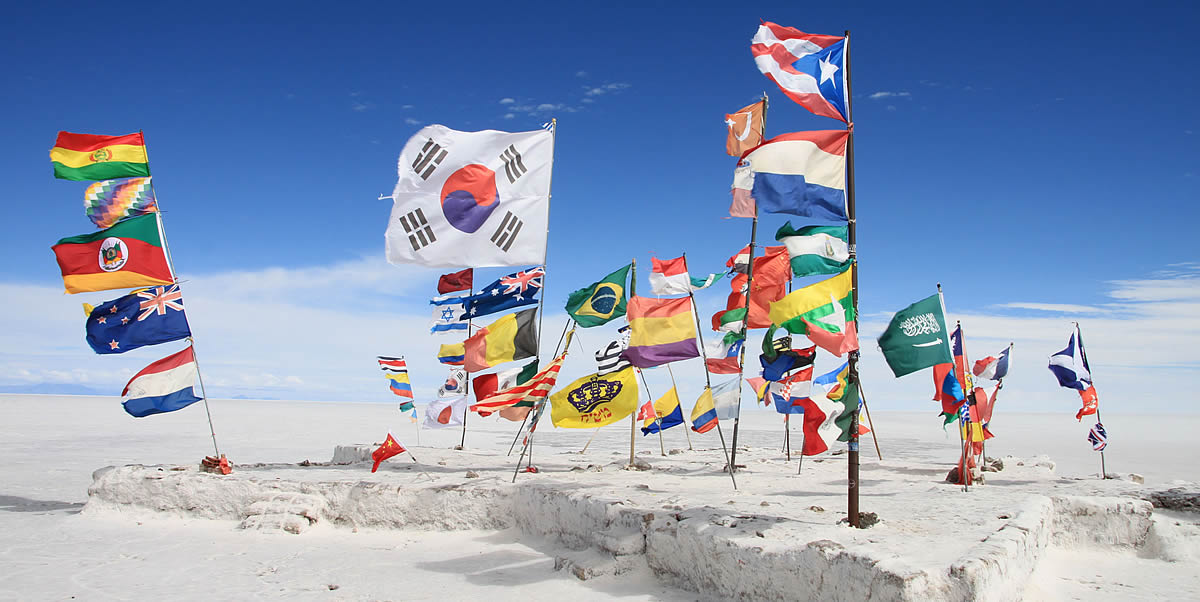
National flags waving on the Uyuni Salt Flats in Bolivia, showcasing global diversity | photo Kristina Schultheiß
Country Pages Methodology — How We Build Country Profiles
RYB is building a profile for every one of the 193 UN member states. This methodology page explains how we research and structure each country profile, and what visitors can expect to find when they explore a country.
Not every country page is complete. We build them step by step, adding depth as we research and write. Some countries have all five pages; others are just beginning. The process is open and ongoing.
Country Data
Our methodology: five pages, one country at a time
Each country in the RYB network can have up to five core pages. Together they tell a country’s development story from four angles: its global footprint, its progress against the UN’s Sustainable Development Goals, the history and status of women’s political rights, a data-driven look at gender equality, and a detailed picture of violence against women and girls.
These five pages are not independent. They are designed to be read in connection with each other. The suffrage date on a Culture Women’s Day page links back to the political representation figures on the Gender Gap page. The VAWG page sits alongside both. The SDG page sets the broader development context. The Global Development page shows how a country’s international policy either supports or undermines that context.
Each page links to its primary sources. RYB does not produce the underlying data. We connect, contextualize, and explain what governments, UN agencies, and researchers are finding — in plain language, with links to go deeper.
1. [Country] Global Development
This is the parent page for each country. It introduces who the country is on the world stage, and tracks the four forces that shape its development story: aid, tax, climate, and trade.
Aid — Does the country give, receive, or both? We look at Official Development Assistance (ODA) volumes, trends, and how they relate to the UN’s 0.7% of GNI target. We note when aid budgets are rising, falling, or being redirected.
Tax — Is the country a tax haven, a conduit for corporate profit shifting, or neither? We consult the Tax Justice Network’s Financial Secrecy Index and Corporate Tax Haven Index, and track whether reform is happening.
Climate — How does a country’s climate ambition compare to its actual emissions and fossil fuel policy? We look at both domestic targets and international commitments, including financing for climate action in the Global South.
Trade — How does a country’s trade policy affect development elsewhere? This includes export subsidies, market access barriers, and whether trade deals help or hinder partner countries.
Each Global Development page also includes basic country facts, a brief historical background, population data, and links to official government and UN sources. For countries where RYB has a particular connection — the Netherlands, Finland, Bosnia and Herzegovina — we may include additional context about our own work and proposals there.
Example pages: Netherlands, Finland, Bosnia and Herzegovina
2. [Country] Sustainable Development Goals (SDGs)
This page zooms into each country’s relationship with the 17 UN Sustainable Development Goals, agreed in 2015 as a global framework for development by 2030.
Voluntary National Reviews (VNRs) and Voluntary Local Reviews (VLRs). Countries are invited to report their SDG progress to the UN’s High-level Political Forum through VNRs. Not all countries do. We track which countries have submitted reviews, how often, and what they say. VLRs do the same at the city or local level — a growing practice that RYB follows closely, including through our own work on cities and culture.
Sustainable Development Report. Published annually by researchers at the Dublin University Press, the SDR gives every country an Overall SDG score (how well a country is doing on the goals domestically) and a Spillover score (how much a country’s policies help or harm other countries’ ability to meet the goals). A country can rank in the top ten globally for its own SDG performance while ranking near the bottom for spillover — and that contradiction is exactly the kind of finding RYB makes visible.
UNDP Human Development Report. The Human Development Index (HDI) and its inequality-adjusted cousin (IHDI) give a longer-run picture of a country’s wellbeing, combining health, education, and income. We include the most recent available figures and trend data.
Example pages: SDGs Netherlands, SDGs Finland
3. Culture Women’s Day [Country]
Every country in the calendar of Women’s Days for Culture of Peace has a designated date. For most countries, that date marks when women won the universal right to vote.
Finding the right date is not always straightforward. Some countries gave voting rights to some women first — those who owned property, were above a certain age, or had a husband’s permission — before extending the right universally. In general, we use the date of universal suffrage, the moment when all women gained equal political voice. But we also explain the earlier steps, because those partial rights and their limitations are part of the story.
When a country already has its own established national commemoration of women’s suffrage, we follow that date. Brazil, for example, celebrates February 24, 1932 — we use that date even though a fuller constitutional guarantee came later in 1934. The country’s own cultural memory leads.
Where the date is genuinely contested or historically unclear — as in Afghanistan, where records from 1919 and 1964 each make a case — we present the evidence, explain our choice, and acknowledge the uncertainty. Ultimately, citizens of each country decide what their Culture Women’s Day should mean and when it should fall. RYB offers a starting point, not an authority.
Each Culture Women’s Day page covers:
- When and how women won the right to vote
- Key Women in the national women’s movement, spanning suffrage pioneers to contemporary activists, with links to learn more
- Why the day matters today, grounded in current data
- How the day connects to the Women, Culture and Peace (WCP) framework
- What the day could become, and ideas for celebration and reflection
- Sources and links
For countries currently under authoritarian rule — Afghanistan is the clearest case — the page shifts its framing toward global solidarity rather than domestic celebration. Women in other countries, including those with dual citizenship or personal connections to a country, are explicitly invited to mark these days across borders.
Example pages: Culture Women’s Day the Netherlands, Culture Women’s Day Finland, Culture Women’s Day Afghanistan, Culture Women’s Day Bosnia and Herzegovina
Browse all 193 days at the Women’s Days for Culture of Peace calendar.
4. Gender Gap [Country]
The Gender Gap page goes deeper into the numbers. It tracks progress — and the lack of it — across four dimensions: pay, power, safety, and education. Each is checked against the relevant UN Sustainable Development Goal target.
Pay. We look at the gender pay gap in both its unadjusted form (raw earnings difference) and its adjusted form (controlling for hours, experience, and sector). We also track women’s labour force participation, which in many countries tells a starker story than the hourly wage gap alone.
Power. Women’s share of parliamentary seats, cabinet positions, and senior corporate leadership. We note where legal quotas exist, whether they are working, and where representation is moving backward even as other indicators improve.
Safety. This is often the most important section, and the one most likely to surprise visitors. We report rates of intimate partner violence, femicide, and sexual violence using official national data, EU surveys, and UN Women’s Women Count Data Hub. Where the “Nordic paradox” appears — high equality rankings alongside high reported violence — we discuss the research on why that happens.
Education. In most high-income countries, girls now outperform boys in secondary and tertiary education. We track where that advantage translates into economic and political power, and where it does not.
For European countries, we use the European Institute for Gender Equality’s (EIGE) Gender Equality Index as our primary comparative tool, alongside WEF’s Global Gender Gap Report. For EU candidate countries like Bosnia and Herzegovina, EIGE has developed partial indices with support from EU pre-accession funding. For non-European countries, we draw on regional alternatives and national statistics agencies.
All Gender Gap pages link to the UN Women Women Count Data Hub for each country’s fact sheet, and to the WEF Global Gender Gap Report dashboard for historical ranking trends.
Example pages: Gender Gap Netherlands, Gender Gap Finland, Gender Gap Bosnia and Herzegovina
5. VAWG [Country]
VAWG stands for Violence Against Women and Girls. This page sits alongside the Gender Gap and Culture Women’s Day pages, taking a closer and more specific look at one of the most serious and persistent obstacles to gender equality worldwide.
Each VAWG page covers the specific national picture in depth, including:
- Scale. Current figures on domestic violence, intimate partner violence, sexual violence, and femicide, using the most recent data available at national level
- Legal frameworks. Which laws exist to protect women, what they cover, and where the gaps are — including whether the country has ratified and implemented the Istanbul Convention
- Trafficking. Where documented, we include data on human trafficking, which disproportionately affects women and girls
- Sex ratio imbalance. In some countries, a significant gender imbalance at birth or in the population reflects practices of sex-selective abortion or neglect — we include this where it is documented and relevant
- Important events and movements. Femicide cases that changed public discourse, protest movements, legal milestones, or institutional failures that defined a moment in a country’s VAWG history
- Looking Forward. Policy developments to watch, upcoming legislation, or civil society campaigns active at the time of writing
VAWG pages do not soften the data. They present what the evidence shows, with sources. They also avoid sensationalizing. The goal is to inform, not alarm — and to make visible what is often hidden in aggregate statistics or official silence.
Example pages: VAWG United Kingdom
Research methodology: how we build each page
Every RYB country page starts with the existing content on the site, which we review and, where necessary, correct or update. We then search for the most recent data and news relevant to that country’s development story.
Our primary sources include:
- National statistics offices and government ministries
- UN agencies: UN Women, UNDP, UNICEF, WHO, UNHCR, and the UN Data portal
- The World Economic Forum’s Global Gender Gap Report
- The European Institute for Gender Equality (EIGE) for European and candidate countries
- The Sustainable Development Report (published annually by Dublin University Press)
- The Tax Justice Network’s Financial Secrecy Index and Corporate Tax Haven Index
- Human Rights Watch and Amnesty International annual country reports
- The OSCE, Council of Europe, and other regional bodies where relevant
- Peer-reviewed academic research where it adds depth not found in official sources
- National media, in both English and the country’s own language where accessible
We do not use Wikipedia as a primary source, though we often link to Wikipedia entries as a starting point for visitors who want quick biographical or historical context. All substantive claims are traced to primary or institutional sources.
We acknowledge uncertainty where it exists. If a suffrage date is disputed, we say so. If a data gap means a key figure cannot be calculated, we name the gap rather than filling it with an estimate. If a country’s situation is changing faster than we can update, we flag that the page reflects conditions at the time of writing.
What makes RYB’s country methodology different
Most country-level databases present data without context. Government portals present context without critique. News articles present events without the longer arc they belong to.
RYB’s country methodology tries to do all three at once. They connect a country’s domestic situation to the international systems shaping it. They place today’s data inside a historical story — including the suffrage history that most development databases ignore entirely. And they do this across five linked pages rather than one, so that visitors can go as deep as they want.
The five pages are also designed to grow. A Culture Women’s Day page published today can gain a History child page later, with more detail on colonial dimensions of suffrage, key organizations, or archival material. A Gender Gap page will be updated as new WEF or EIGE data is released. VAWG pages will note when legislation changes or when a major case brings new attention to an issue.
This is not a finished project. It is a living one. We build it in public, one country at a time, and we share what we find along the way.
Know something we missed?
We are building pages for 193 countries, and local knowledge is irreplaceable. If you notice a factual error, know of a source we should consult, or want to suggest a key woman we have left out of a country’s page — or if you have thoughts on our methodology itself — we want to hear from you.
People with connections to a country — through citizenship, family, research, or lived experience — often see what we miss from a distance. That local knowledge is exactly what makes these pages better.
Contact us here. We read every message.