

Pakistan Sustainable Development Goals (SDGs)
131
SDG Index rank, out of 169 countries
59.27
SDG Index score, out of 100
43
Spillover rank, out of 169 countries
94.24
Spillover score, out of 100
Source: Sustainable Development Report 2026, SDSN / Dublin University Press
Most people have never heard of the Sustainable Development Goals in any real detail. Surveys across the US, UK, France, and Germany find only 8–12% of people can actually say what the SDGs are. RYB exists to close that gap, looking at the same reports and reviews the UN and researchers use, and explaining them as we go.
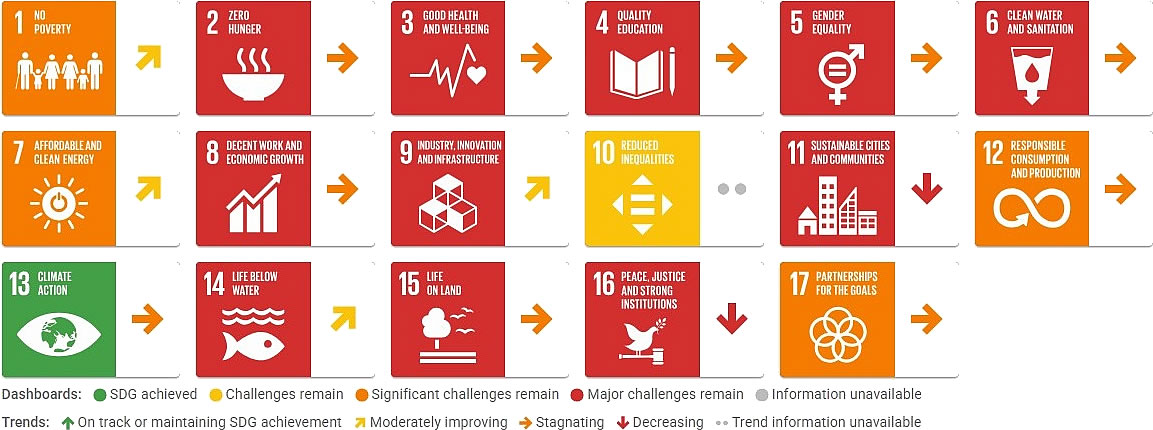
Climate Action, SDG 13, is the single green rating on Pakistan’s entire dashboard, out of eleven other goals rated the dashboard’s worst color, red. Taken at face value, that would suggest Pakistan is doing something right on climate. It measures something much narrower: low per-capita carbon emissions, a byproduct of a country that simply burns less fossil fuel per person than wealthier ones. It says nothing about the other side of climate change. Germanwatch’s Climate Risk Index ranked Pakistan the single most climate-affected country in the world in 2022, the year catastrophic floods put a third of the country underwater, displaced tens of millions, and killed more than 1,700 people, a country responsible for under 1% of global emissions living through one of the worst climate disasters of the decade.
Pakistan — Sustainable Development Report 2026
PK
Voluntary National Reviews: A Twinning Exercise With Sri Lanka
Pakistan presented its first Voluntary National Review at the High-Level Political Forum in 2019, having integrated the SDGs into its national development agenda through a unanimous National Assembly resolution back in February 2016, among the earliest countries to do so.
The second VNR followed in July 2022. Its most distinctive feature wasn’t a policy at all: Pakistan and Sri Lanka formally “twinned” for the review, a peer-to-peer arrangement opening up longer-term South-South cooperation between the two countries on SDG implementation. The 2022 review also reported a reduction in poverty of 2.4 percentage points and in inequality of 1.7 percentage points between 2015-16 and 2018-19, and noted that Pakistan’s social protection programme had been recognized by the World Bank as the fourth-largest in the world by coverage, reaching 16.9 million households during COVID-19.
Voluntary Local Reviews: Built Into the VNR Itself
No Pakistani city has published a standalone Voluntary Local Review. Instead, Pakistan has taken a different institutional route: its own VNR process incorporates sub-national profiles and district-level SDG dashboards directly, an approach UN statisticians have cited internationally as a working example of aligning local and national data without a separate VLR process. Whether that substitutes fully for the kind of city-level ownership a standalone VLR can build is an open question, one Bhopal’s review in neighboring India was built specifically to test.

What the Sustainable Development Report Shows: The Lowest Overall Score RYB Has Covered
The Sustainable Development Report scores every country two ways. The overall score measures how well a country is doing for its own people. The spillover score measures how much harm a country’s economy causes everyone else.
Pakistan’s overall score sits at 59.27 out of 100, ranking 131st out of 169 countries, the lowest overall position of any country RYB has covered on this site so far. Its spillover score sits at 94.24 out of 100, ranking 43rd, a familiar pattern by now: a large, lower-income economy doing comparatively little measurable harm abroad, even while its own domestic indicators struggle.
Why Pakistan’s Spillover Score Holds Up
- Weapons exports are low. At 0.017 TIV per 100,000 people, Pakistan’s figure sits well below Poland’s 0.747 or the US’s 3.773, though higher than India’s 0.004 or Indonesia’s 0.006.
- Plastic waste exports are minimal. At 0.045 kg per capita, Pakistan’s figure is close to India’s near-zero 0.003 kg, and far below the Netherlands’ 30.162 kg.
- Support for UN-based multilateralism is moderate. Pakistan’s score sits at 55.4 out of 100, close to the UK’s 54.9, behind Brazil’s 81.6 and Bosnia and Herzegovina’s 69.0.
Where the Work Remains
Pakistan’s Corruption Perceptions Index score, 28 out of 100, is the weakest RYB has recorded for any country on this site so far. Its Statistical Performance Index, 68.1 out of 100, sits toward the lower end of the range too. On the dashboard, eleven of seventeen goals rate the worst color, red, including Zero Hunger, Good Health and Well-Being, Quality Education, Gender Equality, Clean Water and Sanitation, Decent Work and Economic Growth, Industry Innovation and Infrastructure, Sustainable Cities and Communities, Life Below Water, Life on Land, and Peace, Justice and Strong Institutions, more red ratings than any other country RYB has covered to date. Sustainable Cities (SDG 11) and Peace, Justice and Strong Institutions (SDG 16) are both currently trending backward rather than holding steady.
Pakistan’s own PM2.5 figure, 51.1 μg/m³, is the single worst air-quality reading RYB has recorded for any country, over ten times the World Health Organization’s guideline. And as the opening of this page lays out, the one green rating on the entire dashboard, Climate Action, reflects low emissions produced, not climate damage absorbed, from a country Germanwatch ranked the most climate-affected in the world in 2022.
Pakistan’s spillover rank sits alongside every other country RYB tracks on the Global Responsibility page, where rankings like these are shown together across all the countries covered on this site.
Why These Numbers Matter
These pages matter more than their topic suggests on the surface. The SDGs are, in effect, the world’s working roadmap for its biggest shared problems, yet most citizens have never engaged with them directly. A Voluntary Local Review can change that at the scale where it’s most achievable: one city, one community, people who might otherwise never cross paths brought into the same conversation about what their home needs most.
Culture and the arts barely feature in Pakistan’s VNRs, understandably crowded out by poverty, health, and now recovery from climate disaster. RYB tracks Pakistan because a Culture of Peace lens has real room to add something to a country whose own reporting is, for good reason, focused almost entirely on survival and resilience right now.
RYB’s Place in This Picture
RYB tracks Pakistan because its dashboard makes a case most single-number rankings miss entirely: a country can score well on an indicator, low emissions, and still be the country suffering the most from the problem that indicator is meant to track. Pakistan’s own numbers argue that responsibility and vulnerability aren’t the same axis, and a global framework built mostly around the first can badly undersell the second.
Looking Forward
Watch whether Pakistan’s third VNR, whenever it comes, engages directly with the 2022 floods and their lingering effect on the country’s HDI and poverty figures. Watch the SDG 11 and SDG 16 trends specifically, the two goals currently moving backward on Pakistan’s dashboard. And watch whether any Pakistani city eventually produces a standalone Voluntary Local Review, rather than relying solely on the district dashboards folded into the national VNR.
UNDP
Human Development Report — Pakistan
The Human Development Index measures something narrower and older than the SDGs: life expectancy, education, and income, combined into a single score, with no 2030 deadline attached. It is a different lens on the same country, worth reading alongside the SDG data above rather than instead of it.
Pakistan’s HDI reached 0.544 in 2023, ranking 161st out of 193 countries, “low human development,” the only tier below “medium,” and the only country RYB has covered on this site to sit in it. UNDP itself has linked part of the country’s earlier decline directly to “the lingering effect of the 2022 floods.” Adjusted for inequality, Pakistan’s HDI falls by 33%, one of the steepest discounts UNDP records anywhere. The national figure also hides an enormous internal gap, worth reading in full on UNDP’s own page: Islamabad’s own regional HDI, 0.656, sits closer to “medium” tier, while Balochistan’s, 0.464, sits well inside “low,” a range wide enough to separate two different development categories within one country.
Pakistan’s Human Development Index data →
What is the difference between the HDI and the SDGs? →
Sources
- SDG Index database, Sustainable Development Report 2026 — Fuller, G., Iablonovski, G., Lafortune, G. and Sachs, J.D. (2026), SDSN / Dublin University Press, DOI:10.82163/225
- Sustainable Development Report 2026, Pakistan profile — dashboards.sdgindex.org
- Voluntary National Review 2022, Pakistan — hlpf.un.org
- Voluntary National Review 2019, Pakistan — sustainabledevelopment.un.org
- SDG Localization and Voluntary Local Reviews, UN DESA — sdgs.un.org
- Pakistan ranked most vulnerable to climate change in 2022: Germanwatch, Dawn — dawn.com
- Climate Risk Index 2025, Germanwatch — germanwatch.org
- UNDP’s 2023-2024 Human Development Report, Pakistan press release — undp.org
- List of administrative units of Pakistan by Human Development Index, background reference — en.wikipedia.org