

The Silk Road in Bulgaria: The European Gateway of Folklore
Table of Contents
Positioned as a vital geographic bridge between the Black Sea, Byzantium, and Central Europe, Bulgaria blended Eastern decorative traditions with ancient Balkan craftsmanship. This national archive documents how Bulgarian master weavers and embroidery artisans institutionalized a primary red, yellow, and blue visual vocabulary to preserve cultural protection and national identity.

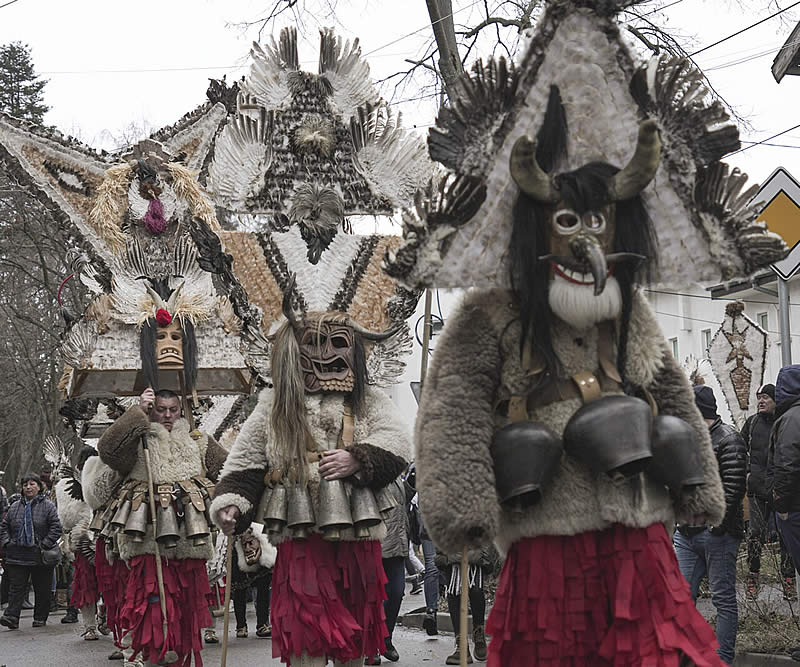
The Surva Festival is an international masquerade event held every January in Pernik, Bulgaria. It features thousands of participants dressed as Kukeri—ancient ritual performers wearing heavy animal skins, terrifying masks, and massive waist bells to chase away evil spirits and welcome the new year. The festival is deeply rooted in ancient pagan traditions and is recognised as one of the most cherished and significant events in the country’s history.
Silk Road
The Symbolic Palette: Spiritual Protection in Bulgarian Folk Art
In traditional Bulgarian folk culture—most prominently displayed in regional embroidery patterns (Shevitsi) and folk costumes—the utilization of a primary color palette went far beyond aesthetic decoration. Colors functioned as a coded symbolic language meant to protect the human body from metaphysical harm:
- Primary Red (Cherven): Represented life-giving blood, fire, fertility, and masculine strength. In historical rituals, it was used to paint the first Easter egg and dye wedding veils to safeguard brides against malevolent forces.
- Primary Yellow (Zholt): Associated with the lifeforce of the sun, light, and fire. In specialized carpet centers, it symbolized future prosperity and the predetermined destiny of a household.
- Primary Blue (Sin): Symbolized the element of water, cosmic infinity, and divine sky protection. It was commonly stitched to balance contrasting tones and cool the fiery weight of dominant red embroidery.
Editorial Note on the Red & White Tradition: While our research focuses heavily on the primary triad (RYB), Bulgaria holds a globally unique cultural exception centered strictly on a binary red and white palette. Inscribed on the UNESCO Representative List of Intangible Cultural Heritage, the ancient Martenitsa custom involves intertwining red and white twisted threads to celebrate the arrival of spring (Baba Marta). This cross-generational textile ritual represents the perfect equilibrium between life, vitality, and purity, deeply anchoring red and white as the foundational color pillars of Bulgarian national identity.

Researchers investigating the cultural codes embedded in regional Balkan clothing motifs can examine the comprehensive analysis published in the Secrets of Bulgarian Embroideries Research Archive.
Material Innovations: Chiprovtsi Weaving and Balkan Biochromes
Long before synthetic colorants arrived in Europe, Bulgarian trade hubs were celebrated across the Ottoman Empire for their exceptionally durable, hand-woven carpets and colorfast natural dyeing practices:
- The Chiprovtsi Carpet Legacy: Recognized by UNESCO as Intangible Cultural Heritage, weavers in the town of Chiprovtsi perfected flat-weave geometric patterns using horizontal and vertical looms, rendering complex Tree of Life designs primarily in rich madder tones.
- Botanical Extraction: Bulgarian artisans utilized wild-harvested weld (Reseda luteola) to achieve vibrant lemon-yellows, madder root for deep crimsons, and European woad or imported indigo for steadfast blues.
For deep documentation regarding the regional differences in technique, plant extraction, and historical geometry between Bulgarian carpet nodes, scholars can read the historical study on Bulgarian Fabrics and Carpet Centers via Bulgarian Roots.
The Elbetica: Bulgaria’s Ancient Cosmological Star and the Eight-Point Axis
The most profound visual parallel to the Chinese five-color system found in the Balkan Peninsula is the Elbetica (or Elbetitsa), the foundational solar star of traditional Bulgarian folk embroidery (Shevitsa). Preserved for centuries on the hems, sleeves, and collars of ritual garments, this intricate symbol functions as an ancient macrocosmic compass. According to research published by the National Ethnographic Museum at the Bulgarian Academy of Sciences, the Elbetica represents a double-cross configuration that charts the eight vital coordinate axes of reality: the four cardinal directions of the material world and the four intermediate directions of the spiritual world.
The layout and traditional execution of the Elbetica mirror the spatial, elemental, and chromatic logic found across the Silk Road trading networks:
- The Core Axis (The Central Sun): Just like the imperial yellow center (Huang) of the Wu Fang Zheng Se model, the Elbetica is built entirely around an unshakeable, centralized pivot point. This middle space represents the Young Sun, the Mother Goddess, or the core trunk of the universal World Tree, acting as the stabilizing divine generator from which all life expands.
- The Primordial Palette: Traditional Bulgarian artisans executed these complex directional stars almost exclusively in vibrant primary natural dyes. Deep madder red dominates the composition to signal fire and life force, framed by golden yellow ochre for solar illumination, and deep indigo blues to channel celestial protection and ward off malevolent forces.
- The Prehistoric Grid: Ethnographic analyses from the Sofia region indicate that the geometric growth of the Elbetica maps the expansion of the orderly cosmos out of primal chaos. By repeating this symmetrical, primary-colored grid across generations, rural weavers used their clothing as a protective barrier to anchor human life cleanly within the balanced geometry of the universe.
While the Chinese state framework was recorded in imperial court books, the Bulgarian Elbetica represents an unwritten, democratic survival of a similar cosmic consciousness. It demonstrates that whether mapping the stars from an imperial observatory in Chang’an or stitching a protective talisman in a mountain village in the Balkans, human cultures independently discovered that balancing a powerful center against the expanding cardinal directions is the ultimate tool for visual and spiritual harmony.
The Continental Corridor: Connecting East & West
Bulgaria’s unique cultural symbiosis emerged from its historic interaction with trade routes branching directly off the Silk Road network. Thracian, Slavic, and Proto-Bulgarian textile traditions merged, setting high standards of fabric production that supplied the massive liturgical and commercial markets of the Byzantine Empire and Western Europe.
For multi-decade archival data and research mapping the history of textile production along these European corridors, scholars can access these institutional platforms:
- Dye Analysis Framework: Review scientific methodologies used to map historical textile artifacts within the China Silk Museum 300-Year History of Dyes Archive.
- Folklore Documentation: Explore the broader history and structural preservation of regional garments through the Bulgarian Traditional Clothing Guide via Fibre2Fashion.
← Return to Master Hub:
The Red Yellow Blue Silk Road Project