

The Five Virtues: How Colour Decided Who Ruled China
Table of Contents
In the third century BC, the philosopher Zou Yan proposed an idea that would shape Chinese politics for the next two thousand years: that every ruling house governed by the “virtue” of one cosmic element, and that when a dynasty fell, its elemental energy had simply run out. A new dynasty did not just seize a throne. It had to claim a new element, and a new official colour, to prove Heaven itself had sanctioned the change.
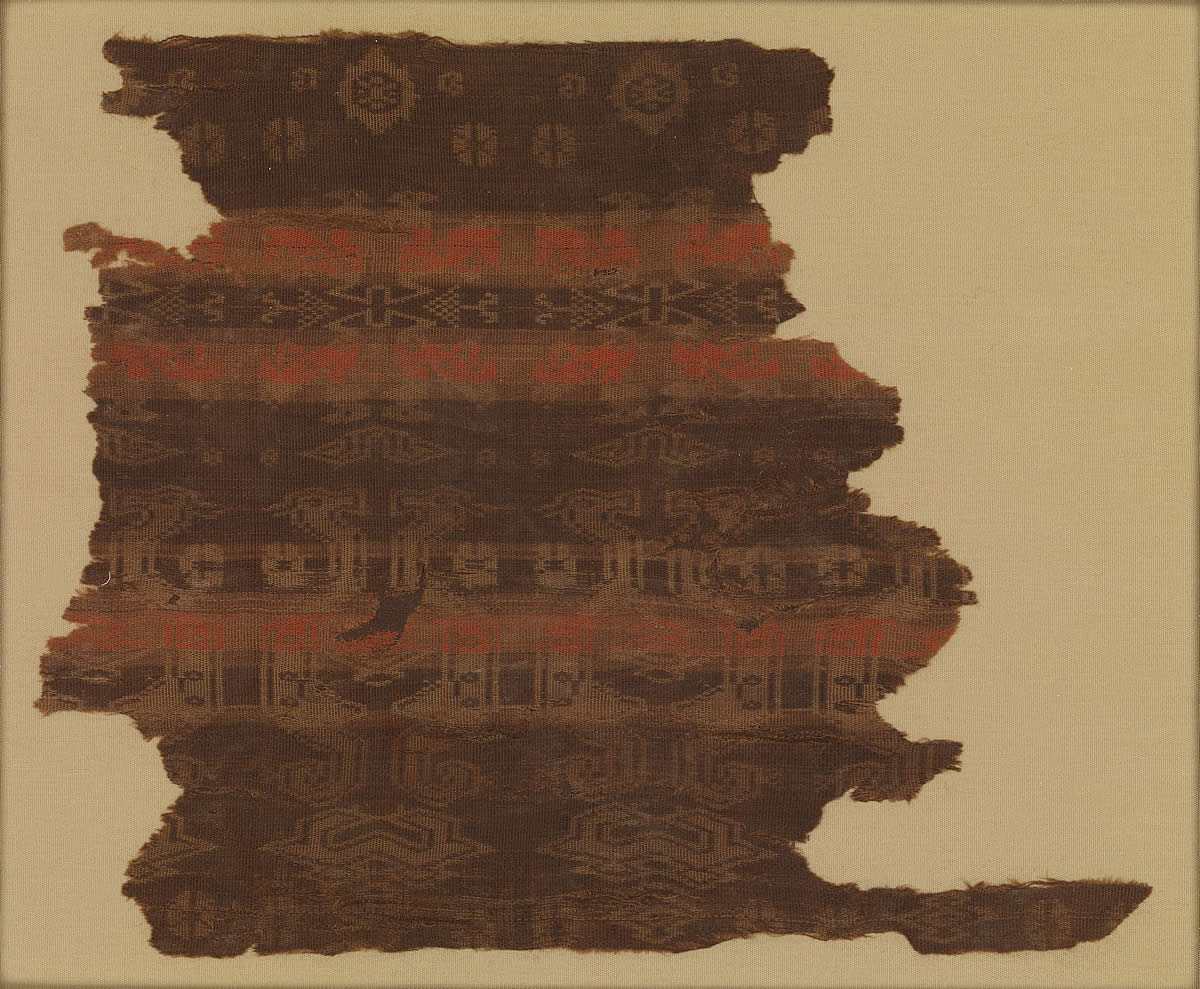
One of the oldest Chinese textiles in the Met Museum's collection, woven silk with a pattern of geometric motifs and birds or dragonlike animals. The stripes, probably dyed with cinnabar, retain a fresh red colour. Cinnabar was mined in China as early as three to four thousand years ago and has been found in Late Neolithic tombs. By the time of the Western Zhou dynasty (ca. 1046–771 BCE), the Chinese were refining and processing it to obtain the very best red colour. Little of the mineral dye was produced, however, and its use was restricted to luxury textiles for the elite.
Silk Road
Conquest by Colour
Early practice followed what became known as the Overcoming Cycle, in which each element violently destroys the one before it: Wood conquers Earth, Earth conquers Water, Water conquers Fire, Fire conquers Metal, Metal conquers Wood. A new ruler had to cosmologically defeat his predecessor’s colour, not merely replace it.
Qin Shi Huang took this seriously when he unified China in 221 BC. The Zhou Dynasty he replaced had ruled under Fire, Red. Because Water overcomes Fire, the Qin court claimed the virtue of Water and made black the only acceptable colour in the empire, from court banners to royal robes to official carriages. Even the number six, associated with water, dictated imperial measurements.
When the Han Dynasty overthrew the brutal, short-lived Qin, the Overcoming Cycle logic said Earth should follow, meaning yellow. Instead, a genuine court dispute broke out. Many Han scholars argued the Qin had been too tyrannical and too brief to count as a legitimate link in the elemental chain at all, and that the Han were the true moral heirs of the old Zhou. For decades, early Han emperors wore black or red inconsistently while the argument continued, unresolved.
A Gentler Logic Takes Over
By the late Han Dynasty, and especially during the Wang Mang usurpation around 9 AD, scholars grew uneasy with a cosmology built entirely on conquest. They proposed the Generating Cycle instead, in which each element naturally births the next, Wood generates Fire, Fire generates Earth, Earth generates Metal, Metal generates Water, Water generates Wood, a far more benevolent model of succession than violent overthrow.
Under this new logic, the whole of Chinese history was quietly re-mapped. Legendary rulers like Fu Xi were retroactively assigned to Wood, the element of spring and new beginnings. The historic Zhou Dynasty, Wood generating Fire, was confirmed as ruling under Red, and the Han court finally settled its decades-long dispute by claiming that the Zhou’s Fire had naturally birthed the Han’s own lineage. Red became the Han’s sacred colour so thoroughly that ethnic Chinese people still call themselves the Han people today, and still associate red with fortune.
The cycle continued through the centuries that followed. When the Han finally collapsed in 220 AD, the successor state of Cao Wei claimed that Fire generates Earth, and made yellow its supreme colour. Centuries later the Song Dynasty claimed the same elemental lineage, elevating yellow to a prominent royal hue long before the Ming and Qing formalised its absolute monopoly, a story told in full on our Imperial Yellow page. When Kublai Khan established the Mongol Yuan Dynasty, his court invoked Metal, since Earth generates Metal, and adopted white, a choice that conveniently aligned Chinese court logic with existing Mongol colour symbolism, where white already meant purity and good fortune.
Where the Cycle Stopped
By the time the Qing Dynasty took power in 1644, centuries of shifting elements and colours had become genuinely politicised, entangled with ethnic tension between Han and non-Han rule. The Qing court largely halted the debate. Rather than claim a new element to justify a new colour, it simply fixed Imperial Bright Yellow as a static, permanent symbol of the throne’s central, cosmic axis, and held that position until the imperial system itself ended in 1912.
Sources
- Wikipedia, “Wuxing (Chinese philosophy)” — wikipedia.org/wiki/Wuxing_(Chinese_philosophy)
- Wikipedia, “Zou Yan” — wikipedia.org/wiki/Zou_Yan
- Muse, Johns Hopkins University Press, dynastic colour and legitimacy research — muse.jhu.edu/article/611399
- ResearchGate, “Legitimation Discourse and the Theory of the Five Elements in Imperial China” — researchgate.net/publication/297647263_Legitimation_Discourse_and_the_Theory_of_the_Five_Elements_in_Imperial_China
← Return to Master Hub:
The Red Yellow Blue Silk Road Project