

De Stijl & Piet Mondrian: The Modern Evolution of Primary Colours
Table of Contents
History is rarely a straight line; it is a tapestry woven from independent threads that inexplicably cross across centuries and continents. At the dawn of the twentieth century, a radical artistic movement emerged in the Netherlands called De Stijl. Spearheaded by Piet Mondrian, who abandoned the natural world to create pristine grids of primary red, yellow, and blue, this movement sought a universal spiritual harmony. Guided by the dense occult literature of the Russian mystic Madame Helena Blavatsky, Mondrian unconsciously built a modern mirror to a system created thousands of years prior: the ancient Chinese cosmology of Wu Fang Zheng Se. This is the story of how two vastly different eras independently arrived at the exact same conclusion—that five foundational colours hold the keys to the universe.
Silk Road
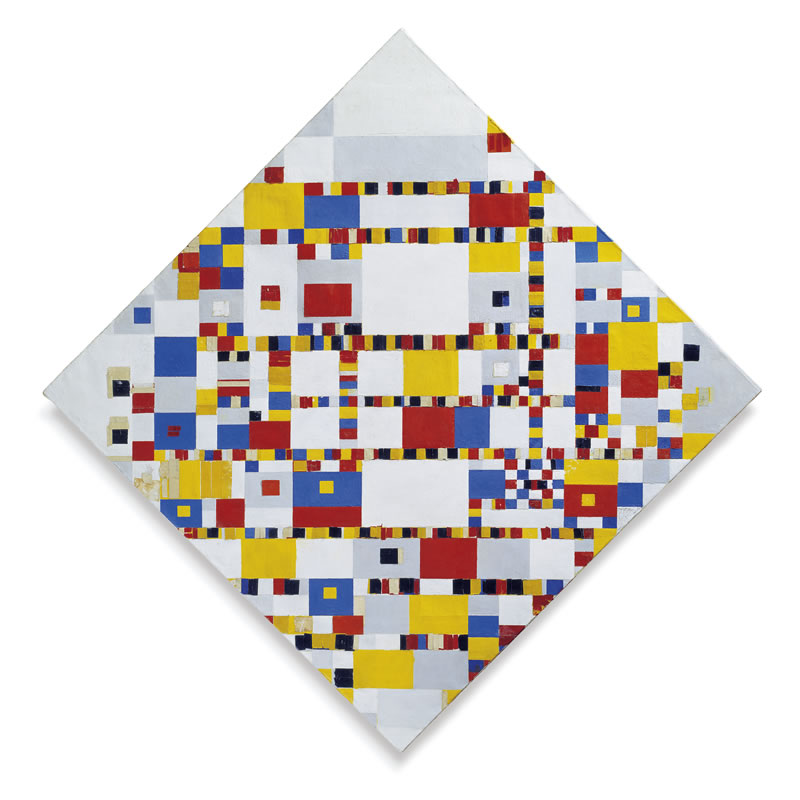
Piet Mondrian's unfinished 1944 diamond-shaped oil painting Victory Boogie Woogie, featuring a dynamic grid of primary red, yellow, and blue squares. It was purchased at a cost of 80 million Dutch guilders (approximately 35 million euros, US$40 million) from the American collector Samuel Irving Newhouse, who previously had bought it the from Emily and Burton Tremaine for US$12 million in the mid 1980s. It was bought in 1997 by the Stichting Nationaal Fonds Kunstbezit (National Art Foundation) through a gift from the Dutch Central Bank, commemorating the introduction of the euro, at the time the most expensive purchase ever for a Dutch museum.
The Dutch Visionary: Piet Mondrian’s Primary Reduction
Born in Amersfoort, Netherlands, on March 7, 1872, the Dutch painter Piet Mondrian underwent a deep intellectual crisis during his early artistic career. Mondrian began by painting traditional, atmospheric landscapes, but he grew increasingly frustrated by the superficiality of copying nature. Seeking an unshakeable, universal truth beneath the messy surface of reality, Mondrian walked into the Amsterdam lodge of the Dutch Theosophical Society and formally became a member in 1909. He began reading Blavatsky’s books meticulously, seeking to translate her mystical concepts of a cosmic blueprint into a tangible, revolutionary visual language.
Mondrian realized that to find a universal spiritual equilibrium, he had to strip art down to its bare, immutable atoms. He abandoned all curves, all perspective, and all recognizable objects, restricting his canvases entirely to vertical and horizontal lines. To colour this new world, he cast aside the infinite variations of nature and restricted his palette strictly to three primary colours—red, yellow, and blue—balanced against three “non-colours”—black, white, and grey. Through this radical theory, which he named Neo-Plasticism, Mondrian and the members of the De Stijl movement believed they were revealing the hidden, geometric spine of the cosmos. They sought to transcend the temporary changes of the physical world, capturing instead a permanent, unchanging spiritual harmony through the sheer perfection of balanced, opposing forces.
The Seer of the Century: Madame Blavatsky and the Occult West
To understand the spiritual landscape that reshaped modern Dutch art, one must meet its primary architect. Born into an aristocratic family in the Russian Empire, Madame Helena Petrovna Blavatsky was a nomadic mystic, writer, and spirit medium, who co-founded the Theosophical Society in New York City in 1875. She claimed to have traveled the world on a nine-year quest, entering the forbidden borders of Tibet to study an ancient, forgotten language from secretive spiritual adepts known as the Masters of the Ancient Wisdom.
Blavatsky set out to systematically dismantle the rigid materialism of Victorian science and the dogmatic constraints of mainstream Christianity. Through her massive, dense literary volumes, such as Isis Unveiled (1877) and The Secret Doctrine (1888), she argued that a single, universal “Ancient Wisdom” underlay all of the world’s great religions. Her doctrines completely globalized Western esotericism, injecting Eastern concepts of karma, cosmic cycles, and spiritual evolution into the modern mainstream, forever altering how European artists like Mondrian viewed the spiritual mechanics of reality.
The Tangled Threads: Divergence and Parallel Realities
Because Mondrian was a dedicated Theosophist, a fascinating question arises: was his legendary red, yellow, and blue art directly inspired by the ancient Chinese Wu Fang Zheng Se colors? The historical evidence reveals a surprising plot twist: no direct link exists. The intersection of these two colour systems is not a story of direct influence, but an extraordinary example of parallel cosmic alignment.
Madame Blavatsky’s books actually omitted traditional Chinese five-element cosmology completely. Because her philosophy sought to align Western occultism with 19th-century scientific frameworks, she chose to focus on septenary, or seven-fold, structures. Her texts outlined seven distinct “Root Races” of human development and a system of “Seven Rays,” mapping a human spiritual aura composed of seven distinct colours rather than five. Mondrian actually had to actively strip away Blavatsky’s complicated seven-colour system to create his own minimalist art. Instead, he drew his immediate colour inspiration from European colour science, particularly Goethe’s Theory of Colours, and the eccentric writings of the Dutch mathematician Mathieu Schoenmaekers. It was Schoenmaekers, a fellow Theosophist, who explicitly laid out Mondrian’s blueprint in 1915, writing that yellow, blue, and red were the only real colours, because yellow represented the ray of light, blue represented cosmic contrast, and red was the physical intensification, where light and contrast met.
Furthermore, the underlying mechanics of the two frameworks are completely opposite. The Chinese model of Wu Fang Zheng Se is a fluid, dynamic wheel; the five colours transform continuously into one another to copy the cyclical rhythm of nature and changing seasons. Conversely, Mondrian’s De Stijl model is deliberately static, rigid, and anti-nature; it relies on flat, locked rectangles designed to break free from nature’s cycles and touch an unchanging, universal spiritual absolute.
Yet, the absence of a direct historical chain makes the connection even more powerful. It reveals an awe-inspiring historical parallel. Separated by thousands of miles, completely isolated by language, and operating under entirely different philosophical motivations, two of the world’s most sophisticated cultures arrived at the exact same aesthetic conclusion. Both the ancient courtly scribes of the Han Dynasty and the radical modernists of 20th-century Europe independently discovered that Red, Yellow, Blue, Black, and White do not merely belong to a painter’s palette—they form the foundational, elemental architecture of human visual expression and spiritual order.
The Diamond Convergence: Lozenge Canvases, Planetary Alignment, and Spatial Axis
The final phase of Piet Mondrian’s career was defined by a striking structural evolution: the “diamond shape” or lozenge paintings, a format he returned to repeatedly until his final, unfinished masterpiece, Victory Boogie Woogie (1942–1944). By tilting a standard square canvas at a forty-five-degree angle, Mondrian created a visual phenomenon where the center anchors a complex grid while the four outer corners point directly toward the cardinal directions—North, East, South, and West. This layout creates an astonishing visual parallel to the classic star diagrams of the Wu Fang Zheng Se system, where the golden yellow center radiates out toward the four coloured directional phases.
Yet, just like his earlier primary grids, Mondrian did not construct this geometric diamond out of an awareness of Chinese cosmology. Instead, his use of the lozenge shape emerged from an intense, internal ideological battle fought within the borders of Western geometry, European colour science, and Dutch architecture. Mondrian was consumed by a specific artistic problem: how to represent infinite, boundless universal space using nothing but completely straight lines. He realized that a standard square frame acted like a window, containing the picture safely inside a box. By rotating the canvas into a diamond, his strict vertical and horizontal lines were abruptly clipped off by the diagonal edges. This trick created a powerful optical illusion, making the viewer feel as though the primary coloured lines extended past the frame, continuing infinitely into the room.
This radical geometric choice actually triggered a historic and permanent feud within the De Stijl movement. Mondrian’s close collaborator, Theo van Doesburg, began arguing that to truly capture the dynamic energy of modern life, machines, and jazz music, artists should start painting actual diagonal lines on their canvases. Mondrian vehemently disagreed, view it as a betrayal of spiritual truth. To Mondrian, the intersection of a perfectly horizontal line and a perfectly vertical line was a sacred, unshakeable law representing the ultimate cosmic balance of opposites—sky and earth, male and female. The diamond canvas was Mondrian’s brilliant compromise: he could rotate the outer boundary of the physical world diagonally, but the internal spiritual axes had to remain completely upright and unbroken.
The Celestial Clockwork: The Planets of Wuxing and the Five Spheres
While Mondrian was using geometry to capture an unchanging spiritual absolute, the ancient Chinese framework he mirrored was inherently tied to the dynamic, cyclical movements of the heavens. In traditional Chinese philosophy and astronomy, the term Wuxing—alternatively translated as the “Five Moving Ones,” “Five Circulations,” or “Five Agents”—originally referred directly to the five classical planets visible to the naked eye. To ancient astronomers, these celestial bodies were not cold, distant rocks; they were the macrocosmic engines driving the five primary forces of earthly life, working in tandem with the central energies of the Sun and the Moon.
Each planetary body was mapped directly onto an orthodox colour, a direction, and a specific elemental frequency within the cosmic matrix:
- Sui-xing (Jupiter): The Wood planet, ruling the East and symbolized by the vibrant, blue-green hue of Qing. It governed the arrival of spring, wind, and the vital essence of vegetative growth.
- Ying-huo (Mars): The Fire planet, ruling the South and symbolized by the brilliant red of Chi. Its erratic, glowing trajectory across the sky was tied directly to summer heat, passion, and dynastic warnings.
- Zhen-xing (Saturn): The Earth planet, ruling the absolute Center and symbolized by the imperial yellow of Huang. As the slow-moving pivot of the planetary system, it represented stability, dampness, and the ultimate balancing transition between seasons.
- Tai-bai (Venus): The Metal planet, ruling the West and symbolized by the stark white of Bai. Its bright, sharp appearance signaled autumn harvesting, contraction, and the dry, indrawing forces of nature.
- Chen-xing (Mercury): The Water planet, ruling the North and symbolized by the deep black of Hei. It governed the cold isolation of winter, moisture, and the preservation of hidden potential.
In ancient Chinese astrology, this planetary clockwork dictated the rise and fall of entire civilizations. When the classical planets aligned smoothly in their clockwise “generative” cycle (Wood feeding Fire, Fire producing Earth, Earth bearing Metal, Metal purifying Water, and Water nourishing Wood), the empire experienced peace, bumper harvests, and healthy citizens. However, if the planets fell into an adversarial, “overacting” arrangement—where Wood depleted Earth, or Fire melted Metal—calamities, natural disasters, and widespread disease were foretold to ensue.
Parallel Realities: The Fixed Axis vs. The Fluid Wheel
Ultimately, comparing Mondrian’s diamond canvases to the celestial clockwork of the Wuxing brings us to a profound realization about human consciousness. Mondrian’s spatial orientation was heavily guided by his Dutch mathematical mentor, the eccentric Theosophist Mathieu Schoenmaekers, who taught that the universe was constructed on an invisible, vertical ray of light from the sun intersecting with the horizontal line of the earth’s horizon. When Mondrian created his diamond paintings, he was trying to prove that even if you tilt the physical frame of reality, the absolute spiritual axis within remains completely stable, rigid, and unaffected by the chaotic movement of the world.
The Chinese model, by contrast, embraced that very movement. The Wuxing is a fluid wheel of perpetual transformation, where no colour or phase remains dominant forever, but instead passes its energy onto the next season and the next planet in an eternal loop. Yet, the striking structural similarity between Mondrian’s diamond compositions and the five-part directional matrix proves that two completely isolated cultures arrived at the exact same aesthetic conclusion. Whether mapping the pathways of the stars across ancient Asia Minor or distilling the frantic energy of 20th-century New York jazz into a geometric grid, humanity independently discovered that balancing a powerful center against four expanding cardinal corners forms the absolute baseline of spiritual order and visual expression.
← Return to Master Hub:
The Red Yellow Blue Silk Road Project