

Wuse (五色): The Five Orthodox Colours of Chinese Cosmology
Table of Contents
Wu Fang Zheng Se, the “Orthodox Colours of the Five Directions,” is a three-thousand-year-old framework that never separated physical colour from cosmic law. Five pure colours, Zheng Se, were mapped directly onto the Five Elements and the five cardinal directions, turning a palette into a working model of the universe. This page sets out that model, and follows it as it travelled far beyond China’s own borders.

Silk Road
The Directional Matrix
At the centre of the system sits a fixed geometry, each colour bound to an element, a direction and a season:
- Huang (Yellow): the Centre and the element Earth. Imperial power, neutrality, supreme rule.
- Chi / Zhu (Red): the South and the element Fire. Vitality, summer, celebration.
- Qing (Blue-Green): the East and the element Wood. Nature, spring, renewal.
- Bai (White): the West and the element Metal. Purity, autumn, stillness.
- Hei (Black): the North and the element Water. Mystery, winter, depth.
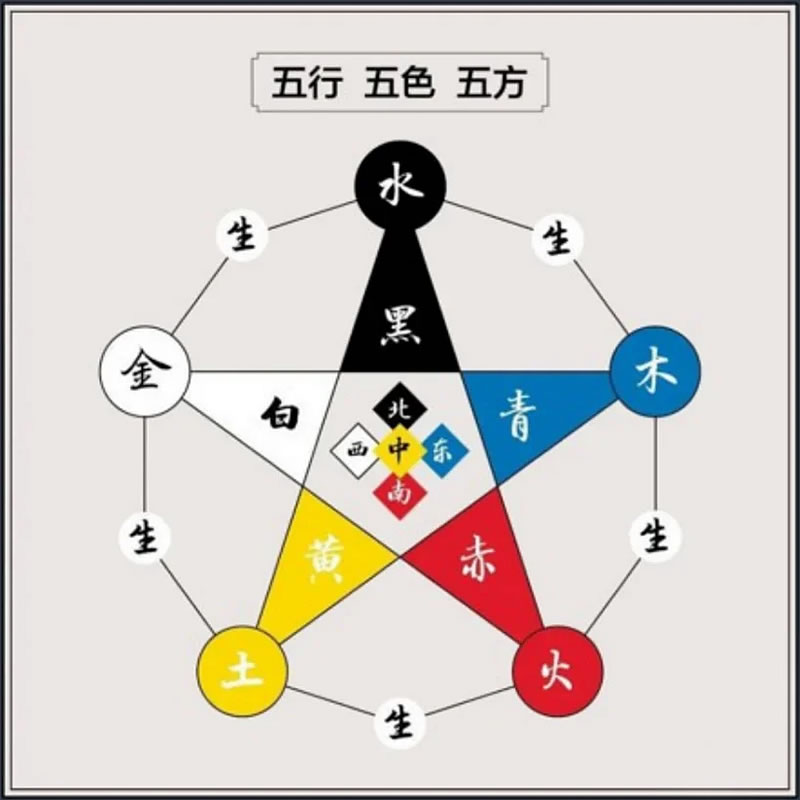
The five-coloured star framework illustrating the traditional Chinese Wu Fang Zheng Se cosmology.
Orthodox Colour, Ritual Law
Zheng denotes “orthodox” or “primary.” Jian Se, by contrast, names the intermediate, blended colours the orthodox five were set against. This was never a soft aesthetic distinction. Ritual court law reserved pure orthodox colours for high-status nobility and official state sacrifice, while secondary, blended colours were left to lower-status, everyday wear. Ruling dynasties went further still, each adopting one orthodox colour as the visible proof of the cosmic element by which it claimed the right to rule, and abandoning it the moment a new dynasty claimed the throne. That story, the politics behind the palette, is substantial enough to deserve its own telling on The Five Virtues: How Colour Decided Who Ruled China, and Yellow’s particular rise to permanent monopoly is covered in full on Imperial Yellow: How a Colour Became a Throne.
The Sinosphere Adopts the System
As Chinese philosophical and administrative systems spread through East Asia, neighbouring courts adopted the five-colour logic into their own rituals, architecture and food.
Korea embedded it as Obangsaek, the five directional colours, fully institutionalised through the Goryeo and Joseon Dynasties. Dancheong, the painting of wooden buildings in brilliant red, yellow, green-blue, white and black, was believed to ward off evil spirits, and the same five-colour balance still governs traditional Hanbok and dishes such as bibimbap.
Japan absorbed the system through Buddhism, Taoism and Confucianism during the Asuka period, most visibly when Prince Shōtoku’s 603 CE Twelve Level Cap and Rank System used the five colours, plus purple, to encode political hierarchy. The logic persists today in the four coloured tassels hung over a sumo ring and in Washoku cooking’s pursuit of Goshiki, five-colour balance, on the plate.
Vietnam folded the system directly into imperial governance from the Lý Dynasty onward. The Imperial City of Huế was laid out along strict Wu Xing directional geography, and the five-colour flag, Cờ ngũ sắc, still marks festivals and sacred spaces in Vietnamese folk tradition.
Tibet developed its own parallel rather than a direct copy, formalised through Tang-era exchange and marriage alliances from the seventh century onward. Tibetan prayer flags order five colours strictly: blue for space, white for air, red for fire, green for water, yellow for earth. The elemental meanings shift from the Chinese original, but the underlying logic, a five-colour cosmic web mapped onto reality, is unmistakably the same instinct at work.
Beyond the Sinosphere
Wuse did not travel as an abstract idea. It moved as physical goods: paintings, silks, carpets, buildings.
Sogdian merchants along the Northern Silk Road were the first to carry it further, replicating Chinese polychrome silks and adopting the distinctive colour groupings in their own textiles and in murals at Afrasiab, near Samarkand. Centuries later, Pax Mongolica carried the palette onto the Eurasian steppe itself: Mongol court records describe diplomatic silk gifts to steppe leaders deliberately featuring all five colours, to preserve cosmic harmony across the empire’s borders.
The deepest transmission reached Persia. The Mongol-ruled Ilkhanate imported Chinese artists, manuscripts and textiles directly into its courts, and Persian miniature painting absorbed the tight, symbolic colour framing of Chinese Buddhist and Daoist art as a result. The reciprocal cobalt trade this opened up, and what China did with it, is covered on our China Silk Road page.
Europe’s turn came last, and by sea rather than overland. Eighteenth-century Chinoiserie saw European elites grow obsessed with imported Qing textiles and porcelain, and European workshops tried, and largely failed, to reverse-engineer the five-colour balance they saw in them. What survived the crossing was the aesthetic. The directional, religious meaning behind it did not.
Sources
- Wikipedia, “Color in Chinese culture” — wikipedia.org/wiki/Color_in_Chinese_culture
- Wikipedia, “Obangsaek” — wikipedia.org/wiki/Obangsaek
- Smithsonian, “Sogdian Textiles Along the Silk Road” — sogdians.si.edu/sidebars/sogdian-textiles-along-the-silk-road/
- ResearchGate, “Wu se (wuse): Ancient Chinese ‘Five Colours’ Theory” — researchgate.net/publication/312444088_Wu_se_wuse_Ancient_Chinese_’Five_Colours’_Theory_What_Does_Its_Semantic_Analysis_Reveal
- Europeana, “Chinoiseries” — europeana.eu/en/stories/chinoiseries
← Return to Master Hub:
The Red Yellow Blue Silk Road Project