

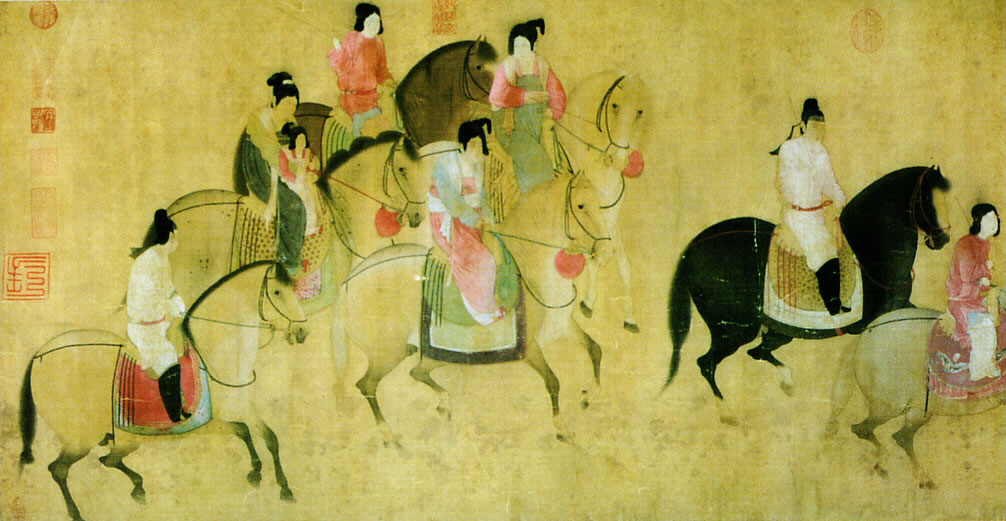
Pleasures of the Tang court, Tang Dynasty, 8th century, Author Zhang Xuan (713–755)
A Timeline of the Red Yellow Blue Silk Road: Colour, Cosmology and Trade
Red, yellow and blue did not travel a single, tidy road. Some civilisations arrived at this palette entirely on their own, shaped by the pigments the earth around them offered. Others inherited it through centuries of trade, conquest and court politics. This timeline follows both threads at once: a chronological walk through the deepest, best-documented story in our research, the rise, codification and eventual export of colour as cosmic and political law in China, framed by the Mediterranean collapse that came before it and the Dutch grid that, many centuries later, distilled the same three colours into something radically new.
Silk Road
A Mediterranean Prologue (c. 1250–1150 BC)
Long before any Silk Road existed, a different colour story was already unfolding in the Mediterranean. When the palace economies of the Aegean and Near East collapsed within a single violent century, the trade networks carrying copper and lapis lazuli broke with them, and the formula for Egyptian Blue was largely lost. Artisans fell back on iron-rich red and black, and a luxury triad briefly lost a third of itself. Read the full story on our Late Bronze Age Collapse page. It has nothing to do with China, and everything to do with how fragile a colour’s survival can be.
Foundations in Bronze and Jade (c. 1600–1046 BC)
Chinese civilisation’s own relationship with colour began just as physically. Shang Dynasty artisans worked red iron-rich earth and yellow ochres into oracle bones and ritual bronze vessels, while early jade carving laid the groundwork for Qing, the blue-green associated with growth and vitality. Nothing here was yet systematised. It was raw material meeting craft, the same way it was everywhere else in the ancient world at this time.
The Mandate of Heaven and the Birth of a System (1046–256 BC)
Under the Zhou Dynasty, colour began to acquire philosophical weight. The idea of the Mandate of Heaven took hold, the belief that a ruler’s legitimacy came from a cosmic order rather than from force alone, and weavers started separating textiles into Zheng Se, the orthodox primary colours, and Jian Se, their intermediate blends. Late in the Zhou period, a Warring States philosopher named Zou Yan systematised this instinct into something far more powerful: the theory that each dynasty ruled by the “virtue” of a specific cosmic element, and that history itself moved in elemental cycles. This single idea would shape Chinese court politics, and the colours its emperors wore, for the next two thousand years. We follow it in full on The Five Virtues: How Colour Decided Who Ruled China.
Black, Then Red: The First Successions (221 BC – 220 AD)
Zou Yan’s theory was put into practice almost immediately. When Qin Shi Huang unified China in 221 BC, he claimed the virtue of Water, since Water overcomes Fire, the element of the fallen Zhou, and black became the empire’s only acceptable colour, from court robes to official banners. When the Han Dynasty overthrew the short-lived Qin, the question of which colour should follow proved far messier than the cycle suggested. Court scholars argued for decades over whether the Han should count the Qin as a legitimate link in the chain at all, and it was not until roughly 9 AD that the court formally settled on Red, framing it as Fire naturally generating the next stage. This was also the era in which Han emissaries formally opened trade west along what would become known as the Silk Road, carrying dyed silks with them.
Yellow Claims the Centre (220–907 AD)
After the Han fell, rival successor states spent the Three Kingdoms and Six Dynasties period trading claims to Yellow and Red, each trying to prove an unbroken line back to the old order. It was the Sui and Tang Dynasties that finally settled the matter for Yellow specifically. Emperor Gaozong legally banned commoners and officials from wearing zhe huang, a reddish ochre-yellow, turning what had been a cosmological preference into an enforceable law. From this point on, wearing the wrong yellow in public was no longer a fashion mistake. It was treason. We trace this story from its geographic roots in the Yellow River’s fertile loess soil through to the Forbidden City’s rooftops on Imperial Yellow: How a Colour Became a Throne.
Parallel Palettes Along the Route (960–1368 AD)
As Yellow’s imperial monopoly deepened under the Song Dynasty, colour traditions elsewhere along the trade routes were developing largely on their own terms rather than through direct transmission from the Chinese court. Anatolian and Central Asian weavers were building their own geometric colour language from madder red and indigo, shaped by nomadic craft rather than by Wuxing cosmology. A more direct link did eventually form further west: when the Mongol-led Yuan Dynasty claimed the virtue of Metal and adopted White as its imperial colour, the same Pax Mongolica that unified the Eurasian steppe also carried Chinese artists, manuscripts and textiles into the Ilkhanate, the Mongol-ruled Persian court. There, Chinese five-colour framing genuinely reshaped Persian miniature painting and, in the cobalt trade that followed, gave the world blue-and-white porcelain. This is the clearest documented case of Wuse itself travelling outward, and we cover it on our Silk Road in Iran page.
The Monopoly Perfected (1368–1912 AD)
The Ming Dynasty revived red and yellow together as the aesthetic of state power, standardising the crimson walls and golden roofs still visible across Beijing today. The Qing Dynasty then took the monopoly to its absolute limit, reserving a specific, brilliant shade known as Ming Huang exclusively for the Emperor, Empress and Empress Dowager. By the time the imperial system fell in 1912, Yellow had spent well over a thousand years as the fixed, immovable colour of the Chinese throne.
A New Colour Grid in Amsterdam (1917–1931 AD)
Centuries later, and on the opposite end of Eurasia, a small group of Dutch artists arrived at their own radical statement built from the same three colours. Piet Mondrian and Theo van Doesburg founded De Stijl in the aftermath of the First World War, stripping painting down to a strict grid of red, yellow and blue. Their influences were their own: Cubism, Georges Seurat’s colour theory, and a deep engagement with Theosophy, not a direct line back to Chinese cosmology. It is a coincidence worth pausing on rather than overstating. Read the fuller story, including that Theosophical thread, on De Stijl and Mondrian.
Where the Road Continues
De Stijl is not where this research ends. Contemporary artists continue to return to red, yellow and blue as a shared visual language, and we plan to research and add that chapter as our work continues. This timeline, and the project behind it, remains open.
How to Read the Country Pages That Follow
As you move from this page into the country and region pages in the sidebar, it helps to know what kind of story each one is telling. The sidebar itself is ordered geographically, roughly following the historic trade route west from China through Central and South Asia into Europe. That order does not mean every page describes a colour tradition that travelled from China. Iran’s page documents a genuine, dated link to Chinese Wuse cosmology, transmitted through the Mongol Ilkhanate. Nepal, Anatolia, Bulgaria and Spain, by contrast, describe colour traditions that are either rooted in their own independent artistic and religious histories, such as Nepal’s Buddhist Paubha painting, or shaped by the broader currents of Silk Road trade without a direct cosmological borrowing from China, as with Anatolian weaving, Bulgarian embroidery and Spanish Moorish pottery. Each is a genuinely rich colour story in its own right. It simply is not always the same story.
Sources
- Wikipedia, “Wuxing (Chinese philosophy)” — wikipedia.org/wiki/Wuxing_(Chinese_philosophy)
- Wikipedia, “Zou Yan” — wikipedia.org/wiki/Zou_Yan
- chinaknowledge.de, “Yin-Yang and Five Agents Theory” — chinaknowledge.de/Literature/Diverse/yinyangwuxing.html
- ResearchGate, “Legitimation Discourse and the Theory of the Five Elements in Imperial China” — researchgate.net/publication/297647263_Legitimation_Discourse_and_the_Theory_of_the_Five_Elements_in_Imperial_China
- Wikipedia, “Late Bronze Age collapse” — wikipedia.org/wiki/Late_Bronze_Age_collapse
- artincontext.org, “De Stijl Art” — artincontext.org/de-stijl-art/
← Return to Master Hub:
The Red Yellow Blue Silk Road Project