

The Silk Road Mirror That Held the Sky
Table of Contents
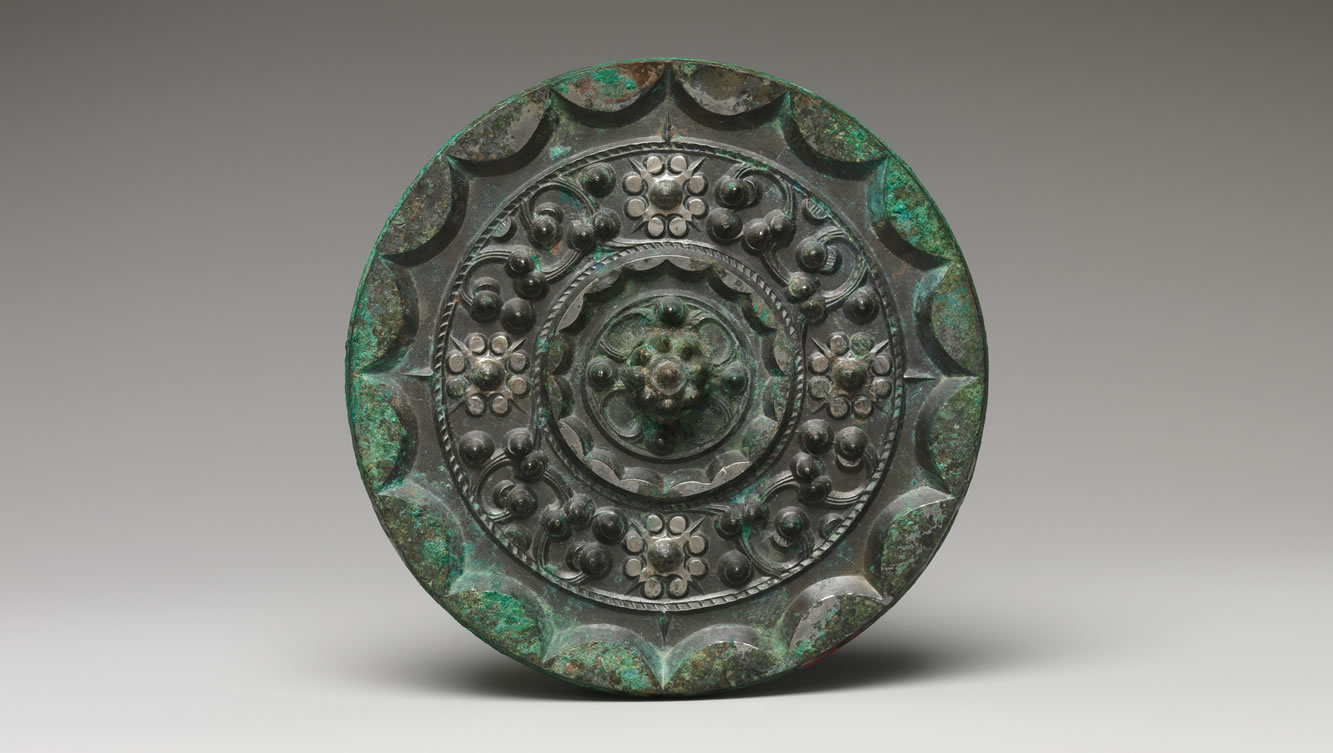
Mirror with Dragons and Knob-and-Swirl Design, 1st century BCE
by The Metropolitan Museum of Art
Cast in the early Western Han dynasty, this mirror’s surface has weathered to a deep green patina over two thousand years underground. Dragons and swirling knob motifs circle the central boss, bordered by a rim of linked lunar arcs — the oldest of the mirrors on this page, and a bridge between the animal-style bronzes of the Warring States and the fully cosmological TLV mirrors that would follow a century or two later.
Somewhere in a workshop near Chang’an, sometime in the first or second century CE, a bronze founder poured molten metal into a clay mould the shape of a small, round world. When it cooled and the mould was broken away, what emerged was a disc barely the width of two hands — one face polished bright enough to catch a face in, the other cast with a diagram of the entire universe.
This was not an unusual thing to own. It was a mirror.
Silk Road
A Tradition Older Than the Silk Road Itself
The Chinese bronze mirror is far older than the network of routes that would later carry silk, spices, and ideas across Eurasia. Its earliest known ancestors come from the Qijia culture of Gansu and Qinghai, in China’s remote northwest, dating back roughly 4,000 years to around 2000 BCE. These first mirrors were small, plain, and rare — precious ritual objects belonging to the elite, prized as much for the mystery of their reflective surface as for their usefulness. For well over a thousand years, they stayed that way: uncommon, ceremonial, more often found in a noble’s tomb than a household.
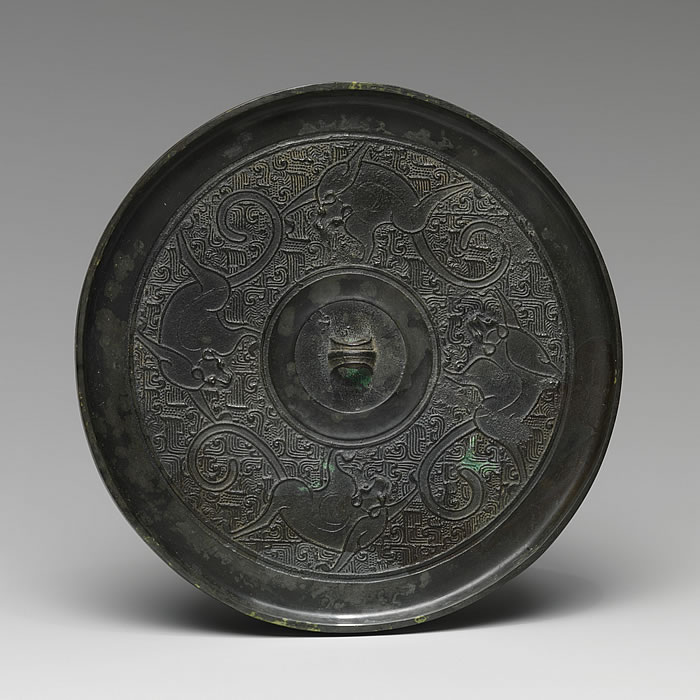
Mirror with Four Felines, 4th–3rd century BCE
by The Metropolitan Museum of Art
Cast during the Warring States period, centuries before the cosmological diagrams of the Han dynasty, this mirror’s four felines circle the central boss in pure decorative symmetry — a reminder that the Chinese mirror tradition experimented with animal imagery long before it hardened into a fixed map of the heavens.
By the Warring States period (475–221 BCE), that plainness had begun to give way. A mirror from this era, now in the Metropolitan Museum of Art, shows four felines circling the central boss in careful rotational symmetry — a sign that mirror-makers had started treating the back of the disc as a canvas, borrowing the same animal-style vocabulary already found on bronze ritual vessels of the time. There is no fixed cosmology here yet, no cardinal directions or calendar marks — just beasts in motion around a still centre. That would come later. For now, the mirror had simply learned how to carry a design.
Everything changed after around 400 BCE. Bronze mirrors suddenly became common, then, under the Han dynasty (206 BCE–220 CE), they became standardised — cast in workshops to repeating designs, traded and gifted across the empire and beyond it. The round shape never changed. What changed was what the makers chose to put on the back.
A Universe You Could Hold
By the Han dynasty, the back of a mirror was no longer just decoration — it was a map of how the cosmos worked. At the centre sits a small raised boss, pierced through so a silk cord can pass through it: the still point around which everything else turns, and the loop by which the owner would have held the mirror or hung it from a stand. Around that boss, a square frame appears — the earth, aligned to the four cardinal directions and marked with the twelve earthly branches used to calculate the calendar. Around the square, a circle — the heavens. And around the heavens, sometimes, a border of waves: the cosmic ocean that was believed to encircle the world entirely.
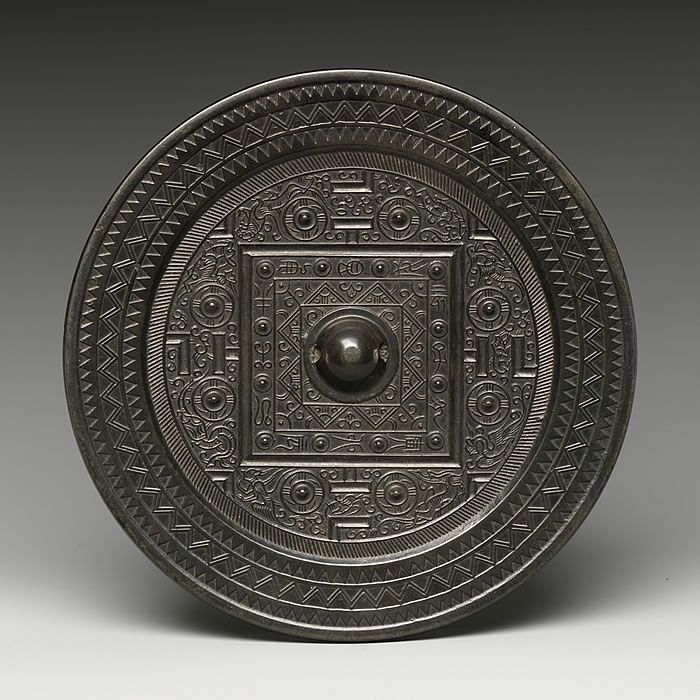
Mirror with Game Board Design and Animals of the Four Directions, 1st–2nd century
by The Metropolitan Museum of Art
A Han-dynasty “TLV mirror,” its back cast with a diagram of the cosmos: a square earth marked with the twelve earthly branches, encircled by the round heavens and the waves of the cosmic ocean, guarded by the Green Dragon, White Tiger, Red Bird, and entwined Black Turtle and Snake of the four directions.
Sharing that heaven are the Animals of the Four Directions — the green dragon of the east, the white tiger of the west, the red bird of the south, and the black turtle entwined with a snake in the north — alongside strange T-, L-, and V-shaped marks that gave this whole style of mirror its modern name: the TLV mirror. Scholars believe those marks echo the measuring rods and rulers said to have been used by Fu Xi and Nü Wa, the mythical pair credited with creating the ordered universe out of chaos. Some mirrors carry a further ring of small linked arcs around the very rim — a fringe of little moons closing the design, as if the edge of the mirror were the edge of the visible sky.
Turn the mirror over, and a face looks back. Turn it again, and the entire structure of heaven and earth looks back instead. For the person who owned it, the two sides were not really separate: the self and the cosmos, reflected in the same small object.
Travelling West, and East
Mirrors like this did not stay in one place. As the Han dynasty pushed trade and diplomacy along the routes that would come to be called the Silk Road, bronze mirrors travelled with it — carried west into the oasis cities of the Tarim Basin, and east into the Korean peninsula and across the water to Japan, where Chinese-made and Chinese-style mirrors became treasured grave goods for centuries, a mark of status and a connection to a distant, powerful court.
The exchange did not run only one way. By the Tang dynasty (618–907 CE), a new mirror style appeared on the back of Chinese bronzes: dense scrolls of grapevine, prowling lions, and foreign beasts, rendered in a style utterly unlike the square-and-circle cosmology of the Han. These “sea-beast and grape” mirrors carried motifs that had travelled the Silk Road in the opposite direction — out of the Hellenistic and Persian/Sogdian world, through the trading cities of Central Asia, and into Chinese workshops, where craftsmen folded them into a mirror form that was, by then, already fifteen centuries old.
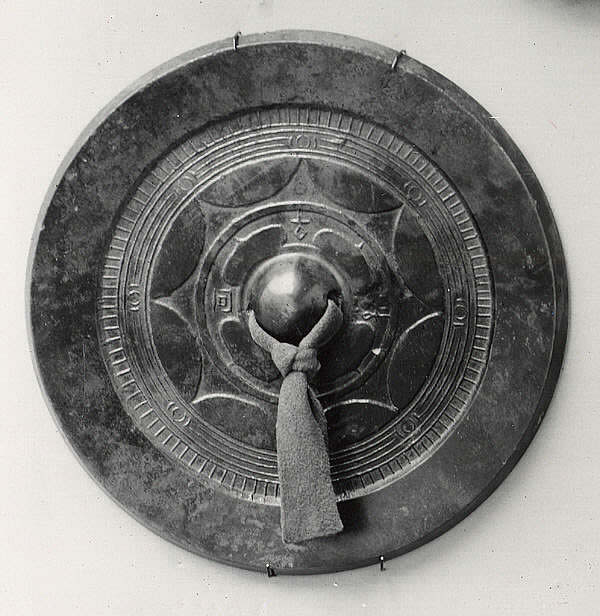
Mirror with Eight-Point Design, 1st century
by The Metropolitan Museum of Art
A Han-dynasty “linked-arc” mirror, its rim bordered by eight lobed arcs — a lighter cousin of the sixteen-arc design on other Han mirrors. A silk cord still threads through the central boss, showing exactly how these mirrors were held, worn, or hung.
What the Mirror Still Shows
A bronze mirror is, on the face of it, a simple thing: a polished disc to check your reflection in. But the mirrors of Han-dynasty China turned that simple object into something else entirely — a pocket-sized model of the universe, carried by ordinary people, buried with the dead, and traded across a continent. In the dragon, the tiger, the bird, and the turtle circling its rim; in the square earth held inside the round heaven; in the small hole at its centre, where a cord once passed through — an entire cosmology survives, small enough to fit in one hand, old enough to have watched the Silk Road itself come into being.
← Return to Master Hub:
The Red Yellow Blue Silk Road Project