

The Silk Road in China: Colour, Craft and Trade
Table of Contents
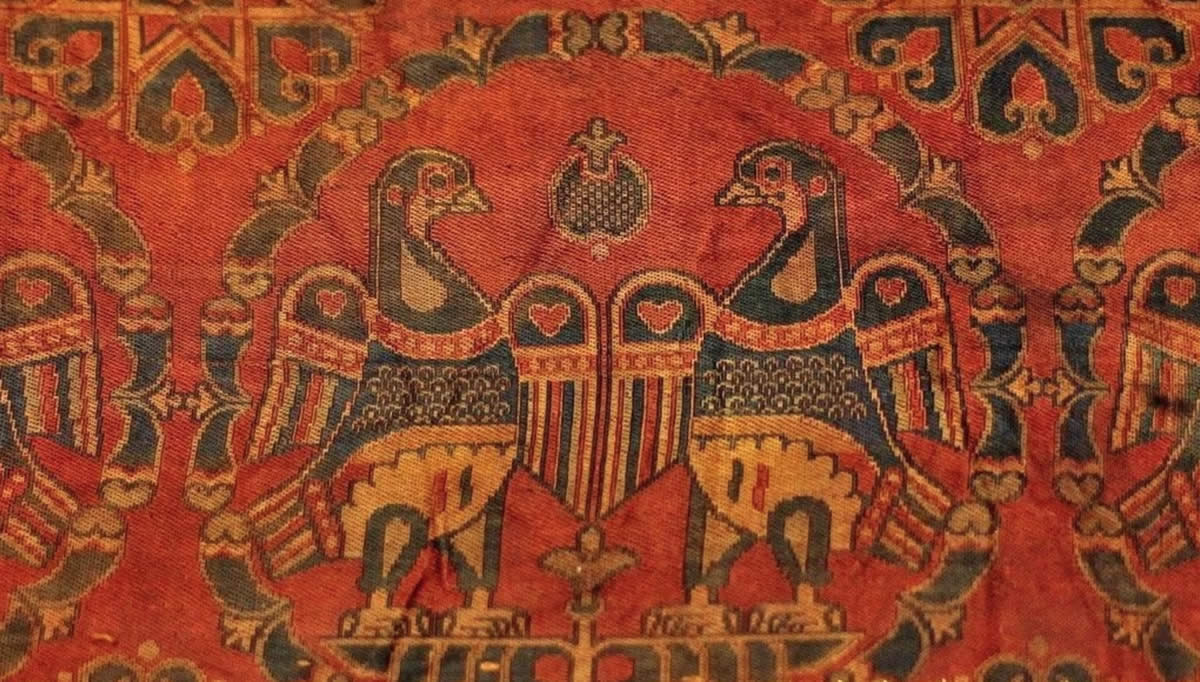
Sichuan brocade with double-bird-within-floral-roundel pattern, displaying strong Central Asian influence. Collection of Chengdu Museum. Date between 618 and 907.
China’s stretch of the Silk Road carried more than silk. It carried colour itself, as pigment, as dye, and as a technical problem to be solved. Long before red, yellow and blue reached Persia, Anatolia or Amsterdam, Chinese artisans were sourcing, refining and trading the raw materials behind them. This page follows that material story. For the cosmological system underneath it, the philosophy that mapped these colours onto the compass, the seasons and the throne itself, see our dedicated Wuse page.
Silk Road
A Timeline of Craft: From Pigment to Porcelain
Chinese artisans were working with mineral pigments long before any formal colour system existed. Hematite red and mercury-based cinnabar appear in Neolithic pottery as foundational materials, worked by hand into some of the earliest recorded decorative traditions in East Asia. By the Zhou Dynasty, court documents including the Rites of Zhou show colour choices for jade and robes becoming bound to formal ritual law, a shift covered in full on the Wuse page.
The Han Dynasty transformed this raw material knowledge into genuine textile engineering. Archaeological finds of polychrome woven silks with intricate cloud patterns show artisans deliberately configuring dark blue, red, yellow, white and black warp threads to weave elaborate protective motifs directly into the cloth worn by nobility, a level of technical precision that took generations of craft development to achieve.
The hardest colour to solve was blue. Plant-based indigo served everyday garments well enough, but a vibrant, kiln-stable blue for porcelain required materials China did not have. During the Yuan and Ming Dynasties, China began importing cobalt ore from Persia, combining Islamic mineral pigments with high-fired Chinese white porcelain clay. The result was the blue-and-white ceramic aesthetic that would go on to dominate global maritime luxury trade for centuries.
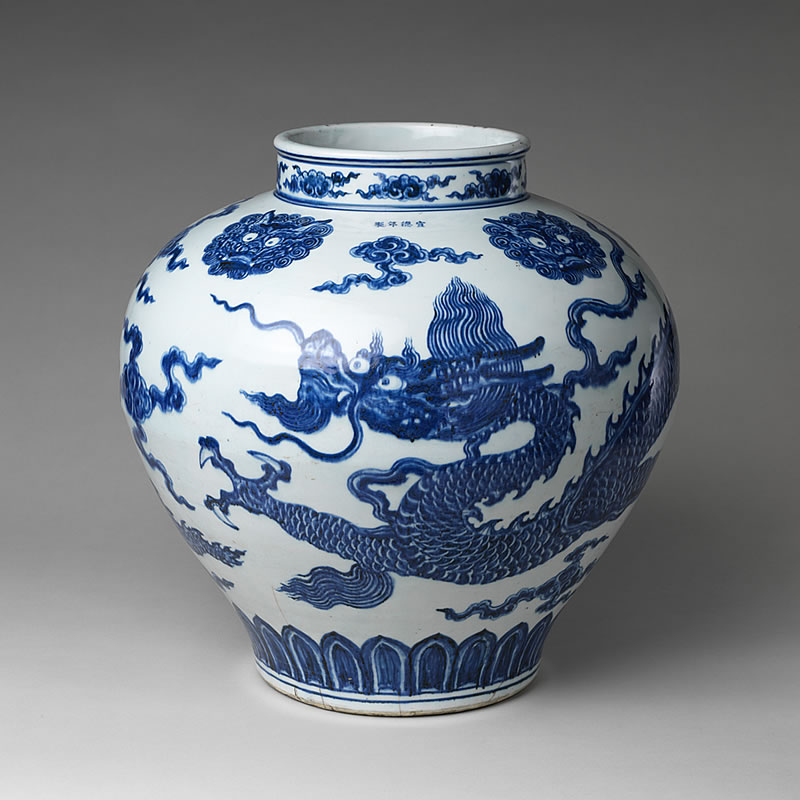
Jar with dragon, China, early 15th century
White porcelain painted with cobalt blue, a style that first flourished in China in the fourteenth century, is arguably the most important development in the history of ceramics. Commissioned by the court, this spectacular storage jar, made in the kilns in Jingdezhen, is dated to the rule of the Xuande emperor by an inscription on its shoulder. Its painted decoration features an animated dragon undulating across a sparsely clouded sky. On view at The Met Fifth Avenue in Gallery 202.
Extracting the Palette
Court-appointed master dyers ran genuinely complex chemical extraction processes to supply the textiles moving along the trade routes. Red came from high-purity cinnabar and red iron oxide, later supplemented by safflower imported from western territories during the Han Dynasty. Yellow was drawn from the inner bark of the Chinese cork tree, alongside pagoda tree buds and turmeric. Blue was farmed and processed from Polygonum tinctorium, Chinese indigo, grown domestically rather than imported.
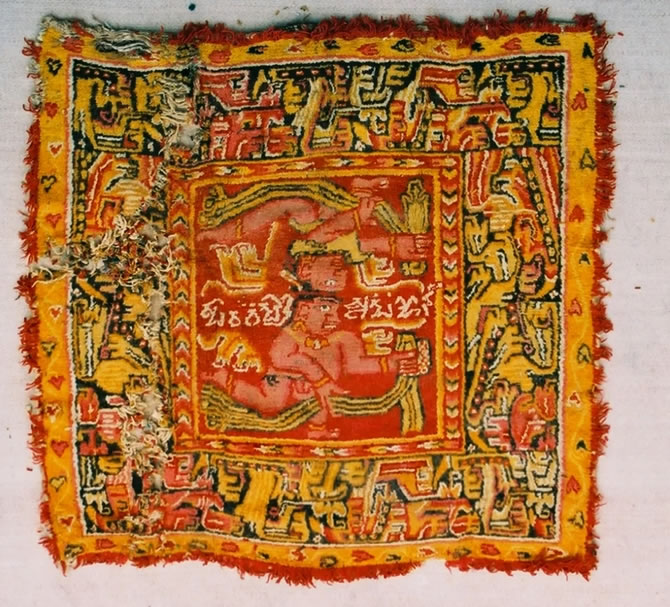
Art historian Zhang He describes them as putti-like figures set among woven Brahmi and Khotanese inscriptions, while linguist Duan Qing identifies the same pair as ttaśa and ttara, genderless deities named in surviving Khotanese texts.
Date: 5th–7th century CE.
The Route of Knowledge: From Xi’an to the West
From the trading gateways of Xi’an and Luoyang, these coloured textiles travelled west across overland oasis networks and maritime lanes. What moved along these routes was never only cargo. It was shared science, artistic motifs, and technical knowledge that permanently reshaped the material culture of Eurasia.
For deeper research into these trade lanes, we recommend the UNESCO Silk Roads Programme, the UNESCO Digital Library’s textile guide, and the International Dunhuang Project hosted by the British Library, which holds high-resolution scans of Eastern Silk Road archaeological fragments.
Sources
- University of Nebraska-Lincoln Digital Commons, Han Dynasty polychrome silk weaving research — digitalcommons.unl.edu/tsaconf/63/
- The Metropolitan Museum of Art, “Ceramics Along the Silk Road” — metmuseum.org/perspectives/ceramics-along-the-silk-road
- China Silk Museum Archive — chinasilkmuseum.com/yz/info_98_itemid_31240.html
- UNESCO Silk Roads Programme — unesco.org/en/silkroads
- International Dunhuang Project, The British Library — idp.bl.uk
← Return to Master Hub:
The Red Yellow Blue Silk Road Project