

The Late Bronze Age Collapse: When Red, Yellow and Blue Went Dark
Around 1200 BC, the glittering world of the Late Bronze Age Mediterranean came apart. Within a few violent decades, palaces burned, empires fell, and writing itself disappeared from entire regions for centuries. Historians call this rupture the Late Bronze Age collapse, and it offers a striking chapter in the story of red, yellow and blue: a moment when the very trade networks that carried these colours across the ancient world dissolved, and the palette of power had to reinvent itself from the ashes. It is where our Red Yellow Blue Silk Road Timeline begins, centuries before the Silk Road itself existed.
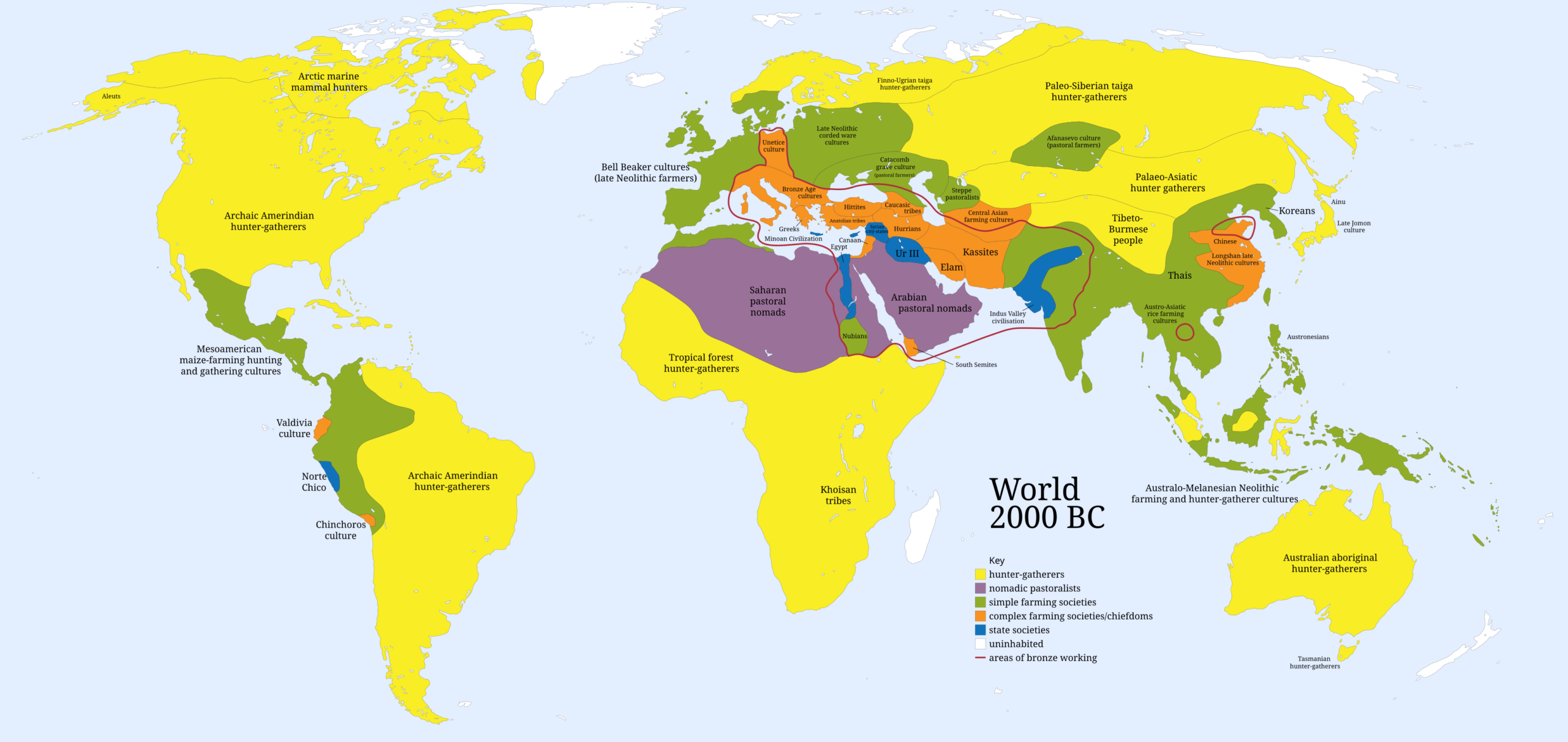
Map of societies, 2000 BCE. Colour coded by cultural stage. Includes simple farming societies; complex farming societies (Near East, Europe, China, Andes); state societies (Fertile Crescent, Egypt, Indus, Crete, Caral/Norte Chico).
Silk Road
A World Built on Colour and Trade
Before the collapse, red, yellow and blue were not decorative afterthoughts. They were the visual language of divine and royal authority. Minoan and Mycenaean artists painted their frescoes with red hematite for skin tones, yellow ochre and orpiment to signal gold and divinity, and a brilliant synthetic blue, known as Egyptian Blue, reserved for gods and kings. Because Egyptian Blue depended on copper and often on imported lapis lazuli, producing it required both chemical know-how and long-distance trade. A wall painted in true blue was, in effect, proof of a functioning international network stretching from the Aegean to the Near East.
That network is exactly what broke.
When the World Burned
Between roughly 1250 and 1150 BC, a cluster of overlapping crises struck the Mediterranean basin at once. Severe, multi-decade droughts triggered crop failures and famine. Clusters of earthquakes, sometimes called “earthquake storms,” damaged cities already weakened by hunger. Displaced populations, later remembered in Egyptian records as the Sea Peoples, moved along the coasts in search of new land, sometimes raiding, sometimes simply arriving as refugees with their families and belongings in tow. Meanwhile, the region’s palace economies, which had grown highly centralised and interdependent, proved too rigid to absorb so many shocks at once. Together, these pressures brought down the Mycenaean civilisation, the Hittite Empire, and major trading hubs like Ugarit. Linear B writing vanished from Greece, and much of the region entered what historians describe as a regional dark age.
The Colour That Disappeared
As the palace workshops shut down, so did the supply chains for pigment. Because the copper and lapis lazuli routes had dissolved, the formula for Egyptian Blue was largely lost across Greece and the Levant, and the colour virtually vanished from Aegean art for generations. Large-scale frescoes stopped being made altogether. In their place, artisans turned to what remained close at hand: iron-rich clays that produced red and black. In Greece, this shift gave rise to the Submycenaean and then Proto-Geometric pottery styles, where careful geometric patterns in red and dark brown replaced the multicoloured scenes of the palace age. The luxury triad of red, yellow and blue had effectively lost a third of itself.
Sparks That Survived the Fall
Not every region went dark in the same way. On Cyprus, rich in copper and less dependent on the collapsed palace networks, potters kept producing lustrous Red-Polished and White Painted wares, and the island continued exporting iron-rich ochres to markets that still needed them, including Egypt. Further south, the Peleset, one of the groups later remembered as Sea Peoples, settled in the Levant and became the people the Bible would call the Philistines. There, they blended Aegean potting traditions with local Canaanite styles to create Philistine Bichrome Ware, decorated in black and vivid red over a warm, yellowish-buff clay.
Survival took stranger forms too. The Sherden, a seafaring people likely from Sardinia, arrived among the raiders Egypt fought off during this turbulent century. Rather than being wiped out, the defeated Sherden were absorbed into Egypt’s own ranks, and temple reliefs from the Ramesside period show them serving as elite royal bodyguards, distinctive in their horned helmets, standing at the pharaoh’s side. In these pockets of resilience and reinvention, the old red-yellow contrast never fully went out. It simply found new hands, and sometimes former enemies, to carry it.
A Lesson in Fragility
The Late Bronze Age collapse is a reminder that even the most sophisticated systems, whether ancient trade routes or modern supply chains, remain vulnerable when too much depends on too few connections. RYB’s own work on Global Development returns to this theme often: resilience comes not from a single dominant network, but from many smaller, adaptable ones that can keep a tradition, a trade, or a colour alive even when the centre falls.
Sources
- Wikipedia, “Late Bronze Age collapse” — wikipedia.org/wiki/Late_Bronze_Age_collapse
- World History Encyclopedia, “Bronze Age Collapse” — worldhistory.org/Bronze_Age_Collapse
- History.com, “What Caused the Bronze Age Collapse?” — history.com/articles/bronze-age-collapse-causes
- Wikipedia, “Sea Peoples” — wikipedia.org/wiki/Sea_Peoples
- Wikipedia, “Minoan art” — wikipedia.org/wiki/Minoan_art
- Wikipedia, “Greek Dark Ages” — wikipedia.org/wiki/Greek_Dark_Ages
← Return to Master Hub:
The Red Yellow Blue Silk Road Project