

The Yongle Encyclopedia: China's River of Knowledge
Table of Contents
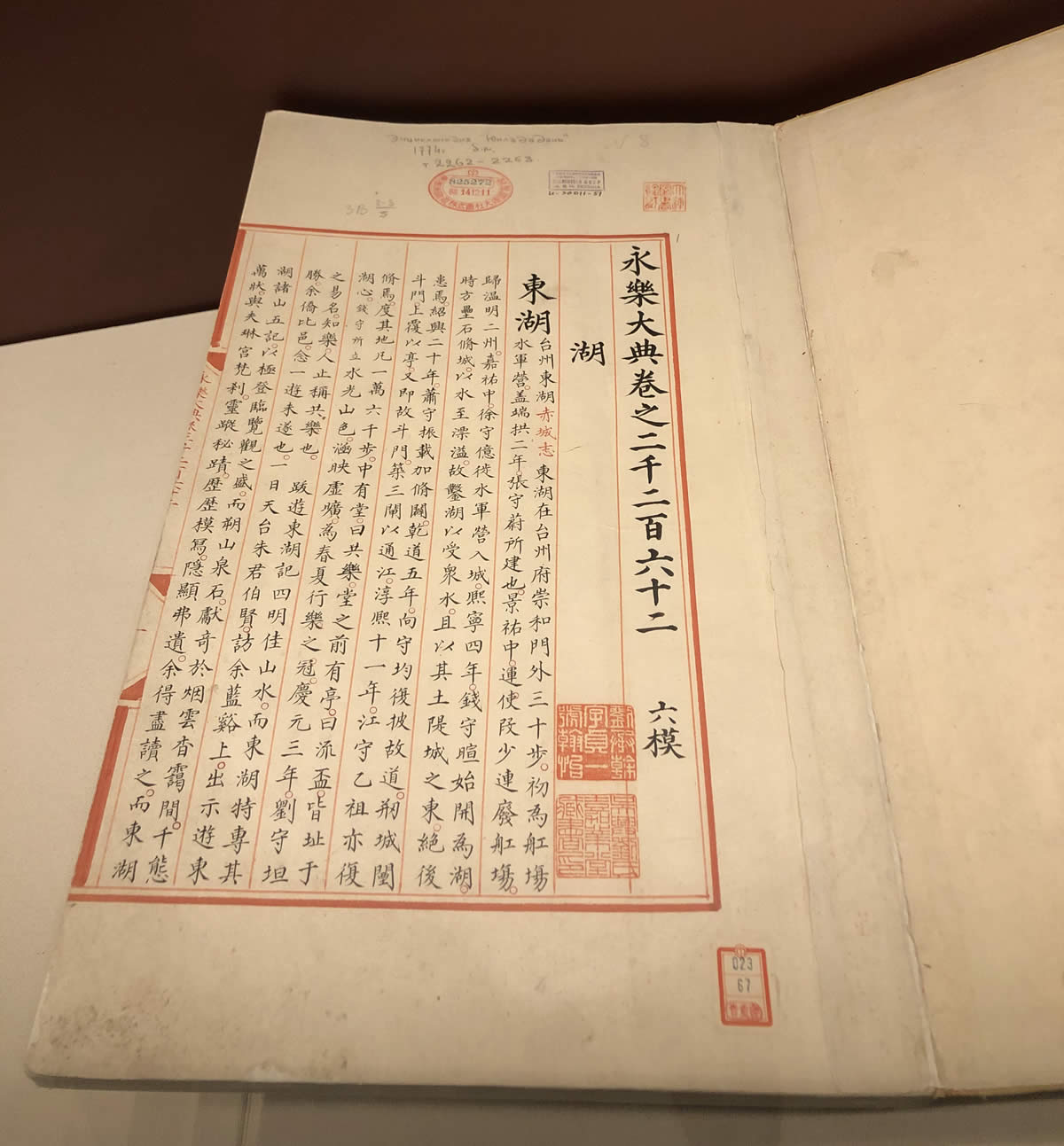
The Yongle Encyclopedia volume 2262
The Yongle Encyclopedia was commissioned by the Yongle Emperor and completed in 1408.
Long before the printing press reshaped Europe’s relationship with knowledge, China had already built — and lost, and partly rebuilt — the largest encyclopedia the world had ever seen. The Yongle Encyclopedia, completed in 1408, ran to roughly 370 to 450 million Chinese characters across 11,095 volumes. It held that record for exactly six hundred years, until Wikipedia overtook it in 2007. This is the story of how it came to be, why its yellow silk covers and red imperial ink belong in the same colour history as the rest of this project, and how the idea of gathering all human knowledge into one place eventually made its way to Europe.
Silk Road
The first river: the Huanglan, 220 CE
China’s encyclopedic tradition — the leishu, or “categorised writings” — begins over a thousand years before the Yongle Encyclopedia, with a text called the Huanglan, or “Imperial Mirror”. It was commissioned around 220 CE by Cao Pi, founding emperor of the Cao Wei dynasty, so that he and his ministers would have convenient, categorised summaries of everything then known — moral precedents, political history, philosophy. The Huanglan ran to more than 1,000 chapters across over 40 sections. It no longer survives complete; it was gradually lost by the Song dynasty, around the year 1000, though fragments were preserved as quotations in later works.
What matters for this story is that the Huanglan set a template that lasted. It became the direct model for the Tang dynasty’s Yiwen Leiju in 624, and, six centuries after that, for the Yongle Encyclopedia itself. Between the 3rd and 18th centuries, Chinese scholars compiled some 600 leishu in total — only 200 of which still exist today. The Yongle Encyclopedia was not the start of this river. It was its widest point.
An emperor’s ambition
The Yongle Emperor, who ruled from 1402 to 1424, is remembered mostly for his military campaigns and for moving the Ming capital to Beijing — but he was also an obsessive reader. He wanted a single work that would preserve every commentary ever written on the Confucian classics, together with all of history, philosophy, and the arts and sciences that had survived to his day. To make it happen, he transformed the Hanlin Academy from a clerical office handling proclamations into an elite scholarly institute, and set it to work.
The first attempt, delivered in 1404 by a hundred scholars, was rejected outright — not ambitious enough. The Yongle Emperor then put more than 2,000 scholars on the project, sending them across China to track down rare texts. Drawing on some 8,000 existing works, they spent four years compiling, editing and hand-copying the result under general editor Yao Guangxiao. It was finished in 1408 in Nanjing, and the emperor was pleased enough to name it after his own reign and write its preface himself.
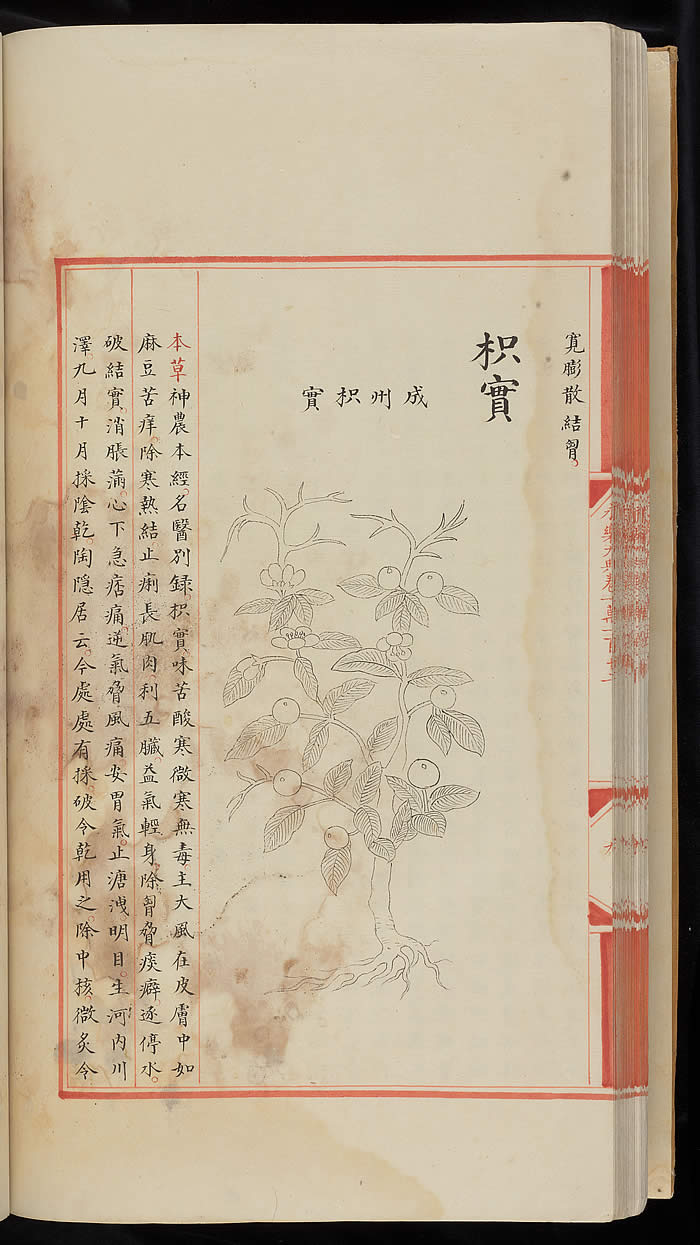
A page from the manuscript of ‘Yongle Encyclopedia’. Chester Beatty Library
Where the colours meet the story
This is where the Yongle Encyclopedia becomes more than a footnote in library history — it becomes a piece of the Red Yellow Blue Silk Road story in its own right. Every volume was bound in the traditional “wrapped-back” style and protected by a hard cover wrapped in yellow silk. Titles and author names inside were written in red ink, a colour reserved exclusively for the emperor, which is precisely what confirmed a volume as authentic royal production rather than a later copy. The body text and the encyclopedia’s many thousands of hand-drawn illustrations were done in black ink, with vermillion used for the hand-ruled borders on every page.
Yellow marking imperial ownership, red marking imperial authority, black carrying the knowledge itself — the same colour hierarchy this project traces through Chinese cosmology elsewhere is written directly into the physical fabric of the world’s largest book.
A scale that held for six centuries
The finished encyclopedia occupied about 40 cubic metres and weighed an estimated 40 tons. Its 370 to 450 million characters made it roughly six times the length of the Encyclopaedia Britannica, and by some estimates more than ten times the size of the French Encyclopédie that Europe would produce more than three centuries later. No other single work would exceed it in scale until Wikipedia did, in late 2007 — nearly six hundred years on.
Fire, war, and near-total loss
Only one full copy of the Yongle Encyclopedia was ever made in the Ming era — a second manuscript copy, commissioned in 1562 after the original narrowly survived a palace fire. The original itself later vanished from the historical record entirely; historians still debate whether it burned in the fall of the Ming in 1644, was buried with the Jiajing Emperor, or was simply lost.
Even the surviving copy fared badly. Ninety percent of it survived until the Second Opium War, when the 1860 Anglo-French occupation of Beijing saw British and French soldiers carry off volumes as souvenirs. By 1894 only 800 volumes remained; the Boxer Rebellion and the 1900 occupation by the Eight-Nation Alliance destroyed or scattered most of what was left. Today fewer than 400 volumes survive worldwide — around 4% of the original — scattered across libraries in Beijing, Taipei, London, Oxford, Cambridge, Washington, and a handful of other cities.
A volume resurfaces in Paris
In June 2020, two long-lost volumes surfaced at a small Paris auction house. They had been in the same French family for generations — descendants of a naval officer who reached the rank of colonel while stationed in China in the 1870s, and who had received the volumes as gifts from Chinese officials of the day. Expected to fetch a few thousand euros, they sold for €8.128 million to Jin Liang, a textile entrepreneur from Zhejiang province. He later arranged for their return to China, and in June 2026 the volumes were formally accessioned into the National Archives of Publications and Culture in Hangzhou — four centuries after they were written, and a century and a half after they left the country.
The echo in the West
It is a common assumption in Western education that Diderot and d’Alembert’s Encyclopédie, published between 1751 and 1772, was the first serious attempt to gather all human knowledge into a single work. China’s leishu tradition — Huanglan to Yongle Dadian — makes clear that the ambition, and the achievement, came far earlier and on a far larger scale.
The connection between the two traditions is real, if indirect. From the late 16th century, Jesuit missionaries at the Ming and Qing courts sent detailed accounts of Chinese scholarship, history and literary method back to Europe. Works like Jean-Baptiste Du Halde’s 1735 Description de la Chine shaped how an entire generation of European thinkers — Leibniz, Wolff, later Kant — understood Chinese civilisation, and recent scholarship suggests Chinese and French encyclopedism developed in genuine dialogue during the 18th century rather than in isolation. The Silk Road’s oldest export was never only silk. It was also the slow, centuries-long transmission of the idea that all knowledge could, in principle, be gathered, categorised, and preserved — an idea China had already proven at enormous scale before Europe ever attempted it.
For more on the colour symbolism behind the Yongle Encyclopedia’s yellow silk and red ink, see Imperial Yellow: How a Colour Became a Throne.
The Next River: From Encyclopedia to Artificial Intelligence
Every era in this story made the last one look enclosed. The Huanglan was written for an emperor’s eyes. The Yongle Encyclopedia, six times larger and far more beautiful, was still copied only twice in six hundred years and kept behind palace walls — its knowledge preserved, but never truly shared. The Encyclopédie broke that pattern deliberately, printed and sold despite royal and church disapproval. Wikipedia broke it again: free, unowned, editable by anyone, and large enough by 2007 to finally surpass the volume the Ming dynasty had achieved six centuries earlier.
Artificial intelligence is now the newest current in this river, and it is flowing in two directions at once. On one hand, a genuinely open, shared layer of AI knowledge is emerging faster than most people realise: open-weight models built in China — Qwen, DeepSeek, Kimi among them — are now downloaded and built upon by developers worldwide more than any single country’s closed alternative, a form of global technical collaboration with no real historical precedent. On the other hand, this same technology is openly discussed by governments as a contest for national advantage, with export controls, restricted access, and competing spheres of AI influence very much part of today’s landscape. Unlike the Yongle Encyclopedia, closed by design, or Wikipedia, open by design, today’s AI knowledge system is being built as both at once — and which instinct wins out is still an open question, not a settled outcome.
Whether shared AI knowledge ultimately strengthens a global Culture of Peace, or instead sharpens the divide between competing blocs, will depend less on the technology itself than on the choices nations and companies make about access, transparency, and who gets to benefit. It is, in that sense, the same question the Silk Road always asked of every empire it passed through: does knowledge travel to connect people, or to be hoarded by whoever holds it? RYB explores this question in more depth in Artificial Intelligence for a Culture of Peace and Artificial General Intelligence and its future implications.
← Return to Master Hub:
The Red Yellow Blue Silk Road Project