

The Silk Road in Spain: The History of Primary Colours in Art & Trade
Table of Contents
The Silk Road is traditionally visualized as a network of camel caravans winding through central Asian deserts, connecting Imperial China with Rome. However, the cultural, technological, and aesthetic currents of this ancient trade route traveled much further west, ultimately anchoring themselves in the Iberian Peninsula. In Spain, the convergence of Eastern trade goods, Islamic chemistry, and Western artistry gave birth to a unique legacy of primary-colour masterpieces—vibrantly mirroring the tri-colour palette of red, yellow, and blue found across ancient traditions.
Silk Road
The Global Blueprint: China’s Wuse and Wucai Porcelain
To understand how a primary colour palette captivated global trade, one must look to China’s Wuse (五色), or “Five Colours” system. Rooted in the ancient Theory of the Five Elements (Wuxing), this philosophy linked specific primary colours to cosmic forces, seasons, and directions. Blue-green (Qing) represented the East and Spring; red (Chi) symbolized the South and Summer; yellow (Huang) marked the Center and Earth; while white (Bai) and black (Hei) completed the cycle.
By the 16th century, during the Ming Dynasty, this philosophy culminated in the creation of Wucai (五彩), or “five-colour” porcelain. The pinnacle of this art form is the celebrated Jiajing Wucai Fish Jar with Cover preserved at the National Museum of China. Created in the imperial kilns of Jingdezhen, these jars paired deep underglaze cobalt blue with vivid overglaze iron-red and bright yellow enamels. Representing spiritual freedom and material abundance, these precious luxury goods traveled along maritime Silk Road routes, fundamentally altering the artistic desires of European courts as seen during major collection sales like the Zande Lou Christie’s Auction.
The Evolution of Colour in Spanish Art
Before the trade routes brought complex mineral processing technologies to Europe, Spain’s oldest art lacked a complete primary colour wheel. In prehistoric sites like the Cave of Altamira and El Castillo—dating back 40,000 to 65,000 years—ancient humans painted masterfully with red and yellow iron oxides and earthen ochres. However, because blue pigment requires sophisticated chemical manufacturing or expensive mineral extraction, true tri-colour art did not emerge in the region until the Middle Ages.
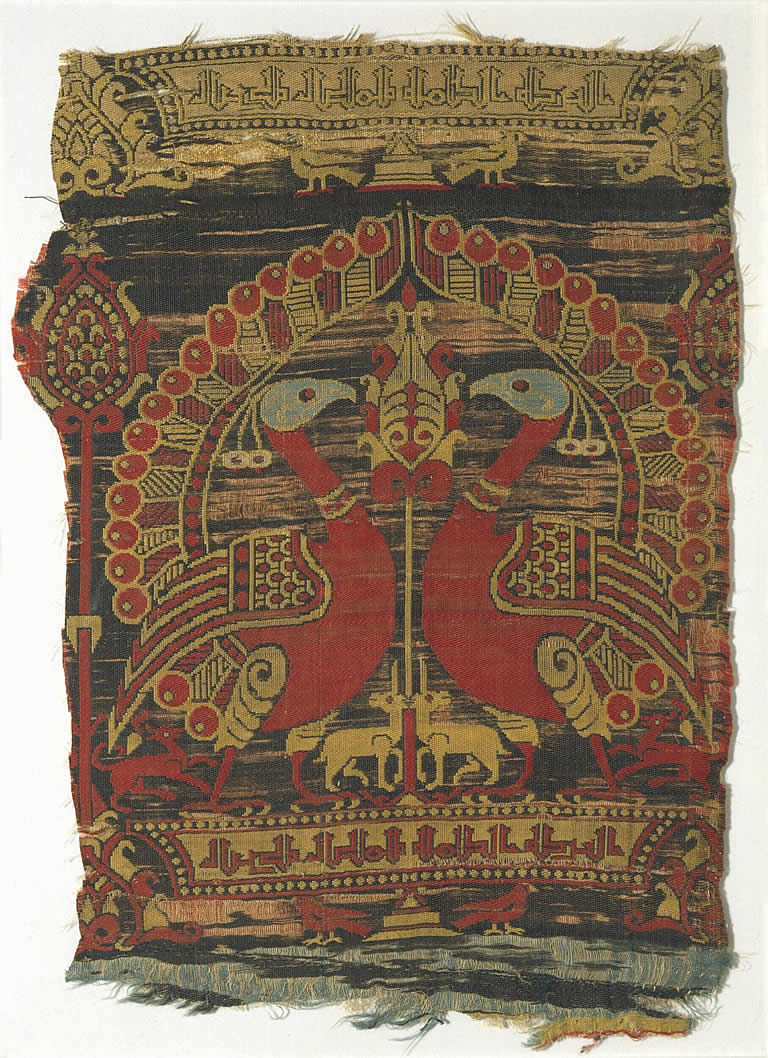
Middle East, Textile. Silk lampas with a geometric pattern, south-east Spain (perhaps Granada), 1300-1400. Rectangular fragment of red, cream and blue silk compound twill, depicting confronted peacocks and unicorns around a central palm tree, Arabic inscriptions in beaded cartouches at top and bottom.
Transliteration: al-barakah al-kamilah, Translation: Perfect blessing — © Victoria and Albert Museum, London
Centuries later, modern Spanish masters reclaimed this classic red, yellow, and blue palette, breathing new life into the traditional combination. The Catalan surrealist Joan Miró treated primary colours as raw, emotional forces of nature. His 1967 masterpiece, The Gold of the Azure (L’Or de l’azur), which can be explored via his artistic history at the Artwork Vault Joan Miró Gallery, showcases a massive, glowing yellow void punctuated by a deep blue planetary disc and sharp patches of vibrant red. Similarly, before moving toward monochromatic tones, Pablo Picasso relied heavily on flat, overlapping planes of sharp yellow, deep blue, and patterned red to fragment and reorder reality. This technique is perfectly captured in cubist masterpieces like The Three Musicians, currently housed in the Museum of Modern Art (MoMA) Picasso Collection.
Moorish Pottery and the Birth of Spanish Cobalt Blue
The true bridge between Eastern Silk Road technology and Spanish art occurred via medieval ceramic innovations. Under the Nasrid Dynasty in Granada during the 13th and 14th centuries, Moorish potters introduced tin-glazing to Europe, giving birth to Hispano-Moresque Majolica and early Fajalauza pottery.
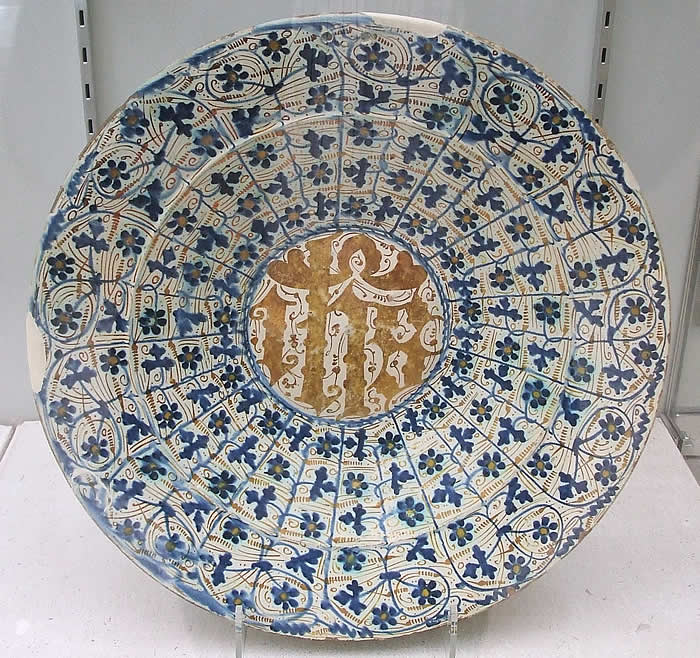
A Hispano-Moresque dish, approximately 32 cm diameter, with Christian monogram “IHS”, decorated in cobalt blue and gold luster. Valencia, c. 1430–1500. Burrell Collection.
Hispano-Moresque ware is a style of initially Islamic pottery created in Al-Andalus (Muslim Iberia), which continued to be produced under Christian rule in styles blending Islamic and European elements. It was the most elaborate and luxurious pottery being produced in Europe until the Italian maiolica industry developed sophisticated styles in the 15th century, and was exported over most of Europe. The industry’s most successful period was the 14th and 15th centuries.
By applying opaque white tin glazes over earthenware, artisans created a canvas where they could paint detailed designs using imported luxury materials. This technique introduced vibrant cobalt blue—mined in the Middle East and traded extensively along the Silk Road—directly alongside traditional iron-based reds and antimony-based yellows. This marked the absolute oldest pottery tradition in Spain to successfully incorporate the complete red, yellow, and blue primary trio.
The Oldest Carpets in Europe
Beyond ceramics, Spain holds the distinction of maintaining the oldest rug-weaving tradition in Europe, a craft deeply impacted by Silk Road aesthetics and Mudéjar craftsmanship. Dating back to the 12th through 14th centuries, workshops in regions like Alcaraz and Letur produced the famous Synagogue Carpets.
Woven by Muslim artisans living in Christian kingdoms, these historic textiles used a distinct, regional “Spanish single-knot” technique. They combined geometric Islamic motifs with a rich, warm primary color scheme: vibrant oxblood red derived from local cochineal insects, earthen gold-yellow, and deep ocean-cobalt blue. These rugs stood as physical evidence of a culture adapting global trade goods into localized luxury art.
Spun from the East: The Introduction of Sericulture to Spain
While trade items initially flowed exclusively from East to West, Spain eventually stopped acting as a mere consumer on the Silk Road and transformed into a powerhouse producer of raw silk. Arab settlers first introduced moriculture (the cultivation of mulberry trees) and sericulture (silkworm rearing) to southern Spain around the 740s. By the ninth century, specialized royal weaving workshops known as tiraz flourished in Córdoba. Over the next few centuries, southern production exploded, and by the eleventh century, the bustling Mediterranean port city of Almería surpassed all regional competitors to become Europe’s premier center for luxury silk manufacturing and export.
This economic and agricultural phenomenon peaked spectacularly in the Kingdom of Granada. Deep within the Alpujarra mountains, hundreds of remote villages were densely peppered with millions of mulberry trees, a region that Italian merchants universally revered as the “Country of Silk.” The highly specialized Moorish weavers in Granada produced stunning satin, velvet, brocade, and damask fabrics that frequently exceeded the quality of Egyptian and Syrian imports. To guard this immensely lucrative commodity, the city established the Alcaicería de Granada, a heavily secured, gated bazaar known as the “Place of Caesar”—a name honoring Roman Emperor Justinian, who historically granted Arabs control over the initial silk trade routes. Though the original market was destroyed by fire centuries later, it remains a testament to the era when thousands of looms buzzed with activity.
As the cultural center of gravity shifted northward, the city of Valencia stepped into its own Golden Age of commerce. Genoese traders journeyed into Valencia at the end of the 14th century, bringing advanced Italian textile technologies to weave a complex silk velvet called velluto. This sparked the formal creation of the velluters (velvet weavers) guild in 1479, which quickly grew into the most economically powerful profession in the city. The sheer financial scale of this booming Mediterranean trade necessitated a dedicated center for global commerce, culminating in the construction of La Lonja de la Seda de Valencia between 1482 and 1533. Today recognized as a legendary UNESCO World Heritage site, this breathtaking late Gothic masterpiece—with its towering, twisted stone columns reaching toward a vaulted ceiling like stone palm trees—stands as the definitive monument to Spain’s crowning status as the western capital of the Silk Road.
From Canvas to Kingdom: Heraldry, Flags, and Politics
As the centuries progressed, the artistic interplay of red, yellow, and blue transitioned from pottery and textiles into the formal architecture of Spanish statehood. While the modern national flag is universally recognized by its bold red and golden-yellow stripes, the inclusion of blue has historically served as a critical visual anchor for royal authority, territorial pride, and sweeping political revolutions.
This dynamic is most apparent at the absolute center of the official Spanish coat of arms. Nestled within the heraldic shield sits a bright blue oval featuring three golden fleurs-de-lis, a device representing the House of Bourbon-Anjou, which has reigned over Spain since 1700. The color blue carries centuries of shifting sovereign meaning; for instance, while the historical Spanish Royal Standard traditionally utilizes a rich crimson red square under King Felipe VI, his father King Juan Carlos I famously broke with tradition by employing a solid, deep royal blue field to mark his personal standard.
The most dramatic entry of the tri-colour palette into mainstream Spanish history occurred during the birth of the Second Spanish Republic in 1931. In an effort to visually dismantle the royal legacy, the newly formed government altered the traditional state banner to create a striking horizontal tricolour of red, yellow, and a distinct murrey purple-blue. According to historical records kept in the Second Spanish Republic Flag Archive, the designers intended the third stripe to honor the historical rebels of Castile. Though modern historians note the original rebel banners were actually crimson, this deep indigo-purple forever transformed into a lasting symbol of left-wing political identity, still widely flown across modern Spain during anti-monarchist demonstrations.
On a regional level, the primary wheel remains a vital tool for asserting autonomous cultural identities. In eastern Spain, the historic Kingdom of Valencia utilizes the traditional Senyera—four red bars over a golden background—but frames the entire hoist with a prominent, brilliant blue vertical band adorned with a crown, a design preserved inside the City Historical Archive of Valencia. Meanwhile, in the north, the autonomous community of La Rioja flies a unique four-coloured flag of red, white, green, and yellow, where the official state shields are traditionally cast against deep blue backgrounds to honour the life-giving regional rivers. This historic separation of colours continues directly into contemporary Spanish campaigns, where voters instantly recognize political leanings by a stark primary divide: the socialist party claims a vibrant red, while the conservative opposition anchors its entire brand in a sharp, bright sky blue.
← Return to Master Hub:
The Red Yellow Blue Silk Road Project