

The Silk Road in Nepal: The Himalayan Sanctuary of Sacred Color
Table of Contents
Situated along the high-altitude mountain passes connecting China, Tibet, and India, Nepal served as a vital cultural repository where cross-continental trade met profound spiritual devotion. Long before the mid-20th-century development of the modern hand-knotted carpet industry, the primary triad of red, yellow, and blue manifested as the foundational visual language of ancient Nepalese religious art and illuminated manuscripts.
Silk Road
The Manifestation of Red, Yellow & Blue in Ancient Nepalese Paintings
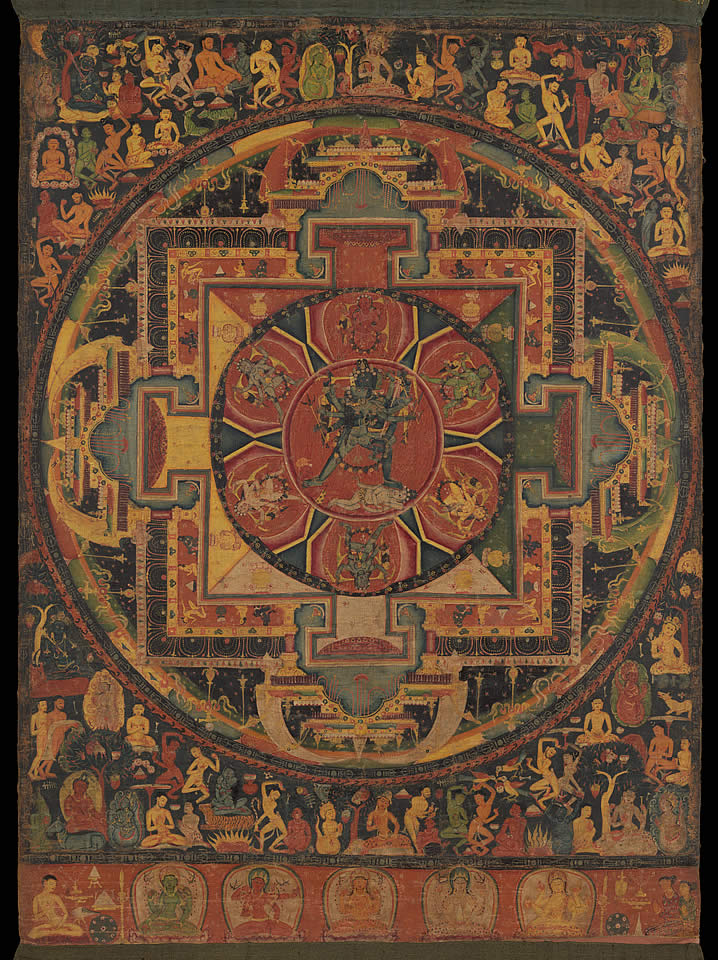
Chakrasamvara Mandala
This mandala is one of the earliest surviving large-scale paintings known from Nepal. Date: ca. 1100
This ritual diagram (mandala) is conceived as the cosmic palace of the wrathful Chakrasamvara and his consort, Vajravarahi, seen at center. These deities embody the esoteric knowledge of the Yoga Tantras. Six goddesses on stylized lotus petals surround the divine couple.
The earliest surviving manifestations of the red, yellow, and blue palette in Nepal date back to around the year 1000. Centuries before the establishment of commercial rug weaving, indigenous Newar artists from the Kathmandu Valley pioneered the creation of illuminated palm-leaf manuscripts and sacred cloth scrolls known as paubhas:
- 11th-Century Palm-Leaf Manuscripts: The oldest tangible evidence of Nepalese painting is found on the delicate folios and wooden covers of sacred texts, most notably the Ashtasahasrika Prajnaparamita (The Perfection of Wisdom). These rare manuscripts utilized flat, vibrant primary backdrops to isolate and illuminate painted figures of deities.
- Traditional Paubha Scroll Paintings: The precursor to the Tibetan thangka, the paubha is a traditional Newar religious art form painted on cotton cloth. These sacred icons were designed using a strict, tradition-bound palette dominated by rich primary blues and reds, functioning as cognitive maps for spiritual meditation and temple rituals.
- The Tibetan Refuges & Carpet Shift: In contrast to this millennium-old painting lineage, the hand-knotted carpet industry in Nepal only emerged in the early 1960s with the arrival of Tibetan refugee communities, who adapted ancient continuous-loop knotting techniques into a modern economic engine.
Researchers seeking to analyze the functional history, spiritual use cases, and visual motifs behind these classical 11th-century illuminated works can study the rare collections archived within The Metropolitan Museum of Art Palm-Leaf Tradition Exhibition.
The Spiritual Palette: Buddhist and Hindu Cosmology
In Nepalese culture, primary colors are inextricably linked to religious philosophy, iconography, and sacred cosmology. In both the Vajrayana Buddhist and Hindu Tantric traditions practiced across the Kathmandu Valley, colors function as active spiritual forces rather than mere decorative choices:
- Primary Red (Vermilion / Sindoor): Symbolizes fire, intense life force, powerful activity, and sacred protective boundaries. It forms the core background energy of fierce, protective deities and meditative thresholds.
- Primary Yellow (Orpiment): Represents the earth element, increasing spiritual activity, cosmic light, and ultimate renunciation. It is systematically reserved for the central thrones of enlightened beings and sacred lotus motifs.
- Primary Blue (Lapis Lazuli): Symbolizes the infinite space of the sky, pristine purity, water, and deep healing. It reflects the unchangeable, absolute nature of cosmic reality.
To deep-dive into the sacred canvas preparations, geometric guidelines, and philosophical dimensions of Newari devotional painting, curators can explore the dedicated insights published in The Sacred Art of Nepal: Paubha via Inside Himalayas.
Material Innovations: Himalayan Minerals and Ancient Biochromes
The extreme longevity and vibrancy of ancient Nepalese paintings stem from a masterly command over high-altitude raw minerals, botanical elements, and traditional chemistry. Newar painters ground raw materials in a mortar and pestle for months to create fine, self-luminous powders that were bonded using water and animal hide glue (saresh):
- Sourcing Red: Achieved through high-purity processing of cinnabar minerals to extract deep vermilion, or by harvesting regional Himalayan madder roots.
- Sourcing Yellow: Derived from orpiment, a natural arsenic sulfide mineral found in mountain veins, yielding a luminous gold-yellow that never fades.
- Sourcing Blue: Finely crushed from high-grade lapis lazuli blocks imported over the mountain passes via ancient trade paths connecting Afghanistan and Central Asia.
For extensive historical records, technical breakdowns of pigment extractions, and cultural mapping tracking the cross-cultural exchange of Newari artists into Tibet and China, researchers can consult these open-access directories:
- Art History Repository: Access a comprehensive database of historic Himalayan iconographies and ground color frameworks on the Himalayan Art Resources Foundation.
- Cultural Significance Guide: Read the detailed history of trans-Himalayan manuscript illustration and cloth painting evolution on the Hinduism Today Thangka Art Archive.
← Return to Master Hub:
The Red Yellow Blue Silk Road Project