

The Human Thread: Slavery, Caste Systems, the Silk Road, and the Transatlantic Slave Trade
Table of Contents
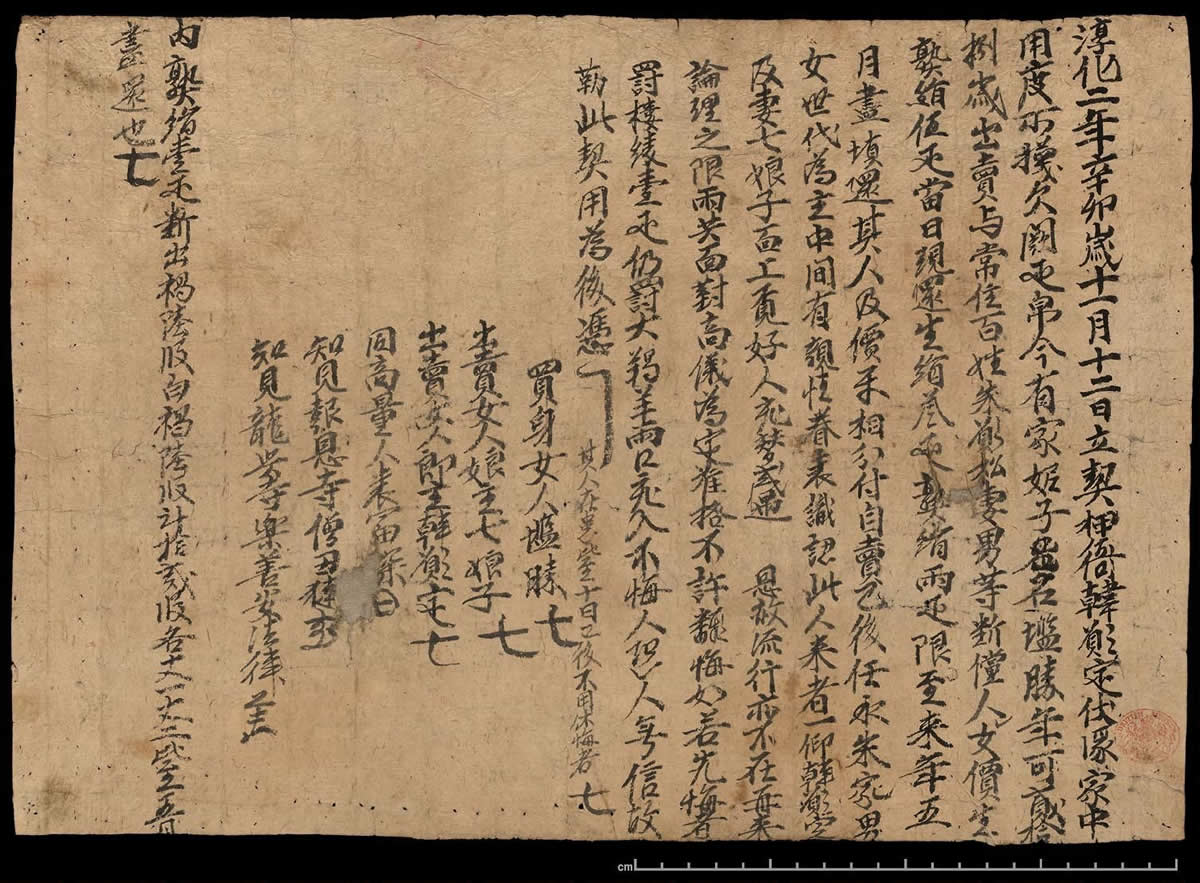
Contract exchanging a slave girl for a debt of silk – Date 991 CE
by International Dunhuang Programme (IDP)
The IDP is a pioneering international collaboration that brings together online collections from the Eastern Silk Roads and promotes the understanding of the history and cultures of the region.
Behind the glittering allure of vibrant natural dyes, exotic spices, and luxurious textiles that traversed the ancient Silk Road lies a complex, deeply human story of social stratification and unfree labor. While these trans-Eurasian trade routes are celebrated as highways of cultural exchange and artistic convergence, they were simultaneously powered by the movement of enslaved peoples and the hardening of hereditary caste systems. From the indigenous maritime networks of Southeast Asia to the crowded slave markets of Central Asian oasis cities, human beings were routinely treated as lucrative commodities. By exploring this darker facet of global connectivity, we uncover how the intense economic demands of international commerce both exploited and reinforced rigid social hierarchies across continents — a story that, as the timelines below show, only deepened when Dutch and other European trading empires turned slavery into a transatlantic system, one whose consequences the Netherlands itself continues to reckon with today.
Silk Road
The Deep Roots of Inequality: Pre-Colonial Bondage in Maritime Southeast Asia
Long before European galleons arrived in the waters of the Indonesian archipelago, indigenous societies across the islands practiced their own established forms of bondage and unfree labor. Deeply embedded within local customary laws, known as adat, and early stratified social systems, servitude was a fundamental element of pre-colonial life. This local bondage was rarely based on the racialized chattel systems later introduced by Western empires; instead, it grew organically from regional conflicts, economic vulnerabilities, and legal punishments within and between neighboring ethnic groups.
In the 17th century, the Indian ocean slave trade was arguably on a bigger scale than the Atlantic slave trade. The hub of this vile industry was in modern-day Tanzania, an area that specialized in three things: ivory, spices, and slaves.
In this maritime world, prisoners of war captured during tribal skirmishes or rivalries between emerging kingdoms were routinely reduced to forced labor or sold into internal trading networks. Economic survival also drove the system through debt bondage, a mechanism where individuals who were unable to repay personal or familial debts surrendered their freedom, working as unfree laborers until their financial obligations were cleared. Similarly, judicial punishments for severe social offenses could result in an entire family forfeiting their liberty to a local chief or noble. These captives and debtors were circulated along active maritime routes, moving from peripheral islands toward major agrarian and coastal polities, such as the historic empires of Srivijaya and Majapahit. Despite the involuntary nature of this labor, many local cultures allowed unfree individuals to live closely integrated within the host household, frequently providing pathways toward cultural assimilation, social redemption, or eventual freedom over generations.
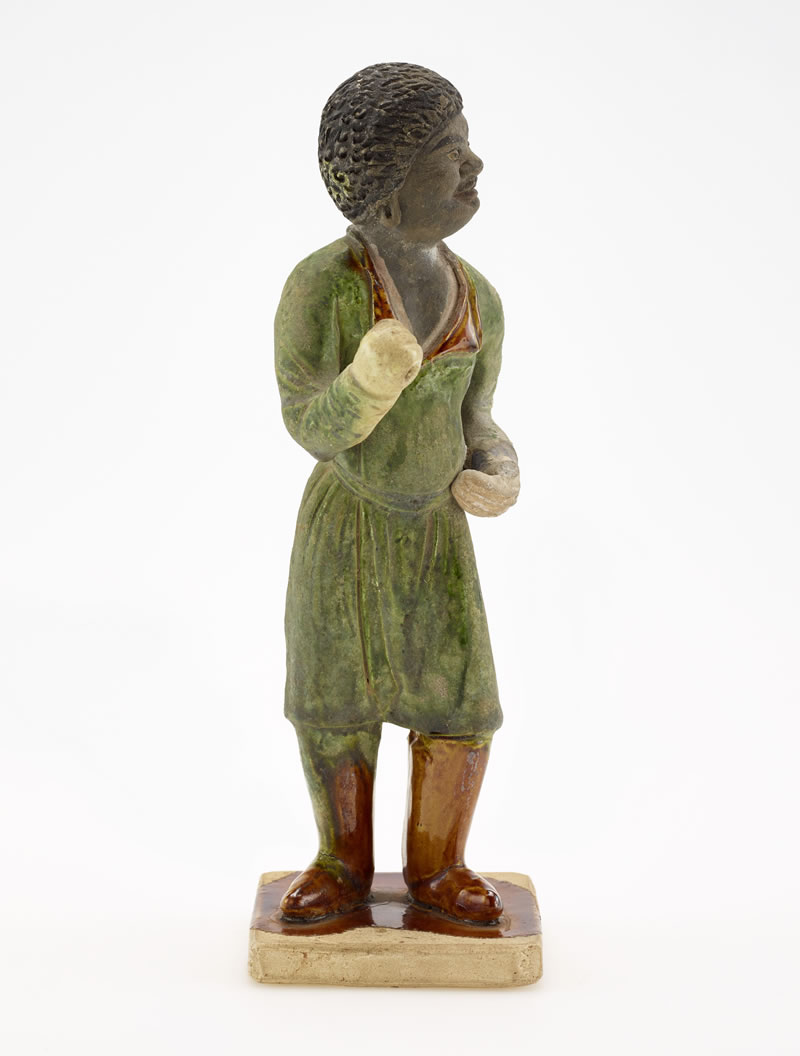
Tang Dynasty Sancai Tomb Figure of a Foreign Groom
by National Museum of Asian Art, Smithsonian Institution
During the Tang dynasty (618–907), people of different races came to China from around the eastern hemisphere over the Silk Road (a network of land and sea trade routes that connected Asia, Europe, and East Africa). Some of them came to trade, and after making some money, they returned home; others, however, chose to settle permanently in big cities like Chang’an (the capital) and Luoyang. The latter group included grooms that managed the horses of the Tang elite. This standing figure represents such a groom from South or Southeast Asia. He could also be from East Africa, brought to China by Arab traders as a slave.
The Human Engine of the Silk Road: Trafficking and the Textile Economy
The ancient Silk Road was not merely a conduit for passive material objects; it was a massive human trafficking network where enslaved individuals were traded at a scale rivaling precious fabrics and elite warhorses. Caravans traversing the harsh terrains of Central Asia routinely carried captives of border wars, victims of organized kidnappings, and children sold by destitute families into the vibrant commercial hubs of Eurasia.
Major oasis towns, such as Turpan and Dunhuang in western China and Bukhara in Central Asia, became famous for hosting legally protected, highly organized slave markets. Bureaucrats serving China’s Tang Dynasty actively monitored and regulated these human transactions, enforcing official contracts that recorded prices, guarantees of health, and ownership origins. Turkish, Sogdian, Tibetan, and Chinese merchants purchased these foreign laborers to satisfy a vast domestic demand, deploying them as agricultural laborers, domestic servants, specialized weavers, and court entertainers, thereby keeping the economic wheels of the Silk Road spinning.
A Global Tapestry of Stratification: The Antiquity of the Caste System
The institutionalization of hereditary social classes developed independently across various continents, creating rigid frameworks that determined a person’s profession, marital options, and social worth from birth. While India hosts the world’s oldest surviving form of social stratification, similar systems solidified in East Asia, the Middle East, and West Africa, often driven by a combination of religious taboos, military conquests, and economic specialization.
In India, early written evidence of social divisions emerged within Sanskrit texts, the Vedas, as early as 1500 BCE. Historical and genetic data reveal that while these class distinctions—divided into the four primary Varnas of Brahmins, Kshatriyas, Vaishyas, and Shudras—were initially flexible, rigid endogamy permanently solidified around 2,000 years ago, pushing an excluded population of Dalits into a status of historical untouchability before the system was legally outlawed in 1950. Across the sea in Japan, a rigid hereditary system grew out of the Taika and Taiho Reforms of 701 CE, separating the populace into Ryomin (good people) and Senmin (low people). Over the centuries, Shinto and Buddhist taboos regarding death, blood, and meat-eating merged with these political divisions, culminating in the strict Edo period hierarchy that placed the ancestors of the modern Burakumin at the absolute bottom of society as outcasts restricted to leatherworking, butchery, and executioner duties until their legal liberation in 1871.
A parallel timeline unfolded on the Korean Peninsula, where hereditary social stratification was formalized during the Goryeo Dynasty between 918 and 1392 CE and deeply codified during the subsequent Joseon Dynasty. By the 15th century, the state exercised tight control over the Cheonmin, or vulgar commoners, within which the Baekjeong caste emerged as hereditary outcasts forced into butchery and hide-tanning until the system dissolved in 1894. Meanwhile, in the Middle East, Yemen’s social hierarchy developed around 525 CE following an ancient military defeat. When occupying Aksumite Ethiopian soldiers were overthrown, the remaining populations and their descendants were stripped of tribal rights and relegated to the Al-Akhdam or Muhamasheen underclass, a group that remains restricted to menial labor today. In West Africa, endogamous occupational castes took root between the 11th and 14th centuries during the heights of the Ghana and Mali Empires, dividing ethnic groups like the Mandé and Wolof into nobles, slaves, and the Nyamakala—a strict caste of specialized professionals including blacksmiths, leatherworkers, and the oral historians known as Griots.
Gilded Garments and Prohibited Hues: Fashion as a Tool of Social Segregation
Across the ancient and medieval worlds, clothing was never merely a matter of personal taste or practical protection; it functioned as a highly regulated, visual manifestation of state-enforced social hierarchies. While the elites of the Silk Road networks used vibrant primary dyes and intricate textiles to broadcast their supreme authority, powerful state and religious institutions systematically weaponized fashion to enforce forced labor, subjugate lower castes, and maintain strict class divisions.
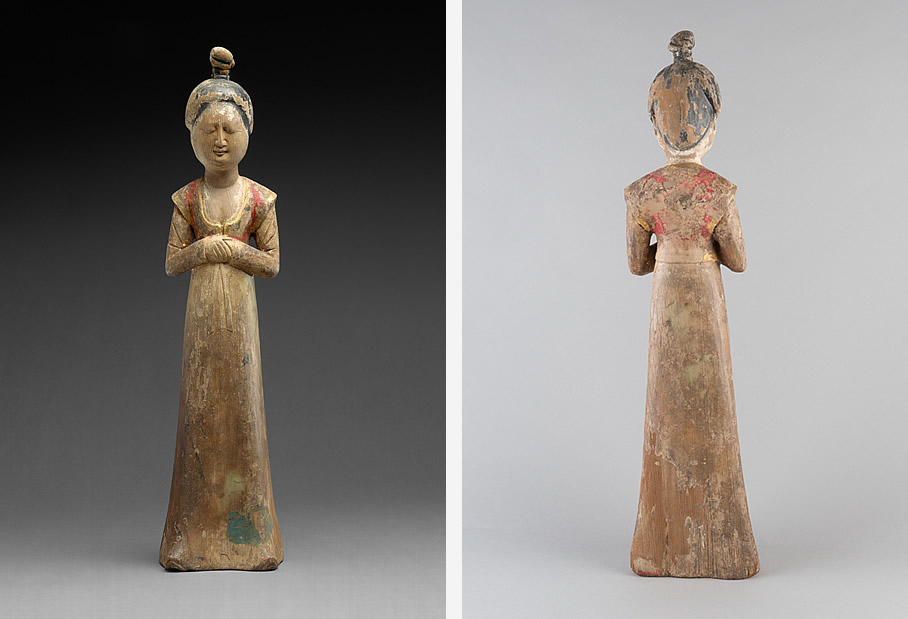
Sculpture of Standing Female Attendant This rare surviving example of a tomb figurine carved from wood must have come from the dry regions of the Silk Road, but displays the fashionable high-waisted dress and short jacket of the Tang court style. Tang dynasty (618–907), Wood with pigment, (53.3 cm) The Met, Gift of Enid A. Haupt, 1997
Ancient Sumptuary Laws and the Criminalization of Clothing Colours
To prevent wealthy merchants or lower-class citizens from blurring the lines of social stratification, empires enacted strict sumptuary laws. In Tang Dynasty China, fashion was regulated down to the exact shade of a garment. While the imperial family monopolized brilliant mineral yellows, and high-ranking officials wore deep purples and reds, commoners and the enslaved population were legally restricted to coarse, un-dyed hemp fabrics or dull, dark tones. For an unfree laborer or outcast to wear a primary red or yellow tunic was treated as a severe political crime—an act of visual treason that threatened the cosmic and political stability of the empire.
The Uniformity of Subjugation: Dressing the Outcast Castes
In highly stratified societies, dress codes were intentionally designed to humiliate and isolate. Across the Korean peninsula during the Joseon Dynasty, members of the untouchable Baekjeong caste were completely forbidden from wearing silk garments, fine leather shoes, or traditional hats worn by commoners. They were forced by law to wear distinct, coarse headgear and rough cotton wraps, making their outcast status instantly recognizable to anyone passing them on the street. Similarly, in Yemen’s historical caste hierarchy, the marginalized Al-Akhdam (Muhamasheen) underclass were restricted to menial attire, culturally excluded from wearing the prestigious tribal daggers (janbiya) and embroidered shawls that signaled honour, freedom, and lineage among the dominant tribes.
The Paradox of Luxury Production vs. Prohibited Wear
This systemic manipulation of fashion created a cruel historical paradox: the very artisans, weavers, and dyers, who possessed the generational knowledge to extract intense primary colours were legally barred from wearing the fruits of their own labor. Lower-caste hereditary guilds in India and specialized slave weavers in Central Asian oasis towns spent their lifetimes handling imperial red cinnabar, precious orpiment yellow, and fermented indigo to produce luxurious garments for the ruling classes. Yet, by decree of the institutions that held them in bondage, these creators were forced to dress in the visual markers of poverty, proving that the dazzling evolution of Silk Road fashion was directly bound to the visual suppression of the hands that wove it.
The Paradox of Faith: Monasteries, Monks, and the Slave Trade
While the spiritual doctrines of Buddhism famously championed karmic equality and offered an alternative to India’s restrictive caste system, the historical reality along the Silk Road was deeply pragmatic. As Indian merchants embraced Buddhism and funded its expansion northward and eastward into China, the religious institutions they established became fundamentally intertwined with the local slave economy.
Archaeological discoveries within the Dunhuang Caves and the Astana Tombs of Turpan reveal that Buddhist monasteries functioned as major corporate entities along the trade routes. They managed vast agricultural estates, water mills, and fruit orchards, requiring immense labor forces. To maintain these properties, monasteries actively purchased and owned slaves to perform field labor, clear irrigation ditches, cook meals, and meticulously copy sacred manuscripts. Despite monastic laws officially prohibiting the ownership of human property, surviving legal archives show that individual monks and nuns regularly bought, sold, and inherited slaves, even filing lawsuits in civil courts to protect their human assets. Furthermore, because monasteries were the safest and most literate institutions in desert oasis towns, they functioned as the essential banking and lodging infrastructure for traveling human traffickers, serving as trusted witnesses and notaries for slave contracts signed in local marketplaces.
Gilded Captives of the Tang Dynasty: Status Symbols of Chang’an
In the cosmopolitan capital of Chang’an, the possession of foreign slaves became the ultimate marker of wealth, sophistication, and global influence among the Tang Dynasty elite. Aristocrats and royals collected diverse groups of displaced peoples, valuing them for specific skills and perceived cultural attributes that added exotic flair to metropolitan life.
Among the most prized were the Kunlun slaves, a broad historical term applied to dark-skinned individuals arriving via maritime trade routes from Southeast Asia, India, and East Africa. In the popular culture and literature of the era, they were romanticized as exceptionally strong, loyal guardians possessing remarkable physical agility. Equally valuable were young women and men from the Korean kingdoms of Silla and Goguryeo, who were brought to the capital through frontier conflicts or targeted human trafficking cartels; they were highly sought after as domestic treasurers and elite court musicians due to their refined training. Simultaneously, Central Asian slaves captured during conflicts with Western nomadic tribes were heavily employed in Chang’an’s legendary nightlife, where Central Asian women worked as celebrated wine-servants and dancers in elite taverns, while the men managed the valuable imported horses that sustained imperial communication and sport.
The Thread That Binds: Hereditary Guilds and Silk Production
The explosive international demand for luxury commodities generated by the Silk Road did not dismantle social barriers; in many cases, it locked them firmly into place. To ensure the consistent, high-volume production of intricate textiles, dyed garments, and sophisticated metalwork, manufacturing societies relied heavily on hereditary occupational groups to protect trade secrets and maintain supply lines.In India, this commercial pressure reinforced the structure of localized caste guilds, known as jatis. Specialized artisan communities, such as the Khatri silk-weaving clans, passed down complex manufacturing methods, weaving patterns, and natural dye formulations exclusively through family lineages. This generational lock-in prevented outsiders from accessing economic secrets, transforming fluid trade guilds into rigid hereditary castes. The immense global appetite for luxury goods along the Silk Road effectively institutionalized these professional divisions, demonstrating that the beauty of ancient textiles was deeply bound to the structured, hereditary labor of the artisans who wove them.
Silk Road Era: The Roots of Caste and Bondage (c. 1500 BCE – 14th Century CE)
- Circa 1500 BCE: Early Vedic texts outline initial social divisions in ancient India, laying the foundations for the Varna system.
- Circa 525 CE: Aksumite military movements in Yemen lead to the eventual formation of the hereditary Al-Akhdam underclass.
- 701 CE: The Taika and Taiho Reforms in Japan legally formalize the division between free citizens and the lowborn caste.
- 618–907 CE: The Tang Dynasty capital of Chang’an thrives as a global marketplace, heavily regulating the trade of foreign and domestic slaves along the Silk Road.
- 918–1392 CE: The Goryeo Dynasty in Korea formalizes the hereditary class system, which later solidifies into the outcast Baekjeong caste during the Joseon era.
- 11th–14th Centuries CE: Endogamous occupational castes expand across West Africa during the heights of the Ghana and Mali Empires.
While the Silk Road’s overland caravan routes hardened caste and slave systems across Asia, the Middle East, and West Africa over more than two millennia, a second and far more destructive system was forming on the far side of the world. Beginning in the 15th century, European maritime powers — Portugal, Spain, and soon the Dutch Republic — turned the Atlantic Ocean into a trade route of its own, built almost entirely on the forced transportation of enslaved Africans. The Dutch were unusual in running two such systems at once: the Dutch East India Company (VOC) trafficking people across the Indian Ocean and the Indonesian archipelago, and the Dutch West India Company (WIC) trafficking people across the Atlantic, both chartered by the same Republic within a generation of each other. The timeline below follows that transatlantic story — and the parallel Dutch trade in Asia — from its 15th-century origins through to the persistence of slavery in the world today.
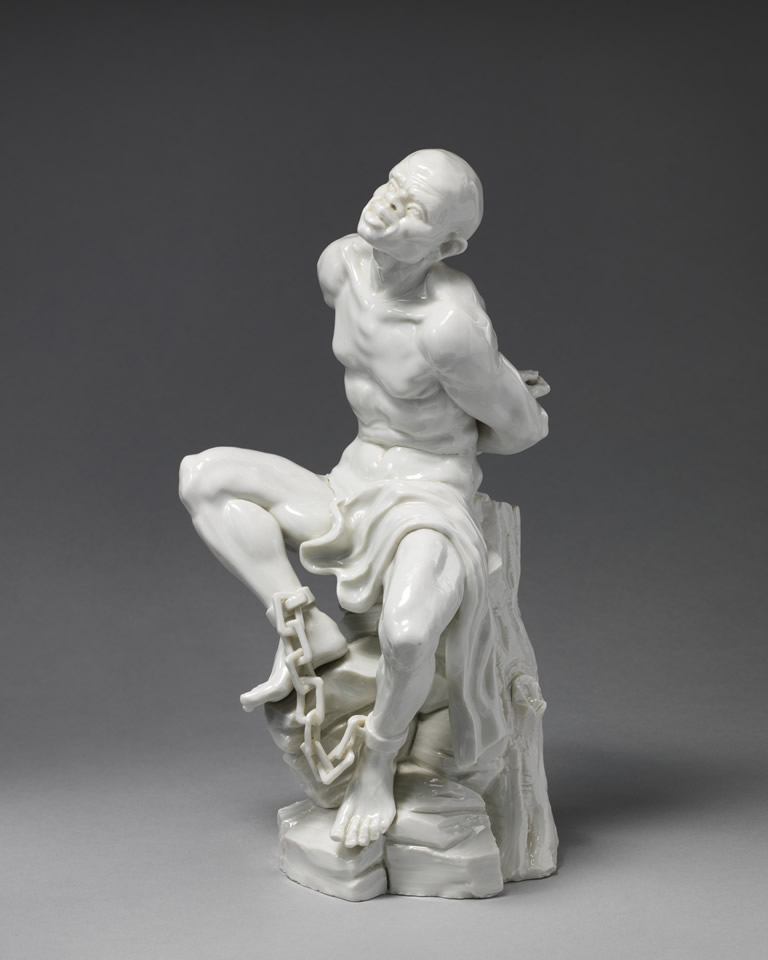
Figure of an Enslaved African Man, late 18th century
by The Metropolitan Museum of Art
This Doccia porcelain figure, possibly after a model by Giuseppe Piamontini, descends from Pietro Tacca’s 17th-century “Four Moors” monument in Livorno. Stripped of that monument’s triumphalist framing, the piece foregrounds the physical suffering behind the Transatlantic Slave Trade as the abolitionist movement made that human cost increasingly visible to European audiences.
The Transatlantic Slave Trade, the Dutch Empire, and the Long Road to Abolition (1444 – Today)
- 1444 CE: Portuguese traders conduct the first recorded public sale of enslaved Africans in Europe, at Lagos, Portugal, opening the era of transatlantic slaving.
- 1502 CE: The first enslaved Africans are transported directly across the Atlantic to the Spanish colony of Hispaniola.
- 1518 CE: Spain authorizes the first direct shipment of enslaved people from Africa straight to the Americas, formalizing the transatlantic route.
- 1602 CE: The Dutch Republic charters the Dutch East India Company (VOC), granting it a trading monopoly across Asia. The VOC becomes deeply involved in an entirely separate slave-trading system, buying, selling, and transporting captives across the Indian Ocean and the Indonesian archipelago.
- 1619 CE: The VOC founds Batavia (present-day Jakarta) as its Asian headquarters. Batavia rapidly grows into one of the largest slave markets in Asia, with captives trafficked in from Bengal, the Coromandel Coast, Madagascar, and East Africa, as well as from closer to home in Makassar and Bali — at times, more than half the city’s population lived in slavery.
- 1621 CE: The Dutch Republic charters a second company, the Dutch West India Company (WIC), granting it a monopoly over Dutch trade — including the trade in enslaved people — across West Africa, the Caribbean, and the Americas.
- 1637 CE: The WIC captures the fortress of Elmina, on the coast of present-day Ghana, from Portugal, turning it into the main Dutch slave-trading post on the West African coast.
- 1667 CE: Under the Treaty of Breda, the Dutch trade the North American colony of New Amsterdam (present-day New York) to England in exchange for Suriname, which becomes the WIC’s largest and most profitable plantation colony, absorbing roughly 40 percent of all Dutch transatlantic trafficking on its sugar plantations.
- 1780s CE: The transatlantic slave trade reaches its overall peak volume, with hundreds of thousands of Africans forcibly transported across the Middle Passage each decade.
- 1807–1808 CE: Britain and the United States both pass legislation banning the transatlantic slave trade, though slavery itself remains legal in their territories for decades to come.
- 1814 CE: Dutch King William I issues a royal decree banning the transatlantic slave trade under the Dutch flag — though not slavery itself in Dutch colonies.
- 1833 CE: Britain’s Abolition of Slavery Act ends slavery across most of the British Empire, compensating plantation owners rather than the enslaved.
- 1860 CE: Slavery is formally abolished in the Dutch East Indies. Formerly enslaved workers are largely replaced by indentured “contract labourers” recruited from China and British India, who work under harsh conditions for low wages.
- 1863 CE: Slavery is abolished in Suriname and the Dutch Antilles on 1 July — a date still commemorated today as Keti Koti (“broken chains”). Freedom is not, however, immediate: the newly emancipated are required to keep working on the plantations for a further ten years under state supervision, meaning true freedom only arrives in 1873.
- 1863–1865 CE: The American Civil War becomes the deciding conflict over slavery’s future in the United States. President Abraham Lincoln issues the Emancipation Proclamation on 1 January 1863, declaring enslaved people in the Confederate states free; the war ends with a Union victory in April 1865, and the Thirteenth Amendment, ratified in December 1865, formally abolishes slavery throughout the United States.
- 1888 CE: Brazil becomes the last country in the Americas to abolish slavery, ending nearly four centuries of transatlantic bondage in the hemisphere.
- 1926 CE: The League of Nations adopts the Slavery Convention, the first international treaty committing signatory states to suppress slavery and the slave trade worldwide.
- 1948 CE: The United Nations’ Universal Declaration of Human Rights enshrines freedom from slavery and servitude as a fundamental human right under Article 4.
- 1981 CE: Mauritania becomes the last country in the world to formally abolish slavery by law, though it does not criminalize the act of owning another person until a further law passed in 2007.
- 2022–2023 CE: The Dutch government issues a formal state apology for the Netherlands’ role in slavery, delivered by Prime Minister Mark Rutte on 19 December 2022 and echoed by King Willem-Alexander on 1 July 2023 — the 150th anniversary of abolition in Suriname and the Antilles — both calling it “a crime against humanity.” The government sets aside a €200 million fund for awareness, education, and community initiatives, alongside a further €27 million toward a new National Slavery Museum planned for Amsterdam’s Java Island.
- Today: The Global Slavery Index estimates that roughly 50 million people worldwide remain in situations of modern slavery, spanning forced labour, forced marriage, debt bondage, and human trafficking — proof that the systems of bondage traced along the Silk Road, across the Atlantic, and through the Dutch trading empires never fully disappeared, but persist in new forms.
← Return to Master Hub:
The Red Yellow Blue Silk Road Project