

The Silk Road in Anatolia (Türkiye): Weaving the Primary Palette
Table of Contents
Serving as the ultimate overland maritime gateway between East and West, Anatolia (modern-day Türkiye) functioned as a grand cultural crucible. From the 11th-century rise of the Seljuk Empire through the peak of the Ottoman Golden Age, Anatolian artisans integrated incoming Chinese cosmological concepts with local nomadic traditions, forging a distinct primary colour vocabulary across textiles, ceramics, and sacred spaces.
Silk Road
The Symbolic Palette: Spiritual Architecture and Nomadic Language
In the high-altitude pastures and courtly workshops of Asia Minor, the choice of primary colours transcended mere decoration. It became an interactive visual code reflecting spiritual protection, cosmic balance, and tribal identity:
- Primary Red (Madder / Al): The foundational background field of Anatolian tribal art, symbolizing fire, vital life force, protection from negative energies, and ancestral continuity.
- Primary Yellow (Ochre / Sarı): Associated with the life-giving warmth of the sun, spiritual illumination, abundance, and divine favor.
- Primary Blue (Indigo / Mavi): Represented the infinite celestial heavens, spiritual wisdom, and paramount protection from the malevolent “evil eye” (Nazar).
While the Chinese Wu Fang Zheng Se five-colour system was deeply structured and imperial, Anatolian cultures adapted these frequencies into fluid geometric symbols. On nomadic kilims, the primary triad formed a protective barrier, where red geometric motifs were sharply framed with deep blue borders to trap negativity and safeguard the household.
Material Innovations: Master Dyers and İznik Potters
The legendary permanence and vivid execution of Anatolia’s primary palette relied on profound innovations in regional dye extraction and ceramic alchemy:
- The Secret of Turkish Red: Western Anatolian dyers mastered a complex, multi-week fermentation process using madder root (Rubia tinctorum) and complex mordants to create “Adrianople Red,” a deep, colourfast blood-red that became a heavily guarded industrial secret sought after by European trade guilds.
- The Ceramic Blue Revolution: During the 15th and 16th centuries, the imperial pottery workshops of İznik adapted Chinese blue-and-white porcelain motifs. By importing cobalt networks along the Silk Road and fusing it with local quartz glazes, potters generated a luminous, glassy blue alongside brilliant tomato-reds that adorned royal mosques and imperial palaces.
- The Saffron and Weld Fields: Golden hues were cultivated locally using wild weld (Reseda luteola) and wild almond leaves, providing a bright, light-resistant primary yellow that formed the stark, geometric contrasts typical of Central Anatolian village weavings.
The Dragon and Phoenix Carpet: Direct Chinese Iconography in Early Anatolia
The most explicit material evidence of Chinese cosmological influence surviving in early Anatolian textiles is the legendary Dragon and Phoenix Carpet (mid-15th century), housed in the Pergamon Museum in Berlin (Inv.-Nr. I 4). Discovered in Central Italy and radiocarbon-dated to the early Ottoman Empire, this rare wool masterpiece demonstrates how deeply Far Eastern mythological archetypes penetrated the weavers’ workshops of Asia Minor via the Silk Road networks.
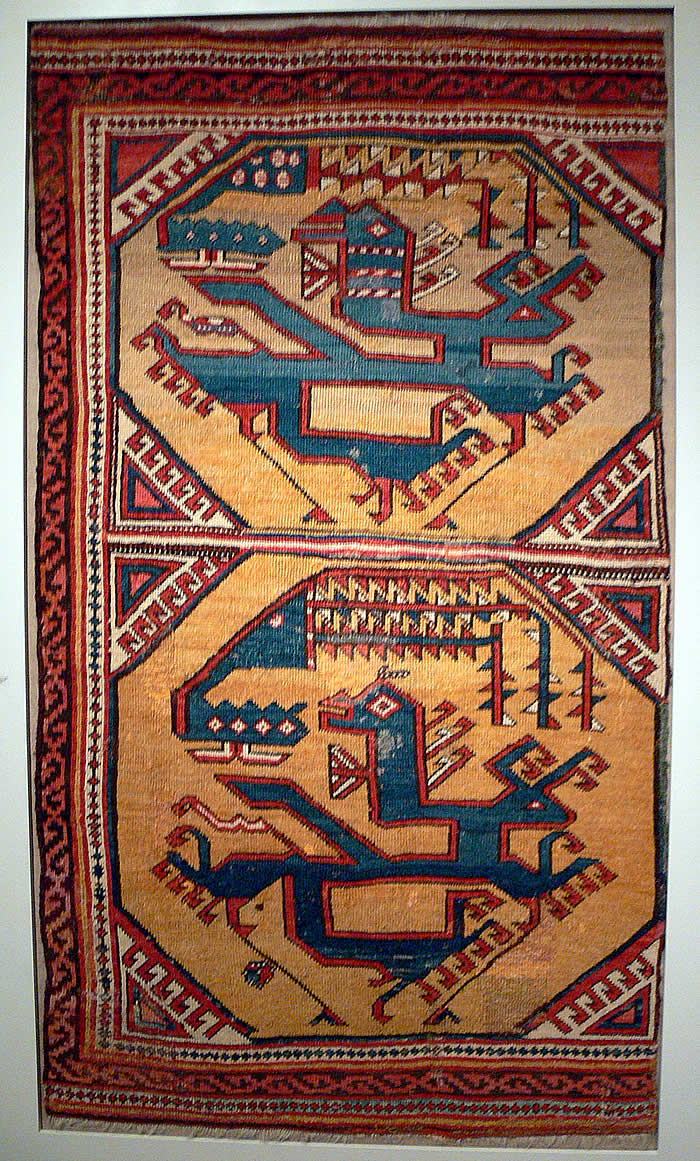
The mid-15th century Dragon and Phoenix animal carpet fragment (Pergamon Museum, Berlin), showcasing the geometric adaptation of Chinese cosmological motifs wrapped in traditional natural dyes.
The carpet features a structured, geometric layout that mirrors both Chinese architectural logic and the strict division of the Wuse colour model:
- The Yellow Field (Huang / Center): The entire composition is built inside two large, octagonal medallions set against a bright yellow ground. In the Chinese Wu Fang Zheng Se matrix, yellow represents the Center, the Earth element, and supreme cosmic balance. This colour choice charges the geometric frame with high symbolic status.
- The Primary Combatants (Qing vs. Chi): Inside the octagons, a stylized Chinese dragon and a phoenix (fenghuang) are locked in geometric combat. The animals are woven in deep blue (representing the East and sky protection), sharply outlined in vibrant madder red (representing the South, light, and vital force). This explicit pairing highlights the eternal interaction between yin and yang forces.
- Reciprocal Frameworks: The outer corners surrounding the octagons are packed with rows of white hooks on a stark red ground. The main border frames the cosmic dance with fluid, red floral tendrils stylized into repeating, S-like motifs over a dark brown background.
Historically, the combat motif was introduced into Islamic art during the 13th century under the Ilkhanid Mongols, who employed Chinese court artists. When Anatolian weavers translated these fluid, imperial ink drawings onto the structural warp and weft of their looms, they geometricized the shapes but strictly preserved the protective, elemental authority of the primary triad.
The Balkan & Mediterranean Bridge: Exporting the Anatolian Palette
From strategic trade outposts like Bursa, Konya, and Istanbul, merchants managed the cross-continental distribution of these intensely colored masterworks. Anatolian carpets featuring bold medallions and a rich, natural-dye palette of madder red, indigo blue, and ochre yellow were traded extensively across the Silk Road network. These textiles were so highly prized in the West that they regularly appeared as supreme symbols of luxury and status in the paintings of Renaissance Old Masters like Holbein, Vermeer, and Rubens.
The Modern Era: Primary Frequencies in Contemporary Turkish Art
The profound cultural relationship with red, yellow, and blue did not vanish with the historical Silk Road; rather, it underwent a mid-20th-century secular and modernist evolution. As contemporary artists in Türkiye began navigating the intersection of local heritage and Western abstraction, the primary triad remained a foundational tool for expression.
- Bedri Rahmi Eyüboğlu & The D Grubu: Modern master painters like Bedri Rahmi Eyüboğlu integrated traditional Anatolian folk motifs—such as flat-weave textiles and stained glass—into abstract expressionist works. His legendary use of raw, vibrant reds and cobalt blues breathed new, modern life into ancient village color sensibilities.
- The Architectural Transition: In early and mid-century Turkish architecture, primary shades transitioned from sacred religious tilework into secular municipal spaces, stained-glass installations, and public ceramic mosaics, serving as permanent symbols of an advancing, vibrant nation.
- Contemporary Design and Visual Identity: Today, the juxtaposition of deep madder-toned reds against protective Nazar-tinted blues remains a deeply embedded psychological foundation in contemporary Turkish graphic design, fine arts, and premium textile manufacturing, continuing a thousands-of-years-old visual inheritance.