

The Silk Road in Iran: The Intersection of Art & Industry
The Heritage of Red, Yellow & Blue in the Persian Carpet
Table of Contents
Serving as the central geographic bridge of the ancient Silk Road, Persia unified eastern material innovations with western trade markets. This national archive traces how traditional Iranian master dyers and carpet weavers transformed primary natural pigments into a complex visual language that permanently redefined global textile artistry.
Silk Road
The Symbolic Palette: Spiritual Harmony in Persian Art
In historical Persian design—especially within the magnificent weaving courts of the Safavid Empire—the selection of primary colours carried deep spiritual, cosmological, and cultural weight. Colour choices were deliberately arranged to tell stories of paradise, protection, and the natural world:
- Primary Red (Ghermez): Symbolized fire, vitality, courage, and physical life forces. It formed the foundational background field for most classical carpets, radiating warmth and enduring strength.
- Primary Yellow (Zard): Represented the life-giving power of the sun, light, joy, and spiritual wealth. It was frequently used to create luminous borders that framed intricate geometric and floral layouts.
- Primary Blue (Abi): Symbolized the infinite heavens, cosmic peace, solitude, and divine protection from negative forces.
Researchers looking to deep-dive into the technical identification and preservation of these classical colour layouts can study the peer-reviewed scientific report Analysis of Historical Persian Textiles on ResearchGate.
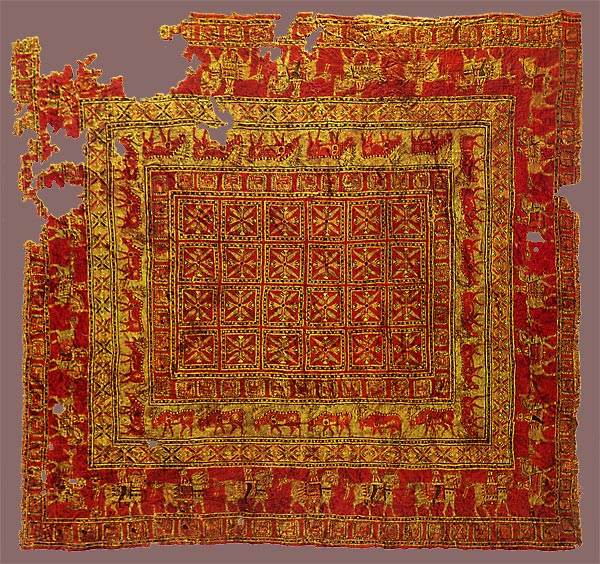
Pazyryk carpet, Pazyryk culture, 5th–4th century BC, State Hermitage Museum in Saint Petersburg, Russia
Material Innovations: The Master Dyers of Iran
The historic prestige of the Persian carpet relies heavily on the extraordinary colorfastness and vibrancy achieved by Iranian master dyers (Sabbagh). Operating regional dye houses along major desert trading routes, these artisans passed down guarded recipes for extracting primary tones from raw desert plants and insect shells:
- Red Dye Agents: Achieved through the brilliant chemical processing of madder root (Rubia tinctorum) harvested from central Iranian deserts, alongside precious cochineal and kermes scale insects imported from trade partners.
- Yellow Dye Agents: Derived locally using wild weld (Reseda luteola), pomegranate rinds, wild almond leaves, and expensive saffron threads to cultivate deep, golden hues.
- Blue Dye Agents: Cultivated from Indigofera tinctoria (indigo) plants imported via maritime routes from India or overland through Eastern networks, then fermented in specialized vats to build deep, enduring shades of blue.
To understand the chemical fingerprinting and botanical taxonomy behind these traditional methods, historians can read the complete academic study on Natural Dye Production in Iran via ScienceDirect.
The Central Trading Bridge: Connecting East & West
From trading hubs like Tabriz, Isfahan, and Rey, Persian merchants managed the fluid transit of luxury raw materials, silk yarn, and completed textile masterpieces. Because of this strategic positioning, Iranian design aesthetics and dye technologies directly influenced both the imperial courts of Europe and the weaving centers of Central Asia.
For comprehensive historical records, archival manuscripts, and archeological mapping tracking Persia’s cross-continental silk networks, researchers can access these open-access institutional databases:
- Global Historical Tracking: Explore the extensive database curated by the UNESCO Silk Roads Programme for Iran.
- Art History Repository: View high-resolution archival scans of historic Persian weaving charts and textile fragments held in the Metropolitan Museum of Art Islamic Textile Collection.
- Cultural Documentation: Review the institutional frameworks regarding traditional craftsmanship via the UNESCO Intangible Cultural Heritage Registry for Persian Carpet Dyeing.
← Return to Master Hub:
The Red Yellow Blue Silk Road Project