

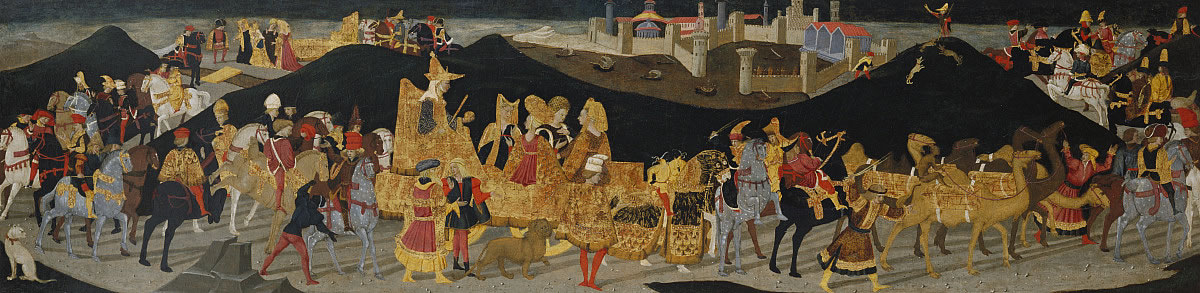
Journey of the Queen of Sheba by Apollonio di Giovanni di Tommaso 1464-1465 - The biblical journey of the Queen of Sheba traveling to Jerusalem to test King Solomon's wisdom.
The Crossroads of Luxury: How the Queen of Sheba, Global Trade, and Byzantine Art Defined the Colours of East Africa and Yemen
Table of Contents
Long before the overland Silk Road reached its historical peak, the legendary realm of the Queen of Sheba—spanning ancient Saba (modern-day Yemen) and the Kingdom of Aksum (modern Ethiopia)—sat at the absolute epicenter of global trade. By commanding the lucrative Incense Route and the Maritime Silk Road, this cosmopolitan gateway exchanged precious resins, exotic goods, and artistic aesthetics across Europe, Asia, and Africa. Far from being passive traders, these cultures developed a profound, independent mastery of color philosophy. While they rejected East Asian color cosmologies, they embraced and subverted rigid Byzantine religious rules to create an artistic legacy written in vibrant fields of primary red, yellow, and blue. This article explores how ancient diplomacy, regional pigments, and sacred trade routes forever transformed the visual identity of the southern Red Sea.
Silk Road
Chronological Context: From Ancient Empires to Modern Nations
To understand how these artistic and spiritual traditions evolved, it is essential to trace the deep history of the region. The timeline below illustrates the lifespan of the ancient Kingdom of Saba alongside the foundations of modern Ethiopia and Yemen.
c. 10th Century BCE (Approx. 965 – 931 BCE)
The Queen of Sheba (Makeda / Bilqis)
The specific lifetime and reign of the Queen. Her chronological placement is tethered to her contemporary, King Solomon of Israel. While the greater Sabaean civilization survived for centuries after, her narrative is rooted in this specific era of early regional trade diplomacy.
c. 1000 BCE – 275 CE
Kingdom of Saba (Sheba)
The ancient South Arabian kingdom flourishes in modern-day Yemen and expands influence across the Red Sea into Eritrea and northern Ethiopia. The wealth of Saba is built on the frankincense trade and the engineering of the Great Ma’rib Dam. It is eventually absorbed by the Himyarite Kingdom in 275 CE.
c. 100 CE – 940 CE
Kingdom of Aksum (Axum)
Centering in northern Ethiopia, Aksum rises into a dominant maritime trading power. In the 4th century CE, under Emperor Ezana, it officially adopts Christianity, which introduces the rigid Byzantine colour rules that altered East African art forever.
1855
Modern Ethiopia (Founding Era)
Following centuries of decentralized feudal rule, Emperor Tewodros II ascends the throne, reunifies regional factions, and lays the administrative and structural foundation for the modern Ethiopian nation-state.
1918
Modern Yemen (North Nationhood)
Following the collapse of the Ottoman Empire after World War I, North Yemen declares its independence as the Mutawakkilite Kingdom of Yemen, marking its entry into modern independent nationhood.
May 22, 1990
Republic of Yemen (Unified State)
The contemporary borders of the nation are finalized. After decades of separate colonial rules and civil splits, the Yemen Arab Republic (North) and the People’s Democratic Republic of Yemen (South) officially unify to form the modern Republic of Yemen.
The Legend of Sheba: A Kingdom Built on Global Trade Networks
Ancient South Arabian and Horn of Africa civilizations operated as a central hub in global commerce, driven by a near-monopoly on frankincense and myrrh, which were transported via an overland Incense Route that connected with the northern Silk Road.
The Meeting of Minds: Queen of Sheba and King Solomon
The defining historical anchor for the Queen of Sheba is her legendary journey to Jerusalem to meet King Solomon of Israel. Recorded across sacred texts including the Hebrew Bible, the New Testament, the Quran, and the Ethiopian Kebra Nagast, this meeting was far more than a casual royal visit. It was an intense intellectual and diplomatic summit between two of the ancient world’s most powerful rulers. Driven by rumors of Solomon’s unmatched insight, the Queen arrived with an immense caravan bearing gold, rare gemstones, and untold quantities of spices to test him with hard riddles and complex governance questions. Solomon’s ability to answer every riddle flawlessly established a bond of profound mutual respect, resulting in a historic exchange of royal gifts that laid the foundation for long-term diplomatic alliance and trade connections between their kingdoms.
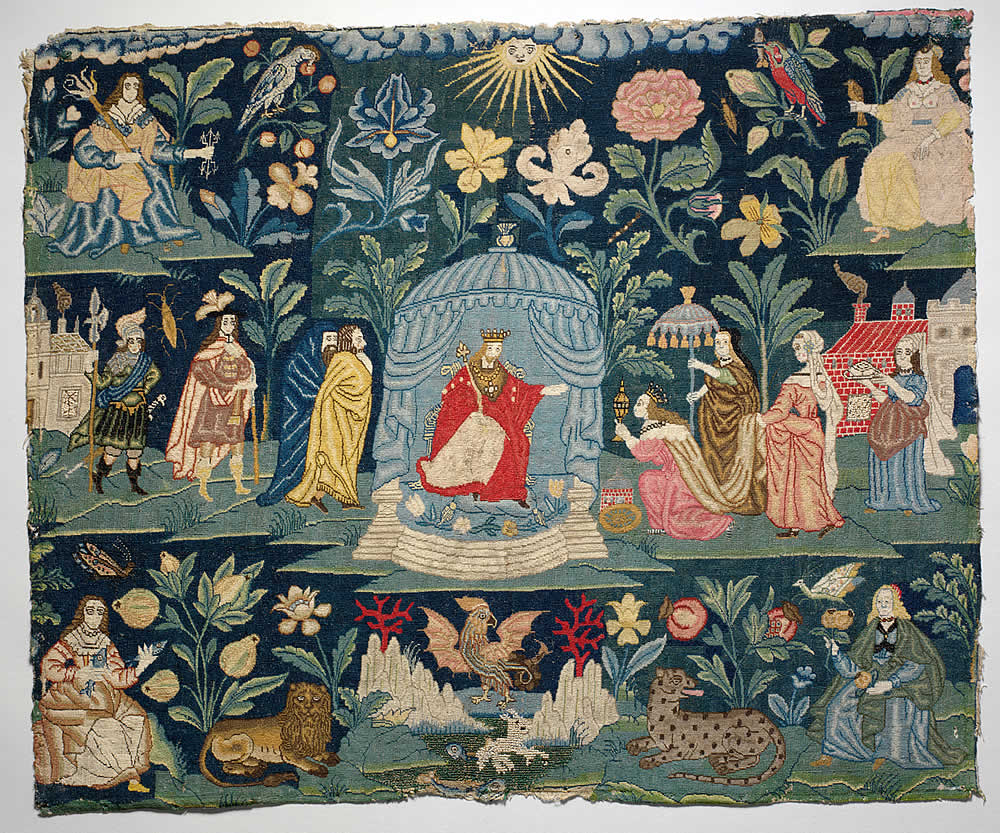
The Meeting of King Solomon and the Queen of Sheba, with the Four Elements
British, ca. 1700, The Metropolitan Museum of Art
The Incense Route Meets the Overland Silk Road
By controlling the caravan networks traveling up the spine of the Arabian Peninsula, Sabaean rulers funneled exotic aromatics straight toward the Mediterranean world and Mesopotamia. These routes directly intersected the overland Silk Road corridors, trading valuable regional items for advanced materials, textiles, and artistic patterns migrating from East and Central Asia. Historians view her historic visit to King Solomon not just as a spiritual quest, but as a critical trade negotiation to secure access to these northern Mediterranean and Silk Road markets via Solomon’s ports.
Ports of Prosperity: Navigating the Maritime Silk Road
As ocean voyages expanded, regional ports such as Adulis in the Kingdom of Aksum and Aden in Yemen evolved into critical, cosmopolitan centers. Maritime Silk Road vessels traveling across the Indian Ocean relied heavily on seasonal monsoon patterns to anchor in southern Red Sea ports. Merchants swapped local goods for luxury Chinese pottery and Indian textiles, locking the region into an integrated web of ancient global shipping lanes.
Independent Chromatic Identity: Red, Yellow, and Blue in Sabaean, Yemeni, and Ethiopian Traditions
Ancient Sabaean, Yemeni, and Ethiopian traditions utilized red, yellow, and blue as a functional, indigenous language based on geological resources and local spiritual frameworks.
Red: Sacrifice, Earth, and Protection
Red served as an essential indicator of life, soil, and protection in early South Arabian and Ethiopian art. Crafted from natural iron ores and plant roots, native madder-red pigments colored traditional bridal clothing and architectural textiles. These vibrant coverings shields communities against malicious cosmic forces while honoring ancestral traditions.
Yellow: Purity, Faith, and the Divine Sun
Before adopting Abrahamic traditions, early Sabaeans practiced sun worship, choosing yellow and gold to mirror the physical heat and protective energy of the sun. Following the region’s religious shift, yellow evolved into an abstract, symbolic language for uncreated spiritual peace, purity, and sacred illumination within church manuscripts and home entryways.
Blue: The Celestial Skies and Deflecting the Evil Eye
Blue held deep spiritual importance as a window into the heavenly universe. For early Red Sea communities, deep blues represented divine safety and cosmic balance. Across Yemen and Ethiopia, indigo-dyed threads and deep blue stones were consistently incorporated into amulets, garments, and talismans to turn back the destructive force of the evil eye.
Divergent Cosmic Views: Why the Five-Colour Cosmology (Wu Xing) Did Not Take Root
Despite heavy trading along the Maritime Silk Road—where Chinese textiles and pottery flowed into Southern Arabian ports—the architectural, artistic, and spiritual practices of Saba and Ethiopia completely rejected East Asia’s five-colour cosmology (Wu Xing). This intentional decoupling demonstrates that while commercial items were eagerly adopted, the structural philosophy behind them was completely ignored.
Commercial Exchange vs. Philosophical Conversion
The nature of Silk Road trade between China and the Red Sea kingdoms was strictly commercial and transactional. Merchants traded precious physical commodities, such as frankincense, myrrh, gold, and Chinese silks, but did not exchange deep theological ideas. While East Asian societies viewed red, yellow, and blue through the lens of five elements (Fire, Earth, and Wood, alongside White/Metal and Black/Water), the southern Red Sea states already maintained a highly developed, indigenous three-primary-colour structure deeply tied to their own immediate survival, geology, and local environments.
The Rise of Abrahamic Theology
As the Kingdom of Aksum formally converted to Christianity in the 4th century CE and Yemen adopted Abrahamic faiths (and eventually Islam), their colour codes became strictly regulated by western religious scriptures and clerical authorities. Instead of viewing colours as cyclical natural elements or directional forces (such as the Chinese system tying yellow to the “Center” or blue to the “East”), the region adopted a narrative theology. Colours became permanent, unchangeable symbols of divine events: red became the fixed colour of sacrificial blood, yellow represented uncreated heavenly light, and blue became the literal dome of heaven. This absolute Abrahamic framework left no intellectual room for the fluid, elemental cosmology of the Far East.
The Byzantine Artistic Canon and its Southern Legacy
Following its formal conversion to Christianity, the Kingdom of Aksum (Ethiopia) deeply integrated the aesthetic and liturgical traditions of the Eastern Roman Empire. Byzantine art treated colours not as decorative preferences, but as rigid, universally recognized codes for narrative theology and spiritual hierarchies. When East African and Southern Arabian scholars adopted these structural rules, they preserved their deep spiritual meanings, but heavily adapted the physical pigments to match their own regional geology, landscape, and indigenous context.
The Dual Meanings of Red: Divinity and Martyrdom
In the strict Byzantine standard, red held an immediate spiritual duality. It simultaneously represented divine fire, life-giving energy, and the blood of martyrdom. This was famously visualized in the classic “Chiton and Himation” palette of Christ, where a deep red under-tunic signified His core divine nature, wrapped in a blue cloak of physical humanity. Ethiopian iconographers adopted this rule, but significantly intensified its optical punch. Rather than using the muted, brownish iron oxides common in late Mediterranean panels, East African painters heavily utilized highly concentrated local cinnabar and vermilion. They painted flat, mathematically bold fields of fiery red to immediately draw a viewer’s eye to holy energy and spiritual authority.
Subverting the Palette: The Ethiopian Indigo Robe vs. Byzantine Blue
While the Mediterranean Byzantine world utilized blue primarily to represent humanity, the physical sky, and the created cosmos, Ethiopian iconography beautifully subverted this convention. In the North, the Virgin Mary was traditionally depicted in a blue dress with a red outer mantle, showing a human woman chosen to carry the divine. Ethiopian masters flipped this layout completely. They almost universally draped the Virgin Mary in a solid, dark, all-enveloping indigo-blue outer robe. To the Ethiopian church, blue became the ultimate colour of heavenly enclosure, celestial mysticism, and divine protection. Instead of relying on imports of rare Mediterranean lapis lazuli, these artists developed advanced localized industries to ferment indigenous indigo plant leaves, achieving a deep, matte blue unique to the Horn of Africa.
From Gold Leaf to Yellow Paint: Innovating with Orpiment and Ochre
The most dramatic divergence from the Byzantine canon occurred in how local artists handled the concept of uncreated, divine light. The Byzantine Empire was famously obsessed with gold leaf—gilded mosaic tiles and shining gold backdrops were systematically used to eliminate shadows, placing holy figures in a transcendent, timeless vacuum outside of physical reality. However, gold leaf was incredibly rare, costly, and difficult to apply to traveling wooden diptychs or animal-parchment manuscripts in the African interior. Ethiopian painters solved this by replacing the physical metal with a vibrant, intensely luminous yellow paint. They manufactured this pigment using orpiment (a natural arsenic sulfide mineral) and rich yellow ochres. Instead of a reflective metallic sheen, East African icons achieved their “heavenly glow” through high-contrast, flat yellow borders, making halos look like burning solar radiant disks rather than static gold plates.
The Evolution of Art at the Crossroads: The Gondar School and Modern Heritage
By the 17th and 18th centuries, the historical colour legacy of the southern Red Sea reached a stunning artistic peak with the emergence of the Gondar School in Ethiopia. Centered in the imperial capital of Gondar, this movement marked a departure from earlier, strictly stylized Byzantine constraints. While Gondarine painters maintained the traditional primary red, yellow, and blue palette that had defined the region for centuries, they completely revolutionized how these colours interacted on parchment and canvas.
The Gondar School introduced a dramatic, high-contrast emotional power to East African Christian art. Artists began pairing flat, vibrant fields of cinnabar red, orpiment yellow, and indigo blue with thick, bold black outlines and a heavy impasto painting technique. Holy figures were given intense, expressive eyes and rhythmic, flowing garments that cascaded across panels. Instead of copying the smooth, realistic colour gradients finding popularity in late European Renaissance works, the Gondar masters chose to double down on raw, graphic intensity, prioritizing spiritual emotion over physical realism.
Today, this ancient primary colour triad remains a pillar of regional identity. The historic convergence of trade, geology, and faith can still be traced directly into the modern era. In Ethiopia, the bold pairing of red and yellow—historically joined by green—remains a powerful symbol of independence and enduring cultural heritage. Meanwhile, across the Red Sea in Yemen, traditional artisans continue to utilize local madder-red dyes for bridal garments and natural yellow ochres to trace geometric patterns around the windows of ancient mud-brick skyscrapers. By bridging the ancient trade routes of the past with living traditions, the primary colours of the Queen of Sheba’s realm continue to serve as a vibrant, universal visual vocabulary.
Summary: The Enduring Chromatic Legacy of the Red Sea
Ultimately, the realm of the Queen of Sheba stands as proof of the power of localized cultural convergence along global trade corridors. While ancient Saba and the successor Kingdom of Aksum were connected commercial gears within the greater Silk Road networks, they preserved an independent visual and spiritual identity. Rather than absorbing Far Eastern cosmological models, they intentionally adapted Byzantine narrative artistic rules to fit their own unique landscape and resources. By transforming raw local materials—such as indigenous indigo leaves, poisonous orpiment minerals, and deep cinnabar earth—into brilliant fields of blue, yellow, and red, these societies left an indelible mark on historical textile and art traditions. Their distinct mastery over this primary triad proves that global trade routes did not homogenize ancient cultures, but rather gave them the wealth and resources to broadcast their distinct visual languages to the rest of the world.
Continue the Journey Across the Cosmological Silk Road
The story of the Queen of Sheba is just one thread in a global tapestry. Our international research project traces how completely unrelated ancient civilizations independently used the primary triad of red, yellow, and blue to build a shared language of peace, protection, and structural cosmic harmony.
Explore our deep-dives into neighboring textile heritages, material trade routes, and colour histories:
China & East Asia
Nepal & The Himalayas
Iran & The Persian Carpet
The New Silk Road
← Return to Master Hub:
The Red Yellow Blue Silk Road Project