

The Silk Road in the United States: Red, Yellow and Blue in a Young Country
The United States is a young country built on very old colour traditions. Red, yellow and blue appear in Navajo sacred geography and weaving, in colonial indigo and Turkey red cloth, in the Stars and Stripes, in the red and blue of today’s political parties, and in the paintings of Piet Mondrian, Barnett Newman and Pat Steir. This page follows those threads and asks where they meet China’s Wuse colour system, Dutch history and the wider Red Yellow Blue Silk Road.
The road that arrived by sea
The Silk Road never crossed the American continent. Its goods, dyes and ideas arrived anyway, by ship, by railway and in the luggage of people. The first American ship to trade with China, the Empress of China, left New York on 22 February 1784 and reached Canton that August. Her hold carried ginseng, a root the Chinese valued highly, and she came home in May 1785 with chests of tea, silk and porcelain. The porcelain was cheap enough to double as ballast, and Chinese painters soon decorated it for American buyers, sometimes with the eagle and the Stars and Stripes. WGBH tells the story of that first trade, and the Biggs Museum shows a porcelain punch bowl that pictures the Empress of China herself.
So do we see China’s Wuse colour system in the United States? Not as a system. In our research so far we have found no sign that the five-colour cosmology of red, yellow, blue-green, white and black shaped American colour culture, the way it shaped Korea, Japan or Vietnam. What we found instead are three quieter stories: Chinese colour that travels with people, Silk Road dyes and designs that arrive through Europe and Mexico, and Native American colour worlds with a logic of their own.
Table of Contents
The first story is the easiest to see. In Washington, DC, the Friendship Archway at the entrance to Chinatown was dedicated in 1986 in the style of Ming and Qing gates. It has seven roofs, about 7,000 glazed tiles and some 270 painted dragons, and Chinese and American craftsmen built it side by side. This is the world of Wuse travelling the way it travels today, with builders and families rather than camel caravans. The National Park Service describes the arch and its neighbourhood.
Four mountains, four colours: the Navajo world
Long before any ship reached Canton, the land that became the United States held colour worlds of its own. The Diné, or Navajo, place their homeland between four sacred mountains, each with its own colour: white shell for the east, turquoise for the south, yellow for the west and black for the north. These colours run through the creation story, through sandpainting and through the symbols of the Navajo Nation. The Nation’s seal also draws a rainbow of red, yellow and blue, left open at the top, in the east, to show that sovereignty is never closed. Explore Navajo and the Navajo Nation’s own visitor guide describe the seal, the flag and the mountains.
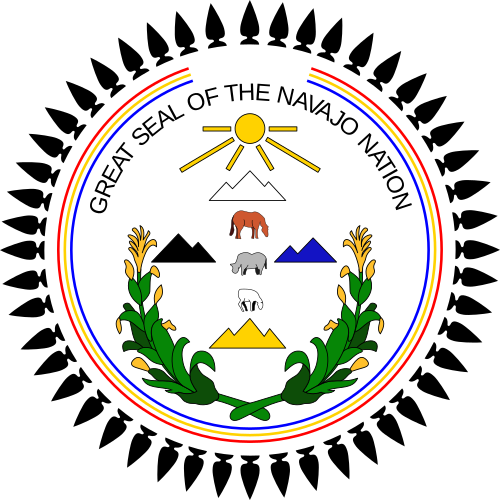
Amos Frank Singer and John Claw, Public domain, via Wikimedia Commons
A traveller from the Wuse world would recognise the shape of this idea: colours bound to directions, to mountains and to a sacred centre. The colours and meanings are different, though, and we have found no evidence of contact between the two. Like Mondrian’s grids, it looks like two cultures reaching for a similar structure on their own. Other Native nations also link colours to the four directions, but they choose different sets, so no single palette speaks for all of them. These are living traditions. We describe them from public sources and welcome corrections from Diné and other Native scholars and museums.
Silk Road
Red from Mexico and Bengal: a Navajo blanket as a map of world trade
Navajo weavers also made some of the most vivid red and blue textiles of the nineteenth century, and their dyes tell a global story. The wool came from sheep the Spanish had introduced. The blue came from indigo grown in Mexico and Central America and carried north along the Old Spanish Trail, as the Mingei International Museum explains in its notes on a Navajo chief’s blanket. The red came from bayeta, a fine flannel woven and dyed in Seville and Manchester with cochineal, an insect dye from Mexico, and later with lac, an insect dye from Bengal. Weavers unravelled the cloth thread by thread, spun it again and wove it into blankets. The National Park Service calls the bayeta years the golden age of Navajo weaving. Spain’s own part in this trade is told on our Spain page.
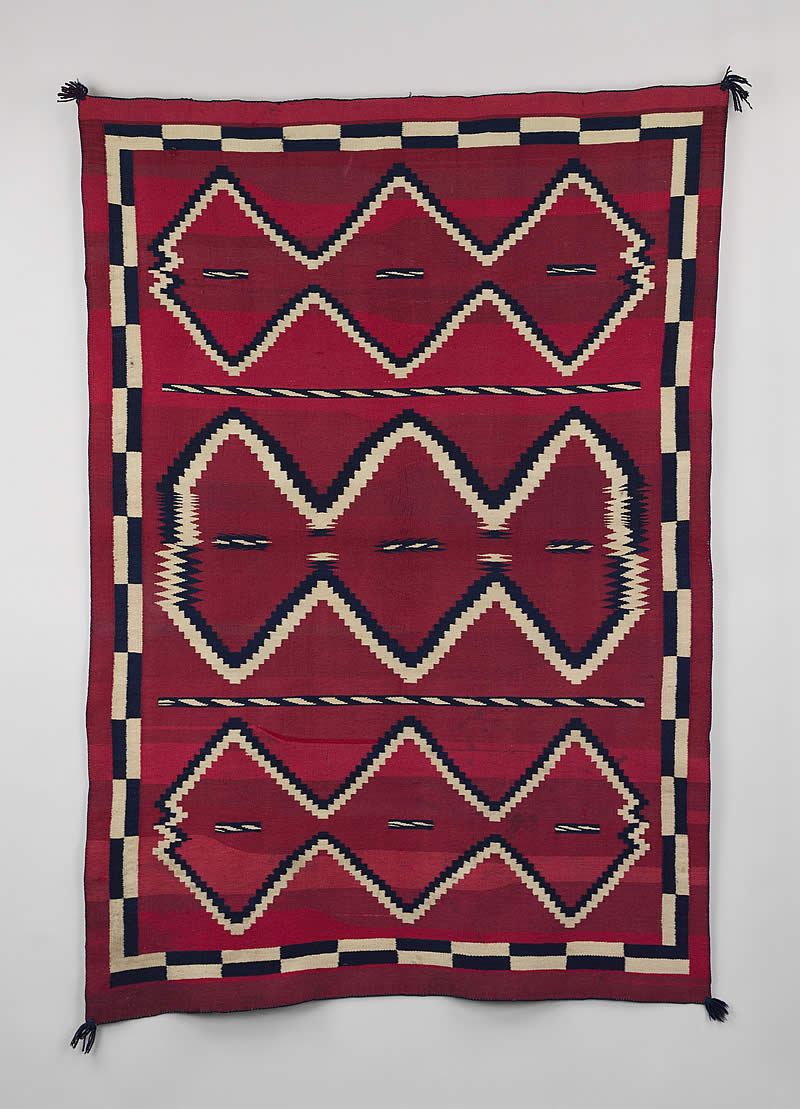
Wearing Blanket, Navajo, 1860–70 | Gift of Mrs. Russell Sage, 1910, Metropolitan Museum of Art
In the 1870s the railway brought bright Germantown yarn from Pennsylvania, dyed with new chemical colours, and a few decades later traders turned red into a brand. At Ganado, Arizona, the trader Juan Lorenzo Hubbell loved crimson and encouraged deep red backgrounds, and the Ganado Red rug was born. Traders also pushed bordered designs that Eastern buyers knew from Oriental rugs, and in some districts weavers were shown pictures of Persian carpets. Here the carpet tradition we follow on our Iran page quietly crosses the ocean and meets a Native art that already had its own grammar.
American quilts carry another thread. Turkey red, the brilliant madder red that American quilters loved from the 1840s, takes its name from the Ottoman world, and its dyeing method is traced to older practice in India. In the eighteenth century French and British dyers sent people east to learn the secret. Red and green appliqué on white became a fashion across the country, and the Metropolitan Museum of Art explains the dyes in its essay on American quilts and coverlets. The Ottoman side of the story is on our Anatolia (Türkiye) page.
Blue gold: indigo, Carolina and the cost of a colour
Blue has a harder American story. In the 1740s, in colonial South Carolina, Eliza Lucas Pinckney helped turn indigo into a successful crop. The knowledge that made it work came from enslaved Africans and from dye-makers from the Caribbean, and the labour of enslaved people kept it going. Planters called it blue gold. Along with rice it made South Carolina the wealthiest of the thirteen colonies, and the dye was shipped to Britain for cloth and uniforms. It took about 180 pounds of leaves to make one pound of dye. Today Gullah Geechee communities in the Lowcountry still paint doors and porches a pale blue often called haint blue, a custom said to have been started by enslaved people. National Geographic follows the indigo trail through South Carolina. This is the darker side of the colour trade that we also follow on our page about slavery and caste systems.
Red, white and blue: how the flag found its colours
On 14 June 1777 the Continental Congress decided that the flag of the United States would have thirteen stripes, alternately red and white, and thirteen white stars on a blue field. The resolution did not say why. Historians usually point to British colours, since the first American flag, the Grand Union, still carried the Union Jack in its corner. The meanings came later. In 1782 Charles Thomson, secretary of Congress, explained the colours of the Great Seal, which match the flag: white for purity and innocence, red for hardiness and valour, and blue for vigilance, perseverance and justice. Those meanings were attached to the flag afterwards and have stayed with it ever since. The U.S. Department of State tells the story of the seal, and Time explains why the flag’s colours had no official meaning in 1777.
The Dutch thread: from the Prince’s Flag to New York
Is there a Dutch connection? Not in the design of the Stars and Stripes, at least not in any source we found. But the Dutch thread is there, and it is colourful. The first flag of the Dutch Revolt was the orange, white and blue Prince’s Flag of the late sixteenth century. Red replaced the orange only slowly. Historians offer several reasons: the orange dye may have faded to red, Dutch leaders may have wanted distance from the House of Orange, or red, white and blue may already have been linked with the Low Countries. More about the dyes behind these colours is on our Netherlands page.
The orange version crossed the Atlantic with the Dutch West India Company, which founded New Amsterdam in 1625, and it never quite left. The flag of New York City, adopted in 1915, is a vertical tricolour of blue, white and orange, a direct echo of the Prince’s Flag. The city where Mondrian would later paint his last works still flies the Dutch colours. Wikipedia has the history of the city’s flags.
A second thread is political. On 16 November 1776 the guns of Fort Oranje, on the Dutch island of Sint Eustatius, answered the salute of the American brig Andrew Doria. It is often called the first foreign salute to the American flag, although historians still debate whether it was meant as recognition. The Dutch Republic recognised the United States on 19 April 1782, the second country to do so after France, and that year Amsterdam bankers gave the young nation its first foreign loan. Arms and supplies had already flowed through Dutch islands in exchange for American goods such as tobacco and indigo. The Dutch Cultural Heritage Agency tells how America left its mark on Dutch heritage, and the DAR magazine explains the Dutch influence on the Revolution.
Why are Democrats blue and Republicans red?
Today the pairing feels permanent: red for Republicans, blue for Democrats. Yet it is younger than many voters. For most of the twentieth century there was no convention at all. In 1976 NBC built a large illuminated map and showed Jimmy Carter’s states in red and Gerald Ford’s in blue. Roy Wetzel, who ran NBC’s election unit, later explained that the network simply followed London, where blue belongs to the Conservatives and red to the left. Other outlets chose differently, and some switched from one election to the next. ABC used yellow for one party in 1976, and Time magazine gave red to the Democrats in every election from 1988 to 2000.
The turning point was the 2000 election between George W. Bush and Al Gore. The result hung on Florida for 36 days, and the networks showed the same map night after night. Presenters began to talk about red states and blue states in the final days of the campaign, and NBC’s Tim Russert is often credited with popularising the words. By 2004 the language was everywhere, and the parties have since embraced it. Neither party has an official colour. The pairing was made by television graphics departments and repeated until it became habit. Smithsonian Magazine and NBC News trace how it happened.
What do the colours mean? Officially, nothing. Unofficially, they borrow from older stories. In much of the world red is the colour of the left and blue of conservative parties, which is why the American pairing surprises many Europeans. And both parties belong to the same flag: red and blue are two of its three colours, with white left for everyone. It is a reminder that colour meanings are agreed by people and can flip within a single generation.
Yellow, the colour no party owns
Yellow has had the quietest American career, and perhaps the most surprising. In Tang China it was a colour of the throne, and wearing the wrong yellow could be treason, as we explain in Imperial Yellow. In the United States it became the colour of the school bus. In April 1939 Frank Cyr of Columbia University’s Teachers College gathered officials, engineers and paint specialists in New York to set national standards for school buses. They chose a golden yellow because black lettering stands out on it and because it is easy to see in the dim light of early morning. According to accounts of the meeting, some had lobbied for red, white and blue buses. A colour once reserved for emperors now carries children to school. Mental Floss tells the school bus story.
Mondrian comes to New York
Mondrian’s own road to red, yellow and blue is told on our De Stijl and Mondrian page. One detail of that story points straight to America: the Theosophical Society, whose ideas shaped him, was founded in New York in 1875, and he joined its Amsterdam lodge in 1909.
In 1940, with Europe at war, he crossed the Atlantic and arrived in New York on 3 October. The city changed him. He swapped his black lines for lines of coloured tape in red, blue and yellow, and filled Broadway Boogie Woogie (1942 to 1943), now at the Museum of Modern Art, with small blocks that pulse like traffic and music. He was still working on Victory Boogie Woogie when pneumonia ended his life on 1 February 1944, and it was left unfinished, with the tape still on the canvas.
The music was boogie-woogie, which grew from the African American tradition. According to the Kunstmuseum Den Haag, he often danced to it at Café Society, at the time the only place in New York where Black and white people could mix both on stage and in the audience. So one of the best known red, yellow and blue paintings of the twentieth century was finished in America and fed by American music. Victory Boogie Woogie now belongs to the collection in The Hague, and the Kunstmuseum Den Haag and MoMA have announced exhibitions that reunite the two paintings. MoMA’s Mondrian Boogie Woogie runs from 21 March to 31 July 2027, and Artdaily describes the partnership.
Mondrian had American followers. When the young sculptor Alexander Calder visited Mondrian’s Paris studio in 1930, he later described it as the shock that converted him to abstraction, and the mobiles that followed are famous for their red, yellow, blue and black.
Who’s afraid of red, yellow and blue?
In the 1960s an American painter answered Mondrian with a question. Between 1966 and 1970 Barnett Newman painted four huge canvases called Who’s Afraid of Red, Yellow and Blue. The title plays on Edward Albee’s 1962 play, and its target was the idea that the three primaries belonged to a strict doctrine. Newman wanted to free them from what he saw as the purists and formalists, and to make them expressive rather than didactic. In the third painting red fills almost the whole canvas, with a thin strip of blue on one side and of yellow on the other.
The Stedelijk Museum in Amsterdam bought the third painting in 1969, and many visitors hated it. In 1986 a man slashed it with a box cutter. Its restoration, finished in 1991, became a controversy of its own, and in 2014 the painting returned to the museum walls. DutchNews reported the return. The question in the title turned out to be a fair one.
Other Americans kept the conversation going. Jasper Johns painted the American flag itself in 1954 and 1955, in encaustic over newspaper collage, and later stencilled the words red, yellow and blue into his canvases. Brice Marden painted in red, yellow and blue in the early 1970s, influenced by Mondrian and Newman. And in 2021 and 2022 Pat Steir, born in Newark, New Jersey, answered Newman directly with three tall paintings, Red Pour, Yellow Pour and Blue Pour, each a single column of one primary poured down a dark canvas. The Brooklyn Rail reviewed that exhibition, and her earlier installation Color Wheel at the Hirshhorn Museum in Washington, DC, in 2019 carried the same curiosity into a whole room.
US vs China

Some of the first humans to arrive in the Americas included people from what is now China, who arrived in two distinct migrations during and after the last ice age, a new genetics study has found.
“Our findings indicate that besides the previously indicated ancestral sources of Native Americans in Siberia, the northern coastal China also served as a genetic reservoir contributing to the gene pool,” said Yu-Chun Li, one of the report authors.
Li added that during the second migration, the same lineage of people settled in Japan, which could help explain similarities in prehistoric arrowheads and spears found in the Americas, China and Japan.
After crossing into Alaska, the ancestors of the Navajo settled in the subarctic forests of interior Alaska and northwestern Canada. They lived there alongside their linguistic relatives, including the ancestors of modern Dene and Apache peoples.
Around 800 to 1,000 years ago, groups of Athabaskan speakers began migrating south. Researchers suggest a massive volcanic eruption in the Saint Elias Mountains of Alaska disrupted local caribou herds and prompted them to move.
These groups traveled along the Rocky Mountains and the Great Plains. They reached their traditional homeland in the American Southwest (known as Dinétah, spanning parts of New Mexico, Arizona, Utah, and Colorado) between 1300 and 1500 AD. There, they interacted with neighboring Pueblo peoples and developed the distinct Navajo culture known today.
There is no direct historical link between the Chinese Wuse color system and Navajo traditions. While both cultures assign colors to cardinal directions, they developed these frameworks independently thousands of years apart. Furthermore, famous Navajo rugs and pottery did not come from ancient Siberia; they developed after the Navajo settled in the American Southwest.
What the United States adds to the Red Yellow Blue Silk Road
For the Red Yellow Blue Silk Road, the United States is a place where the story changes shape. The Silk Road’s dyes, carpets and porcelain arrived by sea and by rail rather than by caravan. Native nations brought colour worlds of their own, with an inner logic that resembles Wuse without borrowing from it. Colours were given new meanings within a lifetime, on a flag, on a television map and on the side of a school bus. And in the twentieth century the triad that De Stijl had made abstract crossed the ocean to New York, grew louder there, and came back to Amsterdam and The Hague in paintings that people still argue about.
RYB is researching these threads, and an exhibition, Cosmology of Peace: Red Yellow Blue Silk Road, is planned for later. Museums, researchers and artists who hold or study red, yellow and blue objects connected to this story are welcome to get in touch. You can follow the wider story on the Silk Road timeline and in the Cosmology of Peace.
Sources
- U.S. Department of State, The Great Seal of the United States (PDF)
- Time, Why the U.S. Flag Is Red, White and Blue
- Wikipedia, Flag of the Netherlands, Flags of New York City and The First Salute
- Cultural Heritage Agency of the Netherlands, The mark America has left on Dutch heritage
- DAR American Spirit, The Dutch Influence
- Smithsonian Magazine, When Republicans Were Blue and Democrats Were Red
- NBC News, Elephants are red, donkeys are blue
- National Park Service, Navaho Life of Yesterday and Today: Crafts
- Mingei International Museum, Third Phase Chief’s Blanket
- Explore Navajo, Navajo Culture
- The Metropolitan Museum of Art, The Materials and Techniques of American Quilts and Coverlets
- National Geographic, Indigo is making a comeback in South Carolina
- WGBH, How a Taste for Chinese Tea Minted America’s First Millionaires
- National Park Service, DC Chinatown
- Mental Floss, Why Are School Buses Yellow?
- The Museum of Modern Art, Broadway Boogie Woogie and Jasper Johns, Flag
- The Art Newspaper, MoMA exhibition on Mondrian’s time in New York
- Stedelijk Museum Amsterdam, Who’s Afraid of Red, Yellow and Blue III on display
- Brooklyn Rail, Pat Steir: Paintings, Part II
← Return to Master Hub:
The Red Yellow Blue Silk Road Project